

Commercial Doors Direct From Factory
Factory-direct commercial doors — 18 product lines, built for B2B volume. EUWOO has manufactured steel and metal commercial doors since 2008. 18,000 m² facility, 6 production lines, 450,000-unit annual capacity — with ISO 9001:2015, CE, SGS, and NFPA 80 certifications covering your key markets.

What We Make and How We're Set Up to Serve Your Volume
Walk through our facility in Luoyang Industrial Park and the first thing you notice is that this is a single-category operation. We don't make furniture, windows, or curtain walls on the side — we make doors. Steel doors, metal doors, aluminum doors, hollow metal doors, fire-rated commercial doors, security-grade commercial doors. That focus, sustained since 2008, is what lets us run 6 dedicated production lines across 18,000 m² without the scheduling conflicts that hit multi-category factories when a large order lands.
The commercial door category is broader than most buyers expect when they first start sourcing. You have exterior-facing products that need weather resistance and curb appeal, interior products that need cycle durability and acoustic performance, fire-rated variants that need third-party certification, and security-grade variants that need anti-pry and anti-drill engineering. We cover all of it under one roof, which matters when you're consolidating SKUs or building out a product line for a new market. One supplier relationship, one QC standard, one shipping coordination — your procurement overhead drops.
Our 220-person workforce runs a 5-stage quality control process with 100% pre-shipment inspection. We've shipped to distributors and project contractors across North America, the Middle East, Southeast Asia, Africa, and Australia. The certifications — ISO 9001:2015, CE, SGS, NFPA 80 — aren't decorative; they're what gets your containers through customs and your products onto approved vendor lists in regulated markets.
Certifications & Compliance
Operational Capacity at a Glance
- Single-category focus — 100% doors, no competing product lines sharing floor time or scheduling priority
- 6 dedicated production lines across 18,000 m² in Luoyang Industrial Park
- 220-person workforce running a 5-stage QC process with 100% pre-shipment inspection
- Export markets: North America, Middle East, Southeast Asia, Africa, Australia

Our Commercial Door Product Line
Eighteen product lines, organized below by application and construction type. Each links to its own product page with full specs, configuration options, and inquiry forms.
Steel & Metal Core
Commercial Steel Door
Cold-rolled SPCC body, 0.8–1.5mm gauge options, the workhorse of the line. Handles the highest volume orders.
View specsHeavy Duty Commercial Doors
Reinforced frame and panel construction for high-traffic and high-abuse environments: logistics hubs, factories, correctional facilities.
View specsHollow Metal Commercial Doors
Standard hollow metal construction per ANSI/SDI specifications, the preferred spec for North American institutional projects.
View specsMetal Door
Broad-spec metal door for buyers who need flexibility across multiple project types without committing to a single construction standard.
View specsExterior & Entrance
Exterior Commercial Doors
Weather-sealed, thermally broken options available; built for building perimeter applications where air infiltration and water ingress ratings matter.
View specsStorefront Commercial Doors
Aluminum frame with glass panel configurations; retail and commercial lobby applications where aesthetics drive the spec.
View specsDouble Commercial Doors
Double-leaf configurations for wide-opening requirements: loading bays, main building entrances, institutional corridors.
View specsInterior & Office
Interior Commercial Doors
Lighter gauge, acoustic-rated options, flush and panel face profiles; office buildings, hotels, healthcare corridors.
View specsOffice Commercial Doors
Designed for corporate fit-out projects: clean profiles, vision panel options, compatible with standard office hardware prep.
View specsSliding Commercial Doors
Top-hung and bottom-track configurations; space-constrained interiors where swing clearance is a problem.
View specsIndustrial & Warehouse
Specialty & Compliance
Security Commercial Doors
Anti-pry, anti-drill, multi-point locking; for applications where access control is a project requirement.
View specsGlass Commercial Doors
Full-glass and partial-glass configurations; tempered and laminated glazing options for lobby, retail, and office applications.
View specsAluminum Commercial Doors
6063-T5 aluminum profile, anodized or powder-coated finish; corrosion-resistant for coastal and humid-climate markets.
View specsRestaurant Commercial Doors
Stainless steel and galvanized options; food-safe surface treatments, easy-clean profiles for commercial kitchen and food service environments.
View specsArchitectural Commercial Doors
Custom profile, finish, and hardware configurations for projects where the door is a design element, not just a functional component.
View specsCommercial Specialty Door
Non-standard configurations: oversized openings, unusual aspect ratios, multi-function requirements that don't fit a standard product line.
View specsOur team can help you select the right construction type, gauge, and certification package for your target application and region.
Technical Specifications Across the Commercial Door Range
These are category-wide parameter ranges. Individual product pages carry the exact specs for each line.
| Parameter | Range / Options |
|---|---|
| Body material | Cold-rolled SPCC steel (0.8–1.5mm), galvanized steel (0.7–1.2mm), stainless steel (304/316), aluminum (6063-T5) |
| Door thickness | 40mm / 45mm / 50mm / 60mm (custom available) |
| Standard leaf sizes | W600–1200mm × H1800–2400mm (single); up to W2400mm (double leaf) |
| Custom sizing | Available; press brake handles non-standard dimensions without tooling surcharge on runs ≥100 units |
| Core fill | Honeycomb paper, mineral wool (acoustic/fire), polyurethane foam (thermal) |
| Surface finish | Powder coat (60+ colors, 60–80μm), galvanized, primer-only, stainless brushed/mirror |
| Hardware prep | ANSI, EN, AS/NZS standards; mortise and cylindrical lock prep available |
| Fire rating | Up to 120-minute (FD120) on applicable lines |
| Certifications | ISO 9001:2015 CE SGS NFPA 80 |
| MOQ | 50 units (standard models) / 100 units (custom configurations) |
| Annual capacity | 450,000 units across 6 production lines |

Spec Recommendation: 1.2mm vs 1.5mm SPCC
The 1.2mm SPCC spec is our standard recommendation for most commercial applications. If your project involves high-traffic corridors or abuse-prone environments, ask us about the 1.5mm reinforced option. The price delta is smaller than most buyers expect.
Where These Doors Sell: Market Segments Worth Your Attention
The commercial door category spans a wide range of end-use markets, and the margin profile varies significantly across them. Here's where our existing distributor and contractor network is active, and what makes each segment commercially interesting.
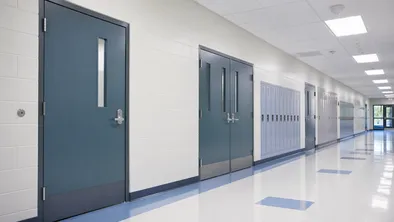
Institutional Construction
Schools · Hospitals · Government Buildings
These projects specify to standards (ANSI/SDI, NFPA 80, local fire codes) and buy in volume. A single school district renovation can run 300–800 doors. The compliance pre-qualification work is front-loaded, but once you're on an approved vendor list, reorder cycles are predictable.
Entry tickets: NFPA 80 certification and hollow metal construction capability.
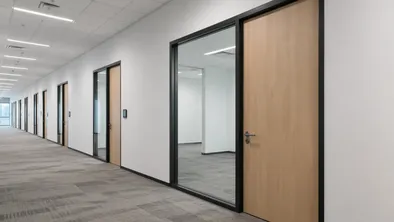
Commercial Real Estate & Fit-Out
Office Towers · Hotels · Mixed-Use Developments
Interior commercial doors and office commercial doors move in quantities of 100–500 per project. Architects specify finish and profile; your value-add is reliable lead times and consistent color matching across a large batch.
Key differentiator: Our automated powder line holds color consistency across full production runs — no batch-to-batch variation complaints from your downstream clients.
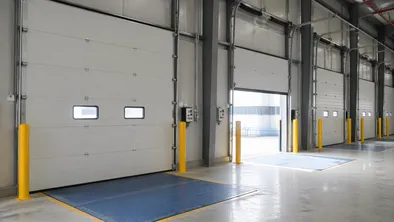
Industrial & Logistics Facilities
Warehouses · Distribution Centers · Manufacturing Plants
Heavy-duty and warehouse commercial doors in this segment see repeat orders as facilities expand or replace worn units. High-cycle ratings matter here — a warehouse door that fails at 200,000 cycles instead of 500,000 cycles generates warranty claims and relationship damage. We rate and test accordingly.
Buying pattern: Repeat orders as facilities expand or replace worn units.
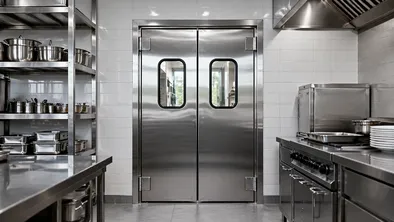
Food Service & Hospitality
Restaurants · Commercial Kitchens · Hotel Back-of-House
Stainless steel and galvanized surface options, easy-clean profiles, and corrosion resistance are the spec drivers. This segment has grown for us in Southeast Asia and the Middle East over the past three years — worth building into your product line if you're serving those markets.
Spec drivers: Stainless steel / galvanized surfaces, easy-clean profiles, corrosion resistance.
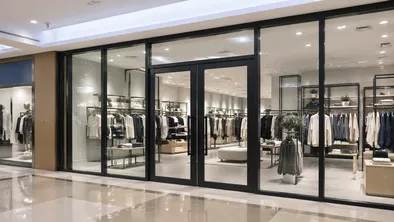
Retail & Storefront
Retail Chains · Shopping Centers · Franchise Fit-Outs
Storefront commercial doors and glass commercial doors for retail chains, shopping centers, franchise fit-outs. Chains order in volume across multiple locations — a regional franchise rollout can mean 50–200 identical door sets. Consistency of finish and hardware prep across the batch is what keeps that relationship.
Growth note: This segment has grown 40% for us in the last two years — worth paying attention to if you're building your product line for Southeast Asian retail expansion.
Not sure which segment fits your distribution model?
Our sales team works with distributors and contractors across all five segments. Tell us your target market and current volume — we'll map the right product lines and MOQ structure to your channel.
Steel Grade, Core Fill, and Finish: How We Make the Spec Decision
Most buyers encounter commercial door specs as a list of options and have to figure out which combination makes sense for their market. Here's how we think about it from the manufacturing side — it's the same conversation we have with new buyers before we quote.
Body Gauge Selection
Gauge selection comes down to the abuse profile of the end application. For standard office and institutional interiors, 0.8–1.0mm SPCC cold-rolled steel is the right call — it's what the hollow metal standard (ANSI/SDI A250.8) is built around, and it keeps your landed cost competitive.
For industrial, warehouse, and high-traffic corridor applications, we move to 1.2–1.5mm. Past 1.5mm body thickness, the bending radius changes and you lose the crisp edge profile that architects and fit-out contractors expect — so we don't push heavier gauge as a blanket upgrade. It's a trade-off, and the right answer depends on the application.
Core Fill
Core fill is where thermal and acoustic performance gets engineered in. Honeycomb paper core is standard for most commercial applications — it keeps weight down and cost competitive.
Mineral wool fill adds acoustic rating (typically STC 32–38 depending on door thickness) and fire resistance; we use it on all fire-rated lines and offer it as an upgrade on standard commercial lines for projects where noise transmission between spaces is a spec requirement. Polyurethane foam fill is the choice for exterior doors where thermal performance matters — U-value down to approximately 1.8 W/m²K on a 50mm door, which satisfies most commercial energy code requirements.
Surface Finish
Surface finish is the most visible spec decision and the one that generates the most downstream warranty claims when it's done wrong. We run an automated powder coating line — 60–80μm consistent thickness across the entire batch, electrostatic application, cured at 180–200°C.
The pre-treatment sequence matters more than most buyers realize: phosphate conversion coating before powder application is what determines adhesion at weld seams, which is where powder coat failures almost always start. We grind and re-treat every weld before the door enters the coating line.
Our standard finish passes 500-hour salt spray testing. For coastal markets (Gulf, Southeast Asia, Australia), we offer a 1000-hour salt spray spec on request, which requires a zinc-rich primer undercoat before powder.
Why Pre-Treatment Determines Finish Longevity
We learned the hard way that standard powder coat on untreated welds fails in humid coastal environments — three containers of returns before we added the pre-treatment step in 2016. The phosphate conversion coating before powder application is what determines adhesion at weld seams, which is where powder coat failures almost always start.
Our process: grind all weld seams flush, apply a secondary phosphate treatment specifically to weld zones, then run the full automated coating sequence. This adds process time, but it's the difference between a 500-hour salt spray pass and a field failure at 18 months.

What Usually Goes Wrong with Commercial Doors — and How We Engineer Against It
Experienced buyers know the failure modes. Here's where commercial doors typically fail in the field, and what we do about each one.
Powder Coat Delamination at Weld Seams
Root cause: Inadequate pre-treatment. Weld spatter and heat-affected zones create surface chemistry that standard phosphate wash doesn't fully address.
Our fix: Grind all weld seams flush, apply a secondary phosphate treatment specifically to weld zones, then run the full automated coating sequence.
This adds process time, but it's the difference between a 500-hour salt spray pass and a field failure at 18 months.
Frame Distortion Under Load
Root cause: Undersized frame steel and inadequate corner reinforcement. Generates the most serious downstream complaints — doors that won't close, gaps that compromise fire ratings, hardware that binds.
Our fix: 1.5mm minimum on door frames (heavier than the door leaf on most of our lines), with welded corner gussets rather than mechanical fasteners.
The frame is what the building opening sees for the life of the installation; the door leaf can be replaced, the frame usually can't.
Hinge Failure in High-Cycle Applications
Root cause: A volume problem — a door that cycles 200 times a day in a warehouse or hospital corridor accumulates 70,000+ cycles per year. Undersized hinges or hinges with inadequate bearing surface wear out and generate lateral play that accelerates frame wear.
Our fix: 4-bearing hinges on all heavy-duty and industrial lines, with a minimum 89mm × 89mm leaf size. For warehouse and high-cycle applications, we recommend specifying continuous hinges (piano hinges) — we can prep for them on any door in the line.
Relevant product lines: Warehouse Commercial Doors and Industrial Commercial Doors.
Acoustic Seal Degradation
Root cause: A slow failure in interior commercial doors that generates complaints 12–24 months post-installation. The culprit is usually a compression seal that was undersized for the door weight, or a perimeter seal that wasn't continuous at the threshold.
Our fix: EPDM compression seals on all acoustic-rated lines, with a continuous threshold seal that maintains contact under the door's operating weight.
STC ratings are tested on the complete assembly — door, frame, and seals together — not just the door leaf in isolation.
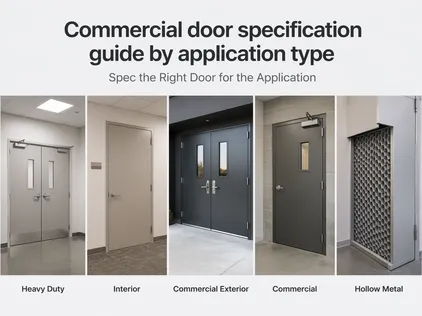
Spec the Right Door for the Application
Every failure mode above is predictable and preventable at the spec stage. The conversation we have with buyers before quoting is the same one we've outlined here — gauge, core, finish, frame, and hardware all need to match the end application's abuse profile and cycle volume.
If you're sourcing for a specific market segment or project type, our product lines are organized by application. Start with the line that matches your end use, and we'll walk through the spec from there.
OEM/ODM: Custom Commercial Doors for Your Brand or Project Spec
We run OEM and ODM programs for distributors and project contractors who need something beyond our standard catalog. The scope of what's customizable is broader than most buyers expect from a factory at our price point.
Dimensional Customization
Non-standard opening sizes — oversized widths for accessible entrances, reduced heights for mezzanine applications, unusual aspect ratios for architectural projects — are handled on our press brake and roll-forming lines without dedicated tooling on runs of 100 units or more. Below 100 units, we can still do it, but we'll discuss the tooling economics with you upfront.
Finish & Color Customization
Runs through our powder coating line. We stock 60+ standard colors with no MOQ premium. Custom RAL or proprietary brand colors are available on runs of 100+ units — we'll do a color match sample before committing the production run.
Color consistency guarantee: Our automated line holds ΔE < 1.5 across a full production run — tighter than most manual coating operations can guarantee.
Hardware & Lock Prep Customization
Covers the full range of ANSI, EN, and AS/NZS hardware standards. If you're supplying into a market with a specific hardware ecosystem, tell us the standard and we'll prep accordingly. We can also supply doors pre-hung with hardware if your downstream customers need a complete assembly rather than a door-only product.
Branding & Labeling
OEM brand plates, custom packaging with your logo, and private-label documentation are all available. Most of our distributor partners in North America and Australia run our doors under their own brand.

Free Design Consultation Included
Send us your project drawings or even a rough sketch — our 15-engineer R&D team will turn it into a production-ready spec and send back a detailed quote with CAD drawings within 3 business days.
- 3D rendering included at no charge
- CAD drawings returned within 3 business days
- Color match sample before production commitment
- Tooling economics discussed upfront for sub-100 runs
Customization at a Glance
| Option | MOQ Threshold |
|---|---|
| Non-standard dimensions | 100 units (no tooling fee); <100 discussed |
| Custom RAL / brand color | 100+ units; sample match first |
| Standard 60+ colors | No MOQ premium |
| Hardware prep (ANSI/EN/AS/NZS) | Any quantity |
| OEM brand plates & packaging | Any quantity |
Container Loading and Export Packaging
This is where factory-direct sourcing pays off in ways a trading company can't match — we control the packaging engineering, and we've optimized it for container efficiency across all our export markets.
Flat-Pack vs. Pre-Hung: Loading Density Trade-Off
Standard commercial doors ship KD (knocked down) flat-pack where the application allows it. A 40HQ container typically loads 400–600 standard single-leaf commercial doors in flat-pack configuration, depending on door thickness and frame inclusion.
Maximum container density. 400–600 single-leaf doors per 40HQ. Requires on-site assembly labor downstream.
Door + frame + hardware complete. Reduces loading density by approx. 30–35% but eliminates on-site assembly labor for downstream customers.
Standard Export Packaging Spec
Each door ships in a corrugated carton with foam corner protection and a stretch-wrap outer layer. Our standard packaging passes a 1.2m drop test on all four faces.
Rough-port reinforcement: For markets with rough port handling (West Africa, some Southeast Asian ports), we add a wooden pallet base and additional corner reinforcement. We've seen enough port damage to know where the risk is.
- Corrugated carton with foam corner protection
- Stretch-wrap outer layer
- 1.2m drop test certified on all four faces
- Wooden pallet base + extra corner reinforcement for high-risk ports (on request)
Container Loading Plan for Large Orders
For large project orders of 500+ units, we can provide a container loading plan with exact CBM calculations before you confirm the order — useful for landed cost modeling and freight booking. Send us your destination port and we'll include a freight estimate from our regular forwarders.

40HQ Container Capacity
Density varies by door thickness and frame inclusion. Pre-hung reduces density ~30–35% vs. flat-pack.
500+ Unit Orders
Get a Container Loading Plan
Exact CBM calculations + freight estimate from our regular forwarders before you confirm. Send us your destination port.
Request Loading PlanExplore Commercial Door Product Lines
Frequently Asked Questions
Specification and sourcing questions we hear from procurement teams, project managers, and distributors — answered with the detail you need to make the call.
What steel gauge should I specify for a commercial door in a high-traffic institutional environment?
For standard office and light commercial use, 0.8–1.0mm SPCC cold-rolled steel (ANSI/SDI Level 1–2) is the appropriate spec. For high-traffic institutional environments — hospital corridors, school hallways, government buildings — specify 1.2mm minimum body gauge with a 1.5mm frame.
For industrial and abuse-prone environments (correctional facilities, loading docks, manufacturing plants), move to 1.5mm body with reinforced frame corners.
The gauge jump from 1.0mm to 1.2mm adds roughly 8–12% to unit cost but eliminates the denting and panel deformation complaints that generate warranty claims in high-traffic applications.
What is the difference between hollow metal commercial doors and standard steel commercial doors?
Hollow metal (HM) is a construction standard, not just a material description. ANSI/SDI A250.8 defines hollow metal doors by gauge, construction method, and performance level — it's the specification language used in North American institutional and commercial construction.
Standard steel commercial doors may meet the same physical specs but aren't necessarily manufactured to ANSI/SDI tolerances or tested to those performance levels.
- Defined by ANSI/SDI A250.8 — gauge, construction method, performance level
- Specification language for North American institutional and commercial construction
- GCs and institutional specifiers ask for HM by name and expect compliance documentation
- May meet equivalent physical specs at the same gauge
- Not necessarily manufactured to ANSI/SDI tolerances or tested to those levels
- Typically more cost-competitive for non-North American markets
If your buyer is a North American general contractor or institutional specifier, they'll ask for hollow metal by name and expect ANSI/SDI compliance documentation. If you're selling into other markets, standard steel commercial doors at equivalent gauge are functionally identical and typically more cost-competitive. See our hollow metal commercial doors product page for full specification details.
How do I prevent powder coat failure on commercial doors in coastal or humid climates?
The failure almost always starts at weld seams, not on flat panel surfaces. The fix is in the pre-treatment sequence: weld seams need to be ground flush and treated separately before the standard phosphate wash, because the heat-affected zone from welding changes the surface chemistry and reduces adhesion.
After pre-treatment, specify a zinc-rich primer undercoat before the topcoat powder — this adds a sacrificial corrosion barrier that extends coating life significantly in salt-air environments.
For Gulf, Southeast Asian coastal, and Australian markets:
Ask your supplier specifically about their weld pre-treatment process and whether they offer a 1000-hour salt spray spec. If they can't answer the pre-treatment question in detail, the coating process probably isn't adequate for your market.
What certifications do I need for commercial doors going into North American projects?
For fire-rated commercial doors in North American projects, NFPA 80 compliance is the baseline requirement — it governs fire door assembly installation and maintenance. The door itself needs to be listed by a recognized testing laboratory (UL, Intertek/Warnock Hersey) to ANSI/UL 10C (positive pressure) or ANSI/UL 10B. For the door construction standard, ANSI/SDI A250.8 is the reference for hollow metal doors.
Fire-Rated Doors
- ›NFPA 80 — assembly installation & maintenance baseline
- ›ANSI/UL 10C — positive pressure fire test (UL or Intertek/WH listing)
- ›ANSI/UL 10B — neutral pressure fire test alternative
- ›ANSI/SDI A250.8 — hollow metal door construction standard
Non-Fire-Rated Doors
- ›ANSI/SDI compliance — North American commercial projects
- ›CE mark — European projects
Our NFPA 80 certification covers the assembly standard. For UL listing on specific fire-rated lines, request current listing documentation directly.
What is the minimum order quantity for custom commercial doors, and what does the customization process look like?
MOQ is 50 units for standard catalog models and 100 units for custom configurations (non-standard dimensions, custom colors, custom hardware prep). The process: you send us your specs or drawings, our R&D team reviews and sends back a production-ready spec with 3D rendering within 3 business days, we align on specs and pricing, then we produce a pre-production sample for your approval before committing the full run.
Lead time from confirmed order to shipment is typically 25–35 days for standard models and 35–45 days for custom configurations, depending on current line loading.
How do commercial door fire ratings work, and which rating do I need for my application?
Fire door ratings are expressed as the duration the door assembly resists fire penetration under standardized test conditions: FD30 (30 minutes), FD60, FD90, FD120. The required rating is determined by the building's fire compartmentation design — specifically, the fire resistance rating of the wall the door is set into. A wall rated at 60 minutes requires a door rated at a minimum of FD60.
Common Application Requirements
- FD30 — Corridor doors in most commercial buildings
- FD60 — Stairwell and service shaft doors
- FD90–FD120 — Plant rooms, electrical rooms, high-risk areas
The rating applies to the complete assembly — door leaf, frame, hardware, and seals — not just the door leaf. Specifying a rated door with an unrated frame or non-compliant hardware voids the rating.
Start Your Sourcing Conversation
New to sourcing commercial doors from China, or switching suppliers after a quality issue? The most useful first step is usually a sample order — 2–4 units across the configurations you're considering, so you can test with your own customers or against your project spec before committing volume.
What to Tell Us
-
Your Target Market
Region, distribution channel, and end-use segment — retail, hospitality, industrial, residential, or project-based.
-
Product Types You're Considering
Steel security, hollow metal, fire-rated, storefront, or a mix across configurations. Mention any spec requirements you already have.
-
Rough Volume Expectations
Annual units or container frequency. Even a rough range helps us recommend the right starter configuration and pricing tier.
We'll recommend a starter configuration based on what's moving for our existing distributors in your region, and send back a detailed quote with CAD drawings and a sample lead time.
Request a Quote
Submit your requirements and we'll respond with a detailed quote, CAD drawings, and sample lead time within one business day.
Request a QuoteContact Our Sales Team
Prefer to talk through your requirements directly? Reach us by email or WhatsApp — our sales team handles distributor and project inquiries across all time zones.
Recommended First Step
A sample order of 2–4 units across the configurations you're considering lets you test against your project spec or with your own customers before committing to volume. Most distributors find this the fastest path to a confident first container order.
Explore Our Commercial Door Product Range