

Hollow Metal Commercial Doors Direct From Factory
ANSI/SDI-compliant hollow metal commercial doors — built for North American institutional specs, shipped factory-direct.
We've manufactured HM commercial doors since 2008. Every door leaves our Luoyang facility with 100% pre-shipment inspection, NFPA 80 certification backing, and the dimensional tolerances North American specifiers put in their project documents.

What "Hollow Metal" Actually Means for Your Sourcing Decision
Hollow metal is a construction standard, not just a material description. ANSI/SDI A250.8 defines hollow metal doors by gauge, construction method, and performance level — and that distinction matters the moment your buyer is a North American general contractor, institutional specifier, or government procurement office. They don't ask for "steel doors." They ask for hollow metal by name, and they expect ANSI/SDI compliance documentation to back it up.
We manufacture to that standard. Our HM commercial doors are built to ANSI/SDI A250.8 tolerances — face sheet gauge, seam construction, hardware reinforcement locations, and frame-to-leaf fit all conform to the specification. When your downstream customer pulls out their project spec sheet and checks "hollow metal door per ANSI/SDI A250.8," our product checks that box with documentation to support it.
The practical difference from a standard steel commercial door at equivalent gauge: tighter dimensional tolerances on the door leaf (±1.6mm on height and width), standardized hardware prep locations that align with North American lockset and closer specifications, and a construction method — full-flush or seamless face — that meets the visual and performance expectations of institutional architects.
If you're selling into markets where the spec language matters as much as the physical product, that's the distinction that gets you onto approved vendor lists.
±1.6mm Dimensional Tolerance
Tighter leaf tolerances on height and width than standard steel commercial doors — the spec-sheet requirement that separates hollow metal from generic steel in institutional procurement.
ANSI A115 Hardware Prep
Standardized hardware prep locations aligned with North American lockset and closer specifications. No field modification required to meet institutional hardware schedules.
Full-Flush / Seamless Face Construction
Construction method meets the visual and performance expectations of institutional architects — the same finish quality that appears in project specifications by name.
Approved vendor lists start with documentation. ANSI/SDI A250.8 compliance isn't just a product attribute — it's the credential that gets your quote reviewed by institutional procurement teams who filter by spec compliance before price.
Technical Specifications
Industry-standard values for ANSI/SDI-compliant hollow metal commercial doors. Contact us for exact product data sheets and configuration-specific specs.
ANSI/SDI A250.8 — Standard Configuration
| Parameter | Standard Value |
|---|---|
| Construction standard | ANSI/SDI A250.8 |
| Face sheet material | Cold-rolled SPCC steel |
| Face sheet gauge | 18 gauge (1.2mm) standard; 16 gauge (1.5mm) heavy-duty |
| Door thickness | 45mm standard; 50mm available |
| Standard leaf width | 610mm – 1067mm (single leaf) |
| Standard leaf height | 1981mm – 2438mm |
| Double-leaf width | Up to 2134mm |
| Core fill | Honeycomb paper (standard); mineral wool (acoustic/fire-rated) |
| Frame material | 1.5mm cold-rolled steel minimum |
| Frame profile | Standard steel frame (KD or welded); 14 gauge for heavy-duty |
| Hardware prep | ANSI A115 series standard; mortise and cylindrical lock prep |
| Hinge prep | ANSI A156.7; 4-bearing hinges on heavy-duty configurations |
| Surface finish | Powder coat, 60–80μm; primer-only available |
| Fire rating | Up to FD90 on applicable configurations |
| MOQ | 50 units (standard); 100 units (custom configurations) |
| Certifications |
ISO 9001:2015 CE SGS NFPA 80
|
Specifications shown are industry-standard values for ANSI/SDI hollow metal doors. Actual specifications may vary by configuration. Contact us for detailed product data sheets.

Need Configuration-Specific Data?
Request a full product data sheet with tolerances, hardware prep drawings, and fire-rating documentation for your target configuration.
Request a Spec Sheet & QuoteWhere HM Commercial Doors Generate Repeatable Volume
The hollow metal commercial door category is dominated by institutional and commercial construction — and that's where the most predictable B2B volume lives. Here's where our distributor and contractor network moves the most product, and why each segment is worth building into your line.

North American Institutional Construction
Schools · Hospitals · Government Buildings
This is the core market for ANSI/SDI hollow metal. A single K-12 school renovation specifies 150–400 HM doors. Hospital projects run 300–800 units. Government building fit-outs are similar.
The compliance pre-qualification is front-loaded — you need NFPA 80 documentation and ANSI/SDI compliance records before you get on an approved vendor list — but once you're in, reorder cycles are predictable and volume is consistent.
Entry requirement: Our NFPA 80 certification and ANSI/SDI-compliant construction are the entry tickets. We can provide the compliance documentation your downstream customers need to satisfy their project requirements.

Commercial Office & Mixed-Use Development
Office Towers · Hotels · Mixed-Use Projects
Interior HM doors for office towers, hotels, and mixed-use projects. These projects specify hollow metal for fire-rated corridor and stairwell applications — FD60 and FD90 are the common ratings in this segment. Order volumes run 100–500 units per project.
Architects specify the profile and finish; your value-add is consistent color matching across the full batch and reliable lead times that don't blow the fit-out schedule.
Our differentiator: Our automated powder line holds color consistency across full production runs, which eliminates the batch-to-batch variation complaints that damage distributor relationships.

Healthcare & Correctional Facilities
High-Abuse Environments · Experienced Buyers
High-abuse environments where 18-gauge (1.2mm) is the minimum and 16-gauge (1.5mm) is frequently specified. These buyers are experienced — they know the failure modes, they ask about gauge and frame construction, and they check references.
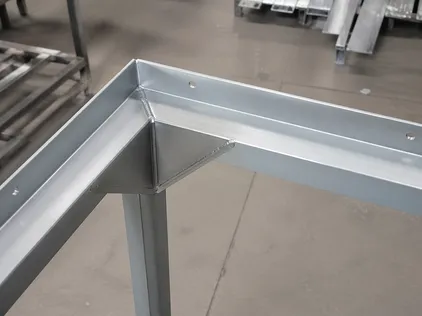
The fact that we run 1.5mm minimum on door frames (heavier than the leaf on most configurations) and use welded corner gussets rather than mechanical fasteners is the kind of manufacturing detail that lands well with experienced institutional procurement teams.
Buyer insight: We've had buyers specifically ask about corner gusset construction after getting burned by frame distortion on a previous supplier's product — it's a real differentiator in this segment.

Export Markets with North American-Influenced Specs
Middle East · Southeast Asia · International Projects
Middle Eastern and Southeast Asian markets increasingly specify to ANSI/SDI standards on international projects, particularly those involving US-based architects or developers.
Catalog advantage: If you're distributing into these markets, having ANSI/SDI-compliant hollow metal in your catalog opens project opportunities that standard steel doors can't access.
How We Build the HM Door: Process Details That Affect Your Downstream Quality
The ANSI/SDI standard defines the output tolerances. What it doesn't specify is the process discipline required to hit those tolerances consistently across a production run of 500 units. Here's where our manufacturing approach differs from what you'll find at a general steel door factory.

CNC Press Brake Forming to ±0.2mm
Face sheet forming is done on CNC press brakes with tooling maintained to ±0.2mm dimensional tolerance. The full-flush construction — where the face sheets wrap around the edge and are continuously welded — requires consistent sheet thickness and precise bending angles to produce the flat, gap-free face profile that institutional specifiers expect.
Incoming inspection: We run incoming material inspection on every coil of SPCC steel — thickness, tensile strength, and surface quality checked before it enters the line. Coils that don't meet spec get rejected at receiving, not discovered after fabrication.

Secondary Phosphate After Weld Grinding
Weld seam treatment is where most HM door quality problems originate, and it's where we invest the most process attention. After continuous welding of the face sheet seams, every weld is ground flush and re-treated with a secondary phosphate application before the door enters the coating line.
Why it matters: The heat-affected zone from welding changes the surface chemistry and reduces powder coat adhesion — if you skip the secondary treatment, you get delamination at the seam within 18–24 months in any environment with humidity cycling. We added this step after seeing field failures on early export shipments; it's now a non-negotiable part of our process.
Pre-Installed ANSI A115 Reinforcement Plates
Hardware reinforcement is pre-installed per ANSI A115 locations — 12-gauge (2.7mm) steel reinforcement plates at hinge, lock, and closer locations, welded in from the inside before the door is closed and seamed.
This is the construction detail that separates a properly built HM door from a steel door with hardware holes drilled in it. The reinforcement plate is what gives the hardware its long-term holding strength under cycle loading.
Field consequence: Without the reinforcement plate, screw pull-out is a matter of time in high-traffic applications.
5-Stage 100% Pre-Shipment Inspection
Our 5-stage QC process runs 100% inspection before shipment — dimensional check, hardware prep location verification, surface finish inspection, and door-to-frame fit check on every unit.
For hollow metal specifically, we also check the frame-to-leaf clearance against ANSI/SDI tolerances, because a door that's dimensionally correct but doesn't fit its frame properly generates installation problems and warranty claims.
100%
Units Inspected
5-Stage
QC Process
Welded Corner Gussets vs. Mechanical Fasteners
We run 1.5mm minimum on door frames — heavier than the leaf on most configurations — and use welded corner gussets rather than mechanical fasteners. This is the manufacturing detail that experienced institutional procurement teams ask about directly.
Buyers in healthcare and correctional segments have been burned by frame distortion from suppliers using mechanical fasteners. Welded corner gussets eliminate that failure mode. It's a real differentiator in high-abuse segments, and it's a question worth being ready to answer when you're presenting to experienced procurement teams.
Certifications and Compliance for Your Target Markets
The certifications we hold on hollow metal commercial doors, and what they mean for your downstream compliance requirements.
Fire Door Assembly Standard
Baseline compliance requirement for fire-rated commercial doors in North American projects. Our NFPA 80 certification means our fire-rated HM door assemblies meet the assembly standard. For UL listing on specific fire-rated configurations, ask us for current listing documentation when you inquire.
Quality Management System
Covers our process controls, inspection protocols, and documentation practices that produce consistent output across production runs. For buyers who need to qualify us as a supplier, we can provide our ISO certificate and audit summary.
European Market Requirements
CE marking covers European market requirements — relevant if you're distributing into EU markets or projects with European compliance requirements.
Third-Party Audit Reports
SGS third-party audit reports are available on request — useful for buyers who need independent verification of our manufacturing claims rather than self-reported data.
North American Institutional Compliance Package
For North American institutional projects, the compliance documentation package typically required includes all of the following. We can provide all of these.
Compliance statement for hollow metal door and frame standards
Fire door assembly installation and maintenance standard certification
Hardware prep location drawings per ANSI A115 standard
Steel material certifications for the steel used in production
If your project has additional requirements — specific UL listing numbers, state or municipal approval documentation — tell us upfront and we'll confirm what we can supply before you commit the order.
Customization: What We Can Configure and Where the Limits Are
Standard ANSI/SDI hollow metal doors cover most institutional project requirements. Here's what we can configure beyond the standard catalog, and where the practical limits are.
Dimensional Customization
Non-standard opening sizesNon-standard opening sizes — oversized widths for accessible entrances (up to 1200mm single leaf), reduced heights for mezzanine or renovation applications, custom aspect ratios for architectural projects — are handled on our press brake lines without dedicated tooling on runs of 100 units or more.
Below 100 units: We can still accommodate non-standard dimensions, but we'll discuss the tooling economics with you before quoting.
Gauge Upgrades
Heavy-duty and high-securityStandard catalog (1.2mm face sheet) — covers the majority of commercial institutional applications.
Heavy-duty and high-security (1.5mm) — correctional facilities, loading dock entries, high-abuse institutional environments.
Max abuse resistance: Frame gauge can be upgraded independently of door leaf gauge. We recommend 14-gauge frames with 16-gauge leaves.
Core Fill Options
Default core for standard catalog doors.
Acoustic-rated configurations (STC 32–38 depending on door thickness). Standard on all fire-rated lines.
Available for exterior applications where thermal performance is a spec requirement.
Finish Options
No MOQ premium on standard colors.
Available on runs of 100+ units. Color match sample done before committing the production run.
For projects where the door will be field-painted after installation.
For high-humidity or exterior applications.
Hardware Prep Customization
Default hardware prep for North American market.
Available for European market requirements.
Available for Australian market requirements.
Pre-hung assemblies (door + frame + hardware) available if your downstream customers need a complete assembly.
Run Our Doors Under Your Brand
Most of our North American distributor partners run our doors under their own brand. OEM brand plates, custom packaging with your logo, and private-label documentation are all available.
- OEM brand plates and custom packaging with your logo
- Private-label documentation included
- Free 3D rendering and design consultation for custom projects
- 15-engineer R&D team turns your specs into a production-ready drawing within 3 business days

Packaging, Container Loading, and Export Logistics
Everything you need to model landed cost accurately — from carton spec to container density to freight estimates.
Standard KD Flat-Pack Shipping
HM commercial doors ship KD (knocked down) flat-pack as standard — door leaf, frame components, and hardware packaged separately. This maximizes container utilization and reduces freight cost per unit.
Pre-Hung Assembly Option
Pre-hung assemblies are available and eliminate on-site assembly labor for your downstream customers — but reduce loading density by 30–35% compared to flat-pack. Factor this into your freight and landed cost model before committing.
Carton & Protection Spec
Each door ships in a corrugated carton with foam corner protection and stretch-wrap outer layer. Standard packaging passes a 1.2m drop test on all four faces. For markets with rough port handling — West Africa, some Southeast Asian ports — we add a wooden pallet base and additional corner reinforcement.

40HQ Container Capacity
Capacity varies by door thickness and whether frames are included. Frame components add more volume than buyers typically estimate — request a container loading plan before booking freight.
Container Loading Plan for Large Orders
For large project orders (300+ units), we provide a container loading plan with exact CBM calculations before you confirm the order. This is useful for landed cost modeling and freight booking — we've seen buyers underestimate container requirements on HM doors because the frame components add more volume than expected.
Send us your destination port and we'll include a freight estimate from our regular forwarders.
Packaging Summary by Market Condition
| Condition | Packaging Spec | Notes |
|---|---|---|
| Standard markets | Corrugated carton, foam corners, stretch-wrap | 1.2m drop test certified on all four faces |
|
Rough port handling (West Africa, some SE Asia) |
Standard + wooden pallet base + extra corner reinforcement | Specify destination port at order confirmation |
| KD flat-pack (standard) | Door leaf, frame, hardware packed separately | 380–520 units per 40HQ; maximizes container density |
| Pre-hung assembly | Door pre-assembled in frame before packing | 30–35% lower container density; eliminates downstream assembly labor |
Frequently Asked Questions
Sourcing decisions for hollow metal commercial doors involve specification language, gauge selection, and compliance documentation. These answers address the questions procurement teams and project specifiers ask most often.
What is the difference between hollow metal commercial doors and standard steel commercial doors?
Hollow metal (HM) is a construction standard defined by ANSI/SDI A250.8 — it specifies gauge, construction method, hardware reinforcement locations, and dimensional tolerances. A standard steel commercial door may be physically similar but isn't manufactured to ANSI/SDI tolerances and doesn't come with the compliance documentation that North American institutional specifiers require.
If your buyer is a North American general contractor or institutional procurement office, they'll ask for hollow metal by name and expect ANSI/SDI documentation. For other markets, standard steel commercial doors at equivalent gauge are functionally comparable and typically more cost-competitive.
Sourcing note: The choice depends on your market's specification language, not just the physical product. If your downstream buyer's spec sheet says "hollow metal," ANSI/SDI documentation is non-negotiable. If it says "steel commercial door," standard gauge-equivalent product is the cost-efficient path.
What gauge should I specify for hollow metal doors in institutional applications?
18-gauge (1.2mm) face sheet is the ANSI/SDI standard for Level 2 hollow metal doors — appropriate for most office, school, and light institutional applications. For high-traffic institutional environments (hospital corridors, school main entries, government buildings with heavy use), specify 16-gauge (1.5mm) face sheet with a 14-gauge frame. For correctional facilities and high-security applications, 16-gauge body with reinforced frame corners and continuous hinges is the standard spec.
18-Gauge / 1.2mm
Office, school, light institutional. ANSI/SDI A250.8 baseline.
16-Gauge / 1.5mm + 14-Gauge Frame
Hospital corridors, school main entries, government buildings with heavy use.
16-Gauge + Reinforced Frame
Correctional facilities. Reinforced frame corners and continuous hinges standard.
Cost-quality note: The gauge jump from 18 to 16 adds roughly 10–15% to unit cost but eliminates the panel denting and deformation complaints that generate warranty claims in abuse-prone environments.
What NFPA 80 and ANSI/SDI documentation can you provide for North American projects?
We can provide: NFPA 80 certification documentation, ANSI/SDI A250.8 compliance statement, hardware prep location drawings per ANSI A115, material certifications for the steel used, and SGS third-party audit reports. For UL-listed fire-rated configurations, ask us for current listing documentation when you inquire — listing status varies by configuration. If your project requires specific state or municipal approval documentation, tell us upfront and we'll confirm what we can supply before you commit the order.
What is the maximum custom size available for hollow metal commercial doors?
Single-leaf: up to 1200mm wide × 2750mm tall without dedicated tooling on runs of 100+ units. Double-leaf configurations up to 2400mm total width. For oversized openings beyond these dimensions — monumental entrances, loading dock applications with unusual aspect ratios — contact us with your drawings. We've handled non-standard configurations on our press brake lines before; the question is whether the run size justifies the setup. Below 100 units on non-standard dimensions, we'll discuss the tooling economics with you before quoting.
How do hollow metal doors perform in humid or coastal climates?
The risk in humid and coastal environments is powder coat delamination at weld seams — the heat-affected zone from welding changes surface chemistry and reduces adhesion if not properly pre-treated. Our process grinds all weld seams flush and applies a secondary phosphate treatment to weld zones before the standard coating sequence.
For Gulf, Southeast Asian coastal, and Australian markets, we offer a 1000-hour salt spray spec that adds a zinc-rich primer undercoat before the topcoat powder. Specify this when you inquire if your market has salt-air exposure — the standard 500-hour spec is adequate for most inland and temperate applications, but coastal markets need the upgraded pre-treatment.
What is the MOQ and lead time for hollow metal commercial doors?
Standard MOQ
50 units
Catalog configurations
Custom MOQ
100 units
Custom dims, colors, or hardware prep
Standard Lead Time
25–35 days
Confirmed order to shipment
Custom Lead Time
35–45 days
Custom configurations
For large project orders (300+ units), we recommend confirming 45–50 days before your required ship date to allow for pre-production sample approval. We can ship samples within 7–10 days for new buyers who want to test against their project spec before committing volume.
Start Your HM Door Sourcing Conversation
Most buyers in this category start with a sample order — 2–4 units across the gauge and configuration options they're considering — to test against their project spec or show their downstream customers before committing volume. We can ship samples within 7–10 days.
Send Us Your Project Spec
If you already have a project spec or a current supplier's product you're benchmarking against, send it to us. Our engineering team will:
-
Identify the ANSI/SDI compliance level of your current spec
-
Flag any spec gaps or compliance risks before production
-
Send back a detailed quote with CAD drawings showing exactly how our product maps to your requirements
Contact Us Directly
Sample Order First
2–4 units across the gauge and configuration options you're considering. Test against your project spec or show downstream customers before committing volume. Samples ship within 7–10 days.
Spec Review & Quote
Send your existing spec or benchmark product. We return a detailed quote with CAD drawings showing exactly how our product maps to your requirements — no guesswork on compliance.
Engineering-Led Review
Our engineering team handles the ANSI/SDI compliance check and spec gap analysis — not a sales rep reading from a datasheet. You get a technically grounded response you can take to your project team.