

Steel Fire Door Direct From Factory
All-steel fire resistant door — FD30 to FD120 ratings, NFPA 80 and CE certified, built for commercial and industrial supply.
1.0–1.5mm SPCC cold-rolled steel body, mineral wool or vermiculite board core, intumescent perimeter seal recessed into a machined channel — not surface-applied. Factory-direct from Luoyang, China.

What This Door Is and Where It Sits in the Fire Door Range
A steel fire door is the core product in any fire door catalog — all-steel construction, no glazing panel, solid mineral wool or vermiculite board core, rated from FD30 through FD120. It's the workhorse SKU: the door that goes into stairwells, plant rooms, corridor compartmentation walls, and any opening where the spec calls for fire resistance without a vision requirement.
Within our 14-variant fire door line, the steel fire door is the foundational product. The distinction matters for your catalog planning. Steel fire doors without glazing are the highest-volume SKU in most markets because they cover the broadest range of code-required openings. Glass fire doors and specialty configurations are the margin items. If you're building a fire door distribution business, the steel fire door is where you establish volume; the specialty variants are where you protect margin.
Get a Quote for Steel Fire DoorsWhere this SKU sits in the 14-variant line
Steel Fire Door
This pageBase configuration — solid panel, standard hardware, full FD30–FD120 range. Highest-volume SKU. Covers stairwells, plant rooms, corridor compartmentation.
Glass Fire Door
Vision panel variant. Margin item. Same steel body, fire-rated glazing insert. For openings where code requires fire resistance and sightlines.
Automatic Fire Door
Electromagnetic hold-open with fire alarm integration. For high-traffic corridors requiring normally-open operation with automatic release on alarm.
Self-Closing Fire Door
Self-latching closer on standard steel body. For openings that must remain closed at rest without electromagnetic hold-open complexity.
Technical Specifications
Standard parameters for our steel fire door line. Exact specifications vary by rating and configuration — contact us for a detailed data sheet on any specific variant.
Standard Specification Table
| Parameter | Specification |
|---|---|
| Fire Resistance Rating |
FD30 FD60 FD90 FD120
|
| Door Leaf Thickness | 44mm (FD30/FD60) · 54mm (FD60/FD90) · 64mm (FD90/FD120) |
| Steel Body Gauge | 1.0mm SPCC (standard) · 1.2mm (commercial) · 1.5mm (industrial) |
| Core Material | Mineral wool board (FD30/FD60) · Vermiculite board · Perlite composite (FD90/FD120) |
| Door Width | 700–1200mm single leaf · up to 2400mm double leaf |
| Door Height | 2000–2400mm standard · custom heights available |
| Frame | Welded steel frame with intumescent seal · KD frame available |
| Perimeter Gap | 3–4mm (maintained by CNC-formed panels, ±0.5mm tolerance) |
| Surface Finish | Powder coat 60–80μm · 60+ RAL colors · primer-only available |
| Hardware (standard) | Stainless or zinc-alloy hinges · mortise lock · door closer |
| Hardware (optional) | Push bar · electromagnetic hold-open · access control prep |
| Certifications |
NFPA 80 CE (EN 1634-1) ISO 9001:2015 SGS
|
Specifications shown are standard values for this product line. Actual specifications may vary by rating and configuration. Contact us for detailed product data sheets.

Steel Gauge Selection Guide
Choosing the right SPCC gauge for your end-use environment
1.0mm SPCC — Standard
Light commercial, residential multi-family, low-traffic corridors. Minimum spec for most FD30 applications.
1.2mm SPCC — Commercial
RecommendedOffice, hospitality, mid-rise residential. Covers most commercial applications without adding unnecessary freight weight. Our standard commercial line runs at this gauge.
1.5mm SPCC — Industrial
Schools, hospitals, industrial facilities where door abuse is a real factor. Adds roughly 8–10% to freight cost per container. Confirm end-use environment before committing across a full project.
Buyer Note on Gauge Spec
We've had buyers spec 1.5mm across an entire hotel project when 1.2mm would have been sufficient. The 8–10% freight premium per container adds upquickly on large-volume orders. Worth confirming the end-use environment before you commit to a single gauge across the full project.
How We Build the Fire Resistance In — Not Just Certify It
The certification is the proof. The construction is what actually makes the door perform. Here's what goes into a steel fire door on our production line, and why each decision matters for the door's performance in a real fire event.

Dimensional Tolerance
CNC laser cutting and press brake forming holds panel and frame dimensions within ±0.5mm. A fire door's rating depends on maintaining a consistent 3–4mm perimeter gap — too wide and the door fails smoke integrity; too tight and it binds in an emergency.
Weld Consistency
Robotic MIG welding on standard production lines gives consistent weld penetration across long runs. Your 500th door off the line is dimensionally identical to your first.
Pre-Pack Fit Test
Every door is test-fit with its frame before packing. Dimensional conformance is verified at the unit level, not sampled at the batch level.
Steel Body & Frame
SPCC cold-rolled steel coil cut on CNC laser equipment, formed on CNC press brakes. Tolerances held within ±0.5mm on panel and frame dimensions. SPCC body thickness: 1.0–1.5mm depending on specification.
Core Material by Rating
FD30 and FD60 use mineral wool board — industry standard, cost-effective, well-proven. FD90 and FD120 require perlite composite core in a 64mm leaf. Core panels are dimensioned to the cavity with a controlled interference fit — no gaps, no voids.
Recessed Intumescent Seal
A continuous channel is machined into the door edge perimeter and the intumescent seal is recessed into it — mechanically retained, not surface-applied. Eliminates the seal-delamination warranty claims common in humid climates (Gulf, Southeast Asia).
Zinc Phosphate Pre-Treatment
Switched from iron phosphate to zinc phosphate in 2020 after adhesion failures on coastal-market orders. Weld seams ground flush before pre-treatment. Automated powder line applies 60–80μm film thickness. Passes 500-hour salt spray test.
Recessed vs. Surface-Applied Intumescent Seal
Surface-applied seals — glued or stapled to the door edge — delaminate over time, especially in humid climates. For export to the Gulf and Southeast Asia, where ambient humidity is a real factor, the recessed construction detail has eliminated the seal-delamination warranty claims seen before the switch was made.
The intumescent strip expands under heat to seal the gap between door and frame, preventing flame and hot gases from passing through. If the seal isn't there when the fire starts, the rating is meaningless.
Recessed (Our Method)
- Mechanically retained in machined channel
- Humidity-resistant — no adhesive bond to fail
- Survives shipping and handling intact
- Zero RMA on seal delamination since switch
Surface-Applied (Industry Common)
- Glued or stapled to door edge
- Delamination risk in humid climates
- Vulnerable during transit and installation
- Warranty exposure for downstream distributors
Fire Rating Selection: Which Spec for Which Market
Ordering the wrong rating for your market's code requirement is the most common sourcing mistake on fire doors. Here's the practical breakdown for the markets we ship to.
Minimum rating for most interior compartmentation in low-rise commercial buildings. Office corridor doors, stairwell access in buildings under four stories, residential-scale commercial projects.
Highest volume · Most price-competitive
The workhorse rating for commercial construction in North America and the Gulf. Required for stairwells in mid-rise buildings, plant rooms, and openings in fire-rated walls separating occupancies.
~60–70% of North American & Gulf orders
Specified for high-risk compartments. Requires 64mm leaf with perlite composite core. Smaller order volumes, higher unit value, less price sensitivity.
64mm leaf · Perlite composite core
Maximum residential/commercial rating. High-rise stairwells and the most demanding compartmentation requirements. Margin-positive SKU for distributors serving commercial and industrial project segments.
64mm leaf · Higher unit value
Certification Coverage by Market
Confirm with your local authority having jurisdiction before specifying.
| Market | Governing Standard | Our Certification | Notes |
|---|---|---|---|
| North America | NFPA 80 | NFPA 80 | Governs installation and labeling. Our NFPA 80 certification covers this requirement. |
|
Europe / EU-aligned markets (Gulf, parts of Southeast Asia) |
EN 1634-1 | CE | EN 1634-1 fire test standard. CE marking required. Our CE certification covers this. |
| Australia, Africa & other markets | Local AHJ | SGS CE | SGS documentation and CE certification accepted as equivalent in most markets. Confirm with local authority having jurisdiction before specifying. |

Not Sure Which Rating Your Market Requires?
The most common sourcing mistake is ordering FD30 for a market that codes FD60 for the application — or specifying FD60 when the project AHJ requires FD90 for the specific compartment type. Both errors create project delays and re-order costs.
We can confirm the right rating and certification for your target market before you place an order. Share your project location, building type, and the specific opening — we'll cross-reference against the applicable code and advise.
Contact Us to Confirm Rating & CertificationMarket Segments: Where Steel Fire Doors Move at Volume
Fire doors are a code requirement, not a discretionary purchase. That makes demand predictable and the buyer base less price-sensitive than general commercial doors. The steel fire door — solid panel, no glazing, standard hardware — is the SKU that moves in the highest volumes across all of these segments.
Commercial Construction & Fit-Out
Office towers, hotels, mixed-use developments. A mid-size office building specifies fire doors at every stairwell, plant room, and compartmentation wall — typically 150–400 sets per building.
Building Materials Distribution
Fire doors are a recurring SKU for distributors serving the construction trade. The steel fire door is the volume mover; glass fire doors and specialty configurations are the margin items.
Property Developers — Middle East, SE Asia & Africa
Large-scale residential and commercial developers building at scale, where fire door compliance is enforced at certificate of occupancy. Developers sourcing factory-direct get consistent product across all buildings and a single documentation package.
Facilities Management & Retrofit
Existing buildings undergoing fire safety upgrades or change-of-use conversions. This segment values fast lead times and the ability to match existing frame dimensions.
Industrial & Logistics Facilities
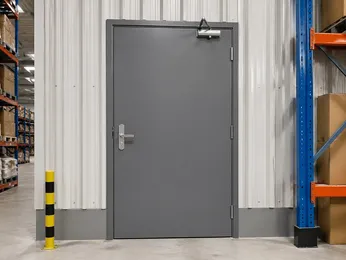
Warehouses, manufacturing plants, logistics hubs. These buyers specify 1.5mm gauge with abuse-resistant hardware. The steel fire door in heavy-gauge configuration is the standard spec for this segment.
Customization Parameters and MOQ
Standard catalog steel fire doors ship from 50 units MOQ. Custom configurations start at 100 units — that's where the powder line changeover and any tooling cost makes sense for both sides.
What Can Be Customized
| Dimension | Options |
|---|---|
| Size | Width 600–1500mm, height 1800–3000mm (beyond standard range, confirm with engineering) |
| Fire Rating | FD30 · FD60 · FD90 · FD120 |
| Steel Gauge | 1.0mm · 1.2mm · 1.5mm |
| Surface Finish | Any RAL color · primer-only · textured powder coat |
| Hardware Package | Lock brand · hinge spec · closer brand · push bar · access control prep |
| Frame Type | Welded frame · KD knock-down frame · frame-only supply |
| OEM / Private Label | Custom branding, labeling, packaging with your brand identity |
| Vision Panel | Fire-rated glazing panel available on select configurations — see glass fire door for full glazing options |
What Affects Lead Time
Standard catalog sizes and ratings
Ship in 25–35 days.
Non-standard dimensions
Add 5–10 working days for engineering review.
New OEM tooling
Custom profiles, embossed panels — add 15–20 working days for first-article approval.
Project orders above 500 units
We can discuss dedicated production scheduling to protect your delivery timeline.
What Requires Engineering Review
Ratings above FD120, leaf thicknesses outside our standard range, or configurations requiring third-party certification testing beyond our existing NFPA 80 and CE scope. If your project spec falls outside these parameters, send it to us — we'll tell you what's feasible and what isn't.
Ready to spec your order?
Send your spec for a free design consultation and quote. Standard orders from 50 units; custom configurations from 100 units.
Container Loading and Landed Cost Planning
A standard 40HQ container holds approximately 160–200 KD steel fire door sets (single leaf, standard sizes) — the exact number depends on door size and whether you're shipping KD or pre-hung.
KD (Knock-Down) Format
KD is the standard format for most export orders — it maximizes container utilization and eliminates alignment risk in transit.
Pre-Hung Assemblies
Pre-hung is available for buyers whose end customers require ready-to-install product. The trade-off is roughly half the container loading efficiency, which affects your landed cost per unit.
Batch Traceability
Every carton carries a barcode linked to our production batch record. If there's a quality question on arrival, you can trace the unit back to its production date, line, and inspection record.
Complete Documentation
Commercial invoice, packing list, bill of lading, CO, NFPA 80 / CE test certificates — complete for customs clearance in all active markets.
Active Markets
North America, Europe, the Gulf, Southeast Asia, Africa, and Australia — documentation package is cleared and tested for each market's customs requirements.
KD vs Pre-Hung: The Landed Cost Trade-Off
The choice between KD and pre-hung directly affects your landed cost per unit. At roughly half the container loading efficiency, pre-hung assemblies carry a meaningful freight premium per door.
For most B2B buyers supplying installation contractors, KD is the right call. Pre-hung makes sense when your end customer has no installation capability and requires a drop-in ready product.

Frequently Asked Questions
Decision-support answers for importers, distributors, and project specifiers sourcing steel fire doors at volume.
What is the difference between a steel fire door and a standard steel door?
A standard steel door provides physical security and weather resistance. A steel fire door is engineered and certified to maintain its integrity for a defined period under fire conditions — the core material (mineral wool or perlite composite), intumescent perimeter seal, and hardware are all specified and tested as a system. You cannot convert a standard steel door into a fire door by adding an intumescent seal; the entire assembly — door leaf, frame, hardware, and seal — must be tested and certified together. Our steel fire doors are certified as complete assemblies under NFPA 80 and CE.
What steel gauge should I specify for commercial versus industrial applications?
For standard commercial applications — office buildings, hotels, retail, mid-rise residential — 1.2mm SPCC is the right spec. It meets the structural requirements for fire door assemblies and keeps freight weight manageable.
For high-abuse environments — schools, hospitals, industrial facilities, correctional facilities — specify 1.5mm gauge with reinforced hinge pockets. The weight difference is real (roughly 8–12% heavier per door), so don't over-specify for low-abuse applications.
If you're unsure, send us your end-use environment and we'll recommend the gauge.
Does NFPA 80 certification cover all US states, or are there additional local requirements?
NFPA 80 is the national standard and is adopted by reference in the International Building Code (IBC), which most US jurisdictions follow. In practice, this means NFPA 80-listed fire doors are accepted in the vast majority of US projects.
Some jurisdictions have additional requirements — California, for example, has specific Title 24 provisions. For projects in specific US markets, confirm with the authority having jurisdiction (AHJ) before specifying.
Our NFPA 80 certification covers the federal standard; we can provide the test documentation your AHJ needs to make a determination.
Can I mix FD30, FD60, and FD90 ratings in a single order?
Yes. You can mix ratings and configurations within a single order as long as each line item meets the individual MOQ (50 units for standard catalog configurations).
For mixed orders where individual line items fall below MOQ, contact us — we can often accommodate smaller quantities on existing production runs, particularly for FD60 which runs continuously on our standard lines.
What is the lead time for a 200-unit FD60 steel fire door order?
Standard catalog FD60 steel fire doors: 25–35 days from deposit confirmation. A 200-unit order falls within our normal production scheduling — no extended queue.
If you need a specific delivery window, tell us your target date when you inquire and we'll confirm production availability before you commit.
How do intumescent seals hold up in humid climates — Gulf, Southeast Asia?
Our intumescent seals are recessed into a machined channel in the door edge perimeter, not surface-applied with adhesive. The mechanical retention means the seal stays in place regardless of humidity cycling.
We made this change specifically after seeing surface-applied seal delamination on orders going to Gulf and Southeast Asian markets. The recessed channel construction has eliminated that failure mode on our export line.
What happens if a door arrives damaged — who is responsible?
Every shipment includes a packing list with barcode-linked batch records. If a door arrives damaged, photograph the packaging and the damage before unpacking further, and contact us with the barcode reference. We can trace the unit to its production and packing record within minutes.
Damage claims are handled case by case — packaging damage in transit is a freight claim; manufacturing defects are covered under our warranty.
KD packaging is designed for port handling conditions at all active export destinations.
Explore the Full Fire Door Range
Steel fire doors are one configuration in a broader fire door range. If your project requires glass vision panels, double-leaf openings, or application-specific variants, the pages below cover each configuration in the same depth.
Get a Quote for Steel Fire Doors
Send us your target spec — fire rating, door dimensions, steel gauge, hardware requirements, surface finish, and destination market. Our engineering team will review it and come back with a detailed quote and, for custom configurations, a 3D rendering. No charge for the design consultation.
What to Include in Your Inquiry
- Fire rating — FD30, FD60, FD90, FD120, or equivalent NFPA / EN designation
- Door dimensions — leaf width × height, frame reveal, wall thickness
- Steel gauge — 1.0mm or 1.5mm SPCC body preference
- Hardware requirements — panic bar, closer, vision panel, access control prep
- Surface finish — powder coat color, texture, or primer-only for site finishing
- Destination market — country and applicable certification standard
Building a Distribution Catalog?
If you're building a distribution catalog and aren't sure which SKUs to start with, tell us your target market and volume expectations. FD60 steel fire doors are the volume SKU in most markets, but the mix shifts depending on whether you're serving contractors, developers, or facilities managers — we see enough order patterns across our active markets to give you a useful read.
