

Aluminum-Frame Storefront Doors Direct From Factory
EUWOO manufactures storefront commercial doors for distributors, fit-out contractors, and retail chain procurement teams. 6063-T5 aluminum profiles, thermally broken options, full glass panel configurations — factory-direct from Luoyang, China.

What Storefront Commercial Doors Are — and Where They Fit in the Commercial Door Line
Storefront commercial doors are aluminum-framed, glass-panel entrance systems designed for retail frontages, commercial lobbies, and public-facing building entrances where visual transparency and curb appeal drive the specification. They sit at the intersection of aesthetics and commercial durability — the frame needs to handle daily high-cycle use, the glazing needs to meet safety standards, and the whole assembly needs to look consistent across a multi-location rollout.
Within our commercial door line, storefront doors occupy a distinct position: they're the product your buyers specify when the door is part of the brand experience, not just a functional barrier. A steel security door or hollow metal institutional door is invisible to the end customer. A storefront door is the first thing a retail customer touches.
That distinction shapes every spec decision — profile aesthetics, anodize or powder finish quality, glass type, and hardware visibility all matter in ways they don't on back-of-house products.

Where Storefront Doors Fit vs. Other Commercial Door Types
Retail Chains
Consistent finish and hardware across multi-location rollouts.
Commercial Lobbies
Glass-forward profiles for office and mixed-use entrance systems.
Franchise Rollouts
OEM and private-label options for brand-consistent procurement.
Fit-Out Contractors
Shopping center and mixed-use fit-outs with tight spec tolerances.
Aluminum Profile Specs and Glass Configuration Options
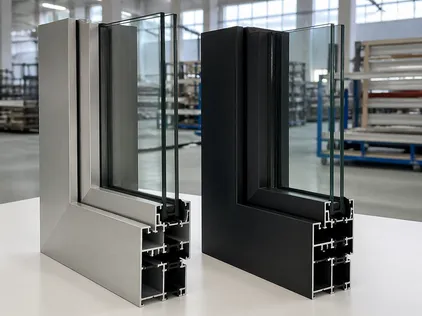
The structural backbone of a storefront door is the aluminum extrusion profile. We use 6063-T5 aluminum alloy — the standard for architectural aluminum applications — with wall thickness of 1.8–3.0mm depending on the profile series.
6063-T5 gives you the right balance of extrudability (clean, sharp profiles), corrosion resistance, and structural stiffness for door leaf and frame applications. 6061 is stronger but harder to extrude into the tight-tolerance profiles that storefront aesthetics require — we've tested both and 6063-T5 is the right call for this product.
Why 6063-T5 Over 6061
Glass area can reach up to 80% of the door leaf — the configuration that maximizes retail visibility and natural light transmission. Tempered glass (6mm, 8mm, 10mm), laminated, and insulated double-glazed options are all available depending on your market's safety code requirements and thermal performance targets.
Specifications shown are industry-standard values for this product type. Actual specifications may vary by configuration. Contact us for detailed product data sheets and exact tolerances.

Standard Specification Table
Request Specs| Parameter | Standard Specification |
|---|---|
| Frame material | 6063-T5 aluminum alloy |
| Profile wall thickness | 1.8mm – 3.0mm (series dependent) |
| Door leaf thickness | 44mm / 50mm |
| Standard leaf width | 700mm – 1200mm (single leaf) |
| Standard leaf height | 2000mm – 3000mm |
| Double-leaf width | Up to 2400mm |
| Glass type | Tempered (6mm / 8mm / 10mm), laminated, insulated double-glazed |
| Glass area | Up to 80% of door leaf area |
| Surface finish | Anodized (silver, bronze, champagne, black), powder coat (60+ RAL colors) |
| Thermal break | Available on select series (polyamide thermal break strip) |
| Hardware prep | ANSI, EN standard; concealed closer prep available |
| Weatherstrip | EPDM perimeter seal, brush seal at threshold |
| MOQ | 50 units (standard configurations) / 100 units (custom) |
Specifications shown are industry-standard values for this product type. Actual specifications may vary by configuration. Contact us for detailed product data sheets and exact tolerances.
Glass Configuration Options
Tempered Glass
6mm, 8mm, and 10mm options. Heat-treated for safety fracture behavior — required by code in most commercial entrance applications. Standard specification for retail and lobby entrances.
Laminated Glass
PVB interlayer bonded between glass plies. Holds together on impact — preferred for high-security retail, jewelry, and pharmacy applications where smash-and-grab resistance is a spec requirement.
Insulated Double-Glazed
Two glass lites with sealed air or argon cavity. Pairs with thermally broken frame profiles for markets where energy code compliance or climate control is a procurement driver.
Need specs for your project?
Send us your door schedule or project brief and we'll return a detailed data sheet with tolerances, finish samples, and lead time.
Thermal Break and Weatherproofing: Where the Spec Decision Matters for Your Market
Standard aluminum profiles are thermally conductive — in climates with significant temperature differentials between inside and outside, that conductivity creates condensation on the interior frame face and drives up heating/cooling loads. For buyers supplying into North American, Northern European, or high-altitude markets, a thermally broken profile is often a code requirement, not just a premium option.
Our thermally broken storefront door series uses a polyamide (PA66) thermal break strip pressed into the aluminum extrusion, separating the interior and exterior aluminum faces. Paired with double-glazed insulated glass units (IGU), the complete door assembly can meet most commercial energy code requirements for temperate climates.
The weatherstrip assembly matters more than most buyers realize when comparing quotes. A door that leaks air at the threshold or perimeter seal generates complaints from the end user within the first winter season. We use continuous EPDM compression seals on all four sides of the door leaf, with an automatic drop seal at the threshold on request — the configuration we recommend for any application where air infiltration rating is part of the project spec.
Request Thermal Break Spec Sheet
North America, Northern Europe, high-altitude: thermally broken profile is often a code requirement. PA66 break + IGU assembly meets most commercial energy codes.
Middle East, Southeast Asia: thermal break less critical. Priority shifts to UV-stable finishes and corrosion resistance. Powder coat with zinc-rich primer undercoat passes 1000-hour salt spray testing.
Retail Chain and Franchise Rollouts: The Commercial Case for Storefront Doors
Retail chains and franchise operators are the highest-volume repeat buyers in the storefront door segment. A regional franchise rollout — 30 to 150 locations opening over 12–18 months — means identical door sets across every location, with consistent finish, hardware, and glass specification. That consistency requirement is where factory-direct sourcing from a single manufacturer pays off.
One Production Standard
One color batch reference, one hardware prep spec across the entire rollout. Factory-direct sourcing from a single manufacturer eliminates the spec drift that comes from splitting orders across suppliers.
Color Consistency Guaranteed
Our automated powder coating line holds ΔE < 1.5 across a full production run — tighter than most manual coating operations. For anodized finishes, we batch-process doors from the same rollout together to ensure consistent anodize depth and color tone.
Capacity for Your Schedule
6 production lines and 450,000-unit annual capacity mean your rollout schedule doesn't compete with other buyers for line time. We can hold a production slot for confirmed purchase orders.
Typical Rollout Order Pattern
First wave of locations. Establishes the production reference for finish, hardware prep, and glass spec across the full rollout.
Review of any installation or performance feedback from the pilot wave before committing to the full rollout volume.
Production slot held for confirmed POs. Consistent spec and color batch maintained across all subsequent shipments through the 12–18 month rollout window.
"We've seen what happens when a contractor sources from two different suppliers for the same rollout — the color mismatch is visible from across the street. We don't let that happen on our end."

A mid-size shopping center fit-out can specify 80–300 storefront door sets across tenant units, common area entrances, and service corridors. The spec is typically driven by the center's design consultant, who sets the profile series, finish, and glass type.
Your value-add as a distributor is reliable supply and consistent quality across the full quantity — which is exactly what a single-factory source with dedicated production capacity delivers.
Commercial Lobby and Office Entrance Applications
Commercial office lobbies and mixed-use building entrances represent a different buying pattern from retail rollouts — typically project-based, architect-specified, and driven by design intent rather than brand standards. The storefront door here is a design element: the profile depth, finish, and glass configuration are selected to complement the building's facade.
For this segment, our architectural storefront series offers deeper profile options (65mm and 80mm face depth), concealed hardware prep, and the full range of anodized finishes — silver, bronze, champagne, and black are standard; custom anodize colors are available on runs of 100+ units. Concealed door closers and flush-face pull hardware give the assembly a clean profile that architects specify for premium lobby applications.
The project contractor buying for this segment needs two things from a supplier: technical documentation for the specification package, and reliable delivery against a construction schedule.

Full Technical Documentation
Technical data sheets, CAD drawings, and test reports included as part of the quotation package — everything your project team needs to get the product approved and onto the procurement schedule.
Concealed Hardware Prep
Concealed door closers and flush-face pull hardware give the assembly a clean profile. The finish architects specify for premium lobby applications — no exposed mechanism, no visual interruption.
Schedule-Reliable Delivery
Project contractors need delivery against a construction schedule. Standard configurations ship in 25–35 days from confirmed order; custom profile or finish specifications in 35–45 days.
Standard Anodized Finishes
Silver, bronze, champagne, and black are standard stock finishes. Custom anodize colors are available on runs of 100+ units — batch-processed together to maintain color consistency across the full project order.
Surface Finish: Anodize vs. Powder Coat for Storefront Applications
Both finishes are viable for storefront doors, and the right choice depends on your market and application. Here's how we think about it from the production side.
Anodized Finish
An electrochemical process that converts the aluminum surface itself into a hard oxide layer — it's integral to the metal, not a coating on top of it. Standard anodize depth is 15–25μm for architectural applications.
The result is a finish that won't chip or peel, handles UV exposure well, and has the metallic sheen that architects specify for premium facade applications.
Limitation: Color range is narrow, and color matching across batches requires careful process control. We batch-process all doors from the same project together to maintain consistency.
Powder Coat Finish
Gives you the full RAL color range — 60+ standard colors, custom colors available on 100+ unit runs — with a 60–80μm coating thickness that passes 500-hour salt spray testing.
The pre-treatment sequence is the same as our steel door line: phosphate conversion coating, weld zone treatment, then automated electrostatic application cured at 180–200°C.
Retail brand advantage: For retail chains with specific brand colors, powder coat is the only way to hit a precise RAL or proprietary color spec.
The Practical Decision
If your buyer is an architect or developer specifying a premium lobby entrance, anodize is usually the right answer — integral finish, metallic sheen, UV-stable.
If your buyer is a retail chain with a brand color standard, powder coat is the path — full RAL range, precise color matching, 60+ standard options.
Mixed specifications on the same project? We can supply both finishes from the same production run if a project requires mixed specifications.
| Criteria | Anodized Finish | Powder Coat Finish |
|---|---|---|
| Finish type | Integral oxide layer (electrochemical) | Applied coating (electrostatic) |
| Thickness | 15–25μm | 60–80μm |
| Color range | Narrow (silver, bronze, champagne, black + custom 100+) | Full RAL range, 60+ standard + custom 100+ |
| Chip / peel resistance | Won't chip or peel (integral to metal) | High durability; impact can chip coating |
| Salt spray | Excellent UV / corrosion resistance | 500-hr standard; 1000-hr coastal (zinc-rich primer) |
| Best for | Architect-specified lobby / premium facade | Retail brand color standards / RAL match |
| Mixed project | Both finishes available from the same production run | |
Customization Parameters and OEM Options
Standard catalog configurations cover most retail and commercial lobby applications. When your project or your downstream customer's spec falls outside the standard range, here's what we can do.
Dimensional Customization
Non-standard leaf widths and heights are handled on our extrusion and fabrication lines without dedicated tooling on runs of 100 units or more. Oversized single-leaf configurations up to 1400mm wide are feasible; above that, we recommend a double-leaf configuration for structural reasons. Custom heights up to 3500mm are available on request.
Profile Series Selection
We offer three profile depth series covering the range from standard retail storefront to architectural lobby applications. Deeper profiles carry more glass area and a more substantial visual presence.
Hardware Integration
We can supply doors pre-hung with hardware. If you're supplying into a market with a specific hardware brand ecosystem, tell us and we'll prep to their rough-in dimensions.
- Panic bars
- Concealed closers
- Electric strike prep for access control integration
- Multipoint locking for high-security lobby applications
- DORMA, ASSA ABLOY, Allegion rough-in compatibility
OEM and Private Label
Most of our distributor partners in North America and Australia run our storefront doors under their own brand. We supply OEM brand plates, custom packaging with your logo, and private-label documentation.
- OEM brand plates included
- Custom packaging with your logo
- Private-label documentation
- Free 3D rendering and design consultation for custom configurations
- 15-engineer R&D team — production-ready drawing within 3 business days
Minimum Order Quantities

Certifications and Compliance for Your Target Market
Our storefront commercial doors are manufactured under ISO 9001:2015 quality management certification, with CE marking covering the European market. SGS audit reports are available on request for buyers who need third-party quality verification for their own procurement approval process.
ISO 9001:2015 quality management certification with CE marking for the European market. SGS audit reports available on request for procurement approval processes requiring third-party verification.
Storefront doors are typically non-fire-rated entrance assemblies in North America. Relevant standards are ANSI/AAMA 101 for aluminum windows and doors — covering performance grades for air infiltration, water resistance, and structural load — and local building codes for glazing safety requirements.
We manufacture to AAMA performance grade standards; ask us for the specific test documentation for your project's requirements.
For lobby entrances where fire compartmentation design requires a rated assembly, we can supply fire-rated aluminum door assemblies. These are a separate product configuration from standard storefront doors. Contact us with your required fire rating and we'll confirm availability and lead time.
Glass Safety Compliance
All glazing in our storefront doors uses tempered or laminated safety glass. For markets with specific glazing safety codes, confirm the applicable standard with us at the quotation stage and we'll supply the relevant test documentation.
Need Compliance Documentation for Your Market?
Confirm the applicable standard with us at the quotation stage and we'll supply the relevant test documentation — whether that's AAMA performance grades, SGS audit reports, or glazing safety certifications for your region.
Packaging, Container Loading, and Export Logistics
Storefront doors ship partially disassembled — door leaf, frame sections, and hardware packaged separately — to maximize container loading efficiency and protect the glass during transit.
Container Loading Capacity
A 40HQ container typically loads 150–220 storefront door sets in disassembled configuration, depending on leaf size and frame inclusion. Glass-panel doors are lighter than steel doors but bulkier — CBM calculation matters more than weight for freight cost.
Glass Packaging Standard
Glass panels are individually wrapped in foam and packed in purpose-built wooden crates with corner protection. Our standard glass packaging passes a 1.2m drop test. For West African and some Southeast Asian ports where handling is rough, we add additional internal bracing.
Large Rollout Orders (100+ Sets)
For orders of 100+ door sets, we provide a container loading plan with exact CBM calculations before you confirm the order — useful for landed cost modeling. We can include a freight estimate from our regular forwarders to your destination port.

Pre-Hung Assembly Option
Pre-hung assemblies (door leaf pre-hung in frame with hardware installed) are available for buyers whose downstream customers need a complete, ready-to-install unit.
The right trade-off depends on your market's labor cost profile and your customer's installation capability.
Packaging note: Our crate design has been refined over years of shipping to markets with rough port handling — it absorbs the impact loads that standard carton packaging doesn't survive. Port-specific bracing upgrades are available on request for high-risk handling environments.
Frequently Asked Questions
Technical and commercial questions answered directly — alloy specs, glass thickness, corrosion protection, MOQ, and more.
What aluminum alloy is best for storefront commercial doors, and why does it matter?
6063-T5 is the industry standard for architectural aluminum applications including storefront doors. It extrudes cleanly into the tight-tolerance profiles that storefront aesthetics require, has good corrosion resistance, and takes anodize and powder coat finishes well.
6061 is stronger but harder to extrude into complex profiles and doesn't anodize as evenly — it's the right choice for structural components, not door profiles. For storefront doors, 6063-T5 is the correct spec; any supplier offering a different alloy should be asked to explain why.
What glass thickness should I specify for a storefront commercial door?
For standard retail storefront applications, 6mm tempered glass is the baseline. For doors over 1000mm wide or 2400mm tall, move to 8mm or 10mm tempered to maintain adequate stiffness and reduce deflection under wind load.
Hurricane zones or high-crime retail: specify laminated glass — 6.38mm (3mm + 0.38mm PVB + 3mm) is the standard laminated safety glass configuration.
Cold climates: insulated double-glazed units (IGU) with a 16mm or 20mm air gap. Tell us your application and climate zone and we'll recommend the right glazing spec.
How do I prevent aluminum storefront door frames from corroding in coastal environments?
Aluminum naturally forms a protective oxide layer, but in salt-air environments, chloride ions can penetrate that layer and cause pitting corrosion, particularly at joints and fastener points.
Specify minimum 20μm anodize depth (AA20 per AAMA 611) for coastal applications — thicker anodize provides better chloride resistance than standard 15μm.
For powder-coated frames, specify a chromate conversion coating pre-treatment (not just phosphate) before powder application, and seal all cut ends and fastener holes with compatible sealant during installation.
We offer a coastal specification package on request covering both finish spec and assembly sealant recommendations.
What is the MOQ for storefront commercial doors, and can I order samples first?
For new buyers, we recommend starting with a 2–4 unit sample order to test the product with your own customers or against your project spec before committing to volume. Sample lead time is typically 15–20 days. Production lead time for standard orders is 25–35 days from order confirmation.
Storefront commercial doors vs. aluminum commercial doors: what's the difference?
Storefront doors are a subset of aluminum doors, optimized specifically for retail frontage and commercial lobby entrance applications — the profile aesthetics, glass area ratio, and hardware configurations are designed for high-visibility, public-facing use.
Face of a retail location or building lobby — storefront is the right product.
Side entrances, service doors, and interior aluminum partitions where aesthetic requirements are less demanding — aluminum commercial door line is more cost-appropriate.
Do storefront commercial doors come with automatic door opener compatibility?
Yes. We can prep storefront door frames for automatic sliding or swing door operators — the frame reinforcement, header box dimensions, and power supply routing are built into the frame at the fabrication stage.
Specify the operator brand and model at the quotation stage and we'll confirm compatibility and prep dimensions. For high-traffic retail entrances where automatic operation is standard, this is a common configuration in our Southeast Asian and Middle Eastern orders.
Start Your Storefront Door Sourcing Conversation
New to sourcing storefront commercial doors, or looking to add this product line to your distribution catalog? The most useful first step is usually a 2–4 unit sample order — one in anodized finish, one in powder coat — so you can compare the finish quality and test the hardware with your own customers before committing volume.
What to Tell Us
-
Target Market
Retail chain, shopping center fit-out, or commercial lobby — your end-use context shapes the profile series and finish spec we recommend.
-
Volume Expectations
Rough annual or per-project unit count. Even a ballpark figure helps us match you to the right MOQ tier and container loading plan.
-
OEM / Private-Label Needs
Whether you need neutral packaging, branded hardware, or full private-label documentation — tell us upfront so we can scope it into the quote.
What You Get Back
Based on what's moving for our existing distributors in your region, we'll recommend the right profile series and finish spec, then send back a detailed quote with CAD drawings.
- Profile series recommendation matched to your market
- Finish spec guidance — anodize vs. powder coat for your climate
- Detailed quote with itemized pricing
- CAD drawings for your review and approval
Recommended First Step
A 2–4 unit sample order — one in anodized finish, one in powder coat — lets you compare finish quality and test the hardware with your own customers before committing to volume.
Request a Quote for Storefront Commercial Doors
Use the quote form to share your target market, volume expectations, and OEM requirements. We'll respond with a profile series recommendation, finish spec, and detailed quote with CAD drawings.
Explore More Commercial Doors