
[email protected] +86 152 3616 2255 Mon–Sat 8:00–18:00 (GMT+8)
Language
ISO 9001:2015 · CE · SGS · NFPA 80

Fire Door Certification & Steel Door Standards

Factory-certified steel and fire doors — pre-qualified for North American, European, and Gulf market compliance requirements.

ISO 9001:2015, CE, SGS, and NFPA 80 certifications cover our full fire door and steel door range. Certification documents and SGS audit reports available on request.

ISO 9001:2015 CE Marking SGS Audited NFPA 80 5-Stage QC 100% Pre-Shipment
Certification Registry

Certifications We Hold and What They Cover

We carry four certifications that between them cover the compliance requirements of every major market we ship to. Here's what each one means in practical terms for your import and resale process.

ISO 9001:2015

Universal

Third-party accredited registrar

Scope: Quality management system — covers our full manufacturing operation from raw material intake to shipment.

Market Relevance: Universal — required or preferred by procurement teams in all markets.

CE

CE Marking

EU / EEA

Notified body (EU)

Scope: European conformity for construction products — structural steel doors and fire-rated door sets.

Market Relevance: EU, EEA, and markets that accept CE as a compliance proxy (Gulf states, parts of Southeast Asia).

SGS

Third-Party

SGS Group

Scope: Third-party product testing and factory audit.

Market Relevance: North America, Europe, Australia — buyers who require independent third-party verification.

NFPA 80

North America

Tested to NFPA 80 standard

Scope: US fire door standard — covers fire door assembly installation and performance requirements.

Market Relevance: North America — required for fire door supply into US and Canadian construction projects.

Certification Issuing Body Scope Market Relevance
ISO 9001:2015 Third-party accredited registrar Quality management system — covers our full manufacturing operation from raw material intake to shipment Universal — required or preferred by procurement teams in all markets
CE Marking Notified body (EU) European conformity for construction products — structural steel doors and fire-rated door sets EU, EEA, and markets that accept CE as a compliance proxy (Gulf states, parts of Southeast Asia)
SGS SGS Group Third-party product testing and factory audit North America, Europe, Australia — buyers who require independent third-party verification
NFPA 80 Tested to NFPA 80 standard US fire door standard — covers fire door assembly installation and performance requirements North America — required for fire door supply into US and Canadian construction projects

SGS audit reports are available on request. If your import compliance file requires third-party documentation, we can provide the relevant reports without delay.

Technical Standards

What Fire Door Certification Actually Requires — and How We Meet It

Fire door certification is the most technically demanding part of our compliance program, so it's worth walking through what the standards actually test and how our production process maps to those requirements.

US NFPA 80: The US Fire Door Standard

NFPA 80 governs the installation and performance of fire door assemblies in the United States. For a manufacturer, meeting NFPA 80 means the complete door assembly — leaf, frame, hardware, and seals — has been tested as a system and performs as rated under fire conditions. The standard specifies fire resistance ratings (typically 20-minute, 45-minute, 60-minute, and 90-minute), and each rating requires the assembly to maintain integrity for the rated duration under standardized fire test conditions.

Our NFPA 80-compliant fire doors use a mineral wool or vermiculite board core — the core material is the primary determinant of fire resistance duration, and we select fill density and thickness based on the target rating. The door leaf is constructed from 1.2mm SPCC cold-rolled steel skins with a fully welded perimeter seam; there are no mechanical fasteners on the perimeter that could fail under thermal expansion.

Intumescent seals are fitted into routed channels on the door edge — they expand at approximately 150–200°C to seal the gap between door and frame before the gap widens from heat distortion. (We specify the intumescent seal depth and channel dimensions to match the seal's expansion ratio — a common failure point on cheaper assemblies is a seal that expands but has nowhere to go because the channel is too shallow.)

Hardware on NFPA 80 assemblies is rated to match the door's fire rating — closers, hinges, and latches are all selected from hardware that has been independently tested to the same standard. We don't mix rated and unrated hardware on fire door assemblies.

NFPA 80 fire door assembly construction showing mineral wool core and intumescent seals

NFPA 80 Rating Tiers

20 min
Corridor / Stairwell
45 min
Corridor / Stairwell
60 min
Standard (EUWOO)
90 min
Standard (EUWOO)
CE marking fire door set EN 16034 European standard compliance

CE Classification System

EI1 30 / EI2 30 30-minute integrity + insulation
EI1 60 / EI2 60 60-minute integrity + insulation
EI1 90 / EI2 90 90-minute integrity + insulation
E only Integrity without insulation

EU CE Marking for Fire-Rated Door Sets

CE marking for fire-rated door sets is governed by EN 16034 (the product standard for fire-resisting and/or smoke control pedestrian doorsets) in combination with EN 13501-2 (the fire classification standard). The CE mark on a fire door set means the product has been tested by a notified body, classified under EN 13501-2, and the manufacturer has issued a Declaration of Performance (DoP) that specifies the fire classification achieved.

The EU classification system uses E (integrity) and I (insulation) designations with a time suffix — so EI2 60 means the door set maintains both integrity and insulation for 60 minutes under the EN 1363-1 fire test. The "2" in EI2 refers to the radiation measurement method. Our fire door sets are classified to EI2 60 and EI2 90 as standard, with EI2 30 available for lower-rating applications.

For CE marking, the door set is tested as a complete assembly — leaf, frame, threshold, seals, and hardware — and the CE mark applies to that specific tested configuration. If you change the hardware or frame dimensions beyond the scope of the test report, the CE mark may no longer apply. We provide the Declaration of Performance and the test report reference with every CE-marked shipment so your project team can confirm the configuration is within scope.

One practical note for importers: CE marking is a legal requirement for placing fire door sets on the EU market, not just a quality indicator. If you're importing into the EU without CE-marked fire doors, you're exposed to customs rejection and liability. Our CE documentation is structured to support your import declaration directly.

Quality Assurance

5-Stage Quality Control: The Process Behind the Certifications

Certifications document what we're capable of producing. Our 5-stage QC process is how we ensure every shipment matches that capability. Each stage has defined pass/fail criteria and is logged in our production record system.

1

Stage 1 — Incoming Steel Inspection

Before production begins

Every coil of SPCC cold-rolled steel is inspected on arrival before it enters the production line. We check:

  • Mill certificate verification — the certificate must match the coil's heat number and confirm the steel grade, yield strength, and tensile strength meet our specification
  • Thickness measurement — we use a calibrated ultrasonic gauge to verify actual thickness against the nominal spec (tolerance: ±0.05mm)
  • Surface condition — visual inspection for rust, pitting, lamination, or surface defects that would affect coating adhesion or structural integrity

Steel that fails incoming inspection is quarantined and returned to the supplier. We do not use non-conforming steel in production.

Stage 1 incoming steel coil inspection with ultrasonic thickness gauge
2

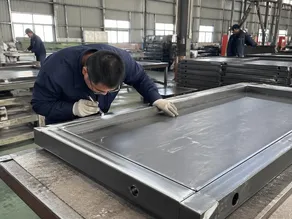
Stage 2 — In-Process Dimensional Check

During fabrication

After the steel skins are cut and formed but before assembly, each door leaf and frame component is dimensionally checked against the production drawing. We measure:

  • Overall dimensions — height, width, and thickness to ±1mm tolerance
  • Squareness — diagonal measurement to confirm the leaf is square within 2mm
  • Hardware cutout positions — hinge mortises, lock backset, and closer reinforcement plate positions are checked against the hardware schedule
  • Frame rebate depth — the frame rebate must match the door leaf thickness to ensure correct clearance for the intumescent seal

Dimensional non-conformances at this stage are corrected before assembly — it's far more efficient to correct a cut component than a finished door.

Stage 2 in-process dimensional check of door leaf components during fabrication
3

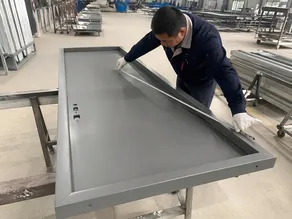
Stage 3 — Weld Integrity Inspection

Post-welding

All structural welds — perimeter seam welds on the door leaf, frame corner welds, and hinge reinforcement welds — are inspected after welding and before surface preparation. The inspection covers:

  • Visual inspection — weld bead continuity, absence of porosity, undercut, or burn-through
  • Weld penetration — spot checks using destructive testing on sample welds from each production batch to confirm full penetration
  • Distortion check — the door leaf is checked for bow and twist after welding; thermal distortion from welding is a common cause of door-to-frame fit problems

For fire doors specifically, the perimeter weld is a structural element of the fire resistance — a failed weld can allow the door leaf to delaminate under fire conditions. We treat weld inspection on fire doors as a critical control point.

Stage 3 weld integrity inspection on fire door perimeter seam welds
4

Stage 4 — Coating Adhesion and Finish Inspection

Post-coating

After phosphating and powder coating, each door is inspected for coating quality. The coating is both a corrosion protection layer and a finish — failures here affect both durability and appearance. We check:

  • Dry film thickness — measured with a magnetic gauge at multiple points across the door face; minimum 60 microns, target 80 microns
  • Adhesion — cross-cut adhesion test (ISO 2409) on sample doors from each batch; we require a rating of 0 or 1 (no or minimal adhesion loss)
  • Surface finish — visual inspection for orange peel, runs, sags, holidays (uncoated areas), or colour inconsistency
  • Colour match — checked against the approved colour standard for the order

Doors that fail coating inspection are stripped and recoated — we don't touch up or over-coat failed areas.

Stage 4 powder coating adhesion and dry film thickness inspection
5

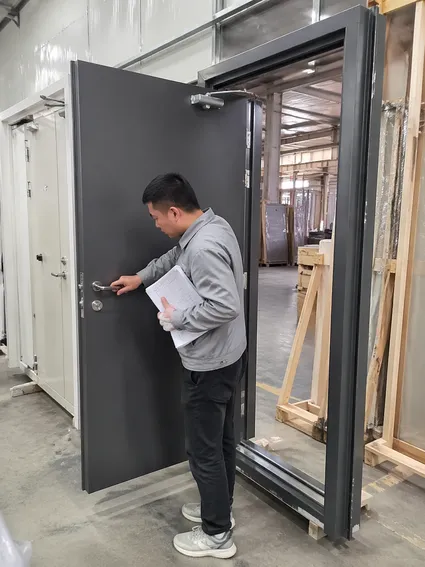
Stage 5 — Final Assembly and Pre-Shipment Inspection

Before packing and shipment

The final inspection is a complete functional check of the assembled door set — leaf, frame, hardware, and seals — before packing. This is the last opportunity to catch any issue before the product leaves the factory. We check:

  • Hardware function — every lock, hinge, and closer is operated through its full range of motion
  • Door-to-frame fit — the door is hung in the frame and the clearance gap is measured at all four edges; maximum 3mm gap on fire doors
  • Seal continuity — intumescent and smoke seals are checked for continuity around the full perimeter
  • Self-closing function — on fire doors with closers, the door must close and latch from any open position without manual assistance
  • Label and marking — fire rating label, CE marking plate, and production batch number are verified against the order
  • Packing inspection — packing method and protection are checked against the shipping specification for the destination market

Every door that passes Stage 5 inspection is assigned a unique production record number that links it to the QC records from all five stages. This record is available to buyers on request and is the basis for any warranty or compliance claim.

For orders where the buyer has arranged a third-party pre-shipment inspection (SGS, BV, TÜV, or similar), Stage 5 is coordinated with the inspector's schedule so the inspection covers the fully assembled and finished product.

Stage 5 final assembly and pre-shipment inspection of complete fire door set
5
Inspection Stages
100%
Doors Pre-Shipment Inspected
ISO
9001:2015 Certified QMS
SGS
Third-Party Audit Available
Market Compliance

Compliance by Market: What Your Import Process Needs

Certification requirements vary significantly by destination market. Here's what applies in each of the markets we regularly ship to, and what documentation we provide to support your import and resale compliance.

NA

North America (US & Canada)

The US and Canadian markets have the most specific fire door requirements of any market we ship to. Fire doors must comply with NFPA 80, and the door assembly must be listed by a recognized testing laboratory (UL, Intertek/Warnock Hersey, or similar). The listing means the door has been tested to the relevant ANSI/UL standard and is included in the lab's published directory of listed products.

For non-fire-rated steel doors, ANSI/SDI A250 is the construction standard — it defines steel thickness, core construction, and hardware reinforcement requirements for commercial steel doors. Our steel doors are manufactured to SDI A250 standards.

For Canadian projects, the National Building Code of Canada references ULC standards for fire door assemblies — ULC-S104 is the Canadian equivalent of the UL 10C fire test. Our fire doors have been tested to both UL and ULC standards.

What we provide: NFPA 80 test reports, UL/ULC listing documentation, SGS inspection reports, and ISO 9001:2015 certificate. For projects requiring AHJ (Authority Having Jurisdiction) approval, we can provide the full technical file including test reports and Declaration of Conformance.

North America fire door compliance NFPA 80 UL listing documentation

Key Standards

NFPA 80 — Fire door assembly standard
ANSI/SDI A250 — Steel door construction
UL 10C — Positive pressure fire test
ULC-S104 — Canadian fire test standard
EU

European Union and EEA

The EU market requires CE marking for fire door sets under the Construction Products Regulation (CPR). CE marking is a legal requirement — not optional — for fire-rated door sets placed on the EU market. The CE mark must be accompanied by a Declaration of Performance (DoP) that specifies the fire classification achieved under EN 13501-2.

For non-fire-rated steel door sets, CE marking under EN 14351-1/2 covers performance characteristics including air permeability, water tightness, wind resistance, and burglar resistance. Our steel door sets are CE-marked under EN 14351.

Individual EU member states may have additional national requirements on top of the CE marking baseline — for example, some countries require specific fire door classifications for certain building types. We can advise on country-specific requirements for your target market.

What we provide: CE Declaration of Performance, EN 13501-2 fire classification certificate, test report references, and ISO 9001:2015 certificate. For projects requiring a full technical file, we can provide the complete DoP package including the notified body certificate number.

EU EEA CE marking fire door set Declaration of Performance EN 16034

Key Standards

EN 16034 — Fire-resisting doorsets product standard
EN 13501-2 — Fire classification standard
EN 14351-1/2 — Non-fire-rated door sets
CPR — Construction Products Regulation
ME

Middle East (Gulf States)

Gulf state markets — UAE, Saudi Arabia, Qatar, Kuwait, Bahrain, and Oman — generally accept CE marking and/or UL listing as the basis for fire door compliance, with local civil defence authority approval required for specific project types. The UAE Civil Defence, for example, requires fire doors to be tested to BS 476 Part 22 or EN 1634-1, and the door must be listed on the Civil Defence approved products register.

Saudi Arabia follows SASO (Saudi Standards, Metrology and Quality Organization) requirements, which reference international standards including BS and EN series. CE-marked fire doors are generally accepted, but project-specific approval from the relevant authority may be required for large commercial or government projects.

Qatar and Kuwait have similar frameworks — CE or UL listing is the baseline, with project-specific authority approval for high-rise and critical infrastructure projects. Our SGS audit reports and CE documentation are structured to support Gulf authority approval submissions.

What we provide: CE Declaration of Performance, SGS test reports, ISO 9001:2015 certificate, and product technical data sheets formatted for Gulf authority submissions. We have experience supporting approval submissions in UAE, Saudi Arabia, and Qatar.

Middle East Gulf States fire door compliance CE marking civil defence approval

Key Standards & Authorities

BS 476 Part 22 / EN 1634-1 — Fire test standards
UAE Civil Defence — Approved products register
SASO — Saudi standards framework
CE / UL listing accepted as baseline
AP

Southeast Asia and Australia

Southeast Asian markets vary considerably in their certification requirements. Singapore follows the Singapore Civil Defence Force (SCDF) requirements, which reference SS 332 (the Singapore standard for fire doors) and require SCDF-approved products for regulated building types. Our fire doors have been supplied into Singapore projects under SCDF approval.

Malaysia references MS 1073 for fire door assemblies, and the Fire and Rescue Department (BOMBA) approval is required for fire doors in regulated buildings. CE-marked fire doors are generally accepted as the basis for BOMBA approval, with local testing sometimes required for specific configurations.

Australia requires fire doors to comply with AS 1905.1 (the Australian standard for fire-resistant door sets) and be listed on the CodeMark or WaterMark scheme, or carry a third-party certification from a JAS-ANZ accredited body. Our SGS certification and CE documentation support the Australian compliance pathway, and we have supplied fire doors into Australian projects through local distributors who manage the CodeMark process.

What we provide: CE Declaration of Performance, SGS test reports, ISO 9001:2015 certificate, and technical data sheets. For Australian projects, we work with your local compliance consultant to provide the documentation package required for the CodeMark or alternative certification pathway.

Southeast Asia Australia fire door compliance AS 1905 SCDF Singapore

Key Standards & Authorities

AS 1905.1 — Australian fire door standard
SS 332 — Singapore fire door standard
MS 1073 — Malaysian fire door standard
SCDF / BOMBA — Local authority approvals
Independent Verification

Third-Party Audits and Verification

Our certifications are issued and maintained by independent third-party bodies. Here's how the audit and verification process works, and what it means for your procurement confidence.

ISO 9001:2015 certification is maintained through annual surveillance audits and a full recertification audit every three years, conducted by our accredited registrar. The surveillance audit covers a rotating subset of our quality management system processes — it's not a paper review, it's an on-site audit of actual production records, non-conformance logs, and corrective action evidence.

CE marking for fire door sets requires initial type testing by a notified body, followed by ongoing factory production control (FPC) audits. The notified body audits our production process against the FPC requirements defined in the relevant harmonised standard — typically annually. The audit confirms that our production process continues to produce doors that match the tested configuration.

SGS product testing and factory audits are conducted on a project or periodic basis. SGS auditors have unrestricted access to our production floor, QC records, and material traceability documentation during audits. SGS audit reports are available to buyers on request — we don't redact or summarise them.

Pre-shipment inspections by buyer-nominated agencies (SGS, BV, TÜV, Intertek, or others) are supported as standard. We schedule production completion to allow inspection before packing, and we provide the inspector with full access to QC records for the production batch being inspected.

Audit Schedule Summary

ISO 9001:2015
Annual surveillance + 3-year recertification by accredited registrar
CE
CE Marking (FPC)
Annual factory production control audit by notified body
SGS
Periodic product testing and factory audit; reports available on request
Pre-Shipment Inspection
Buyer-nominated agency supported; SGS, BV, TÜV, Intertek accepted
SGS third-party factory audit and pre-shipment inspection at EUWOO facility

What Buyers Can Request

  • ISO 9001:2015 certificate (current, with expiry date and registrar details)
  • CE Declaration of Performance for the specific door configuration ordered
  • EN 13501-2 fire classification certificate with notified body reference
  • NFPA 80 test report for the relevant fire rating and configuration
  • SGS factory audit report (most recent)
  • Production batch QC records for your specific order
  • Steel mill certificates for the material used in your order
Frequently Asked Questions

Frequently Asked Questions

Which products does your NFPA 80 certification cover?

Our NFPA 80 testing covers steel fire door assemblies — the complete set of door leaf, frame, and rated hardware. The certification applies to our standard fire door configurations in 60-minute and 90-minute ratings. If your project requires a specific rating or configuration not in our standard range, contact us — we can advise on whether your spec falls within our tested assembly parameters or requires additional documentation.

What is the difference between CE marking and NFPA 80 for fire doors?

CE marking and NFPA 80 are parallel standards for different markets, not interchangeable. CE marking (under EN 16034 / EN 13501-2) is the EU framework — it uses the EI classification system and is required for fire door sets placed on the EU market. NFPA 80 is the US standard — it governs fire door assembly installation and performance for North American construction projects.

A door can hold both certifications if it has been tested to both standards, which is the case for our fire door range.

Can you provide test reports for specific door configurations?

Yes. We can provide test reports for our standard certified configurations. If you need a test report for a specific size or hardware combination, we'll confirm whether it falls within the scope of our existing test reports or whether additional testing would be required. Most standard commercial configurations are covered.

What steel door standard applies to non-fire-rated commercial steel doors?

For non-fire-rated steel doors, there's no single universal standard — requirements vary by market and application. In the EU, EN 14351-1/2 covers door sets for performance characteristics including air permeability, water tightness, and wind resistance. In North America, ANSI/SDI A250 is the industry standard for steel door and frame construction.

Our steel doors are manufactured to SDI A250 construction standards and CE-marked under EN 14351, covering both markets.

Do you support third-party factory inspections before shipment?

Yes. We support pre-shipment inspections arranged through SGS, BV, TÜV, or your own nominated inspection agency. Inspection access is scheduled around production completion — contact us when your order is in the final production stage and we'll coordinate timing with your inspector.

Document Request

Request Certification Documents

If you need certification documents for a procurement file, import declaration, or project approval submission, contact us directly. We provide the full documentation package — ISO certificate, CE Declaration of Performance, NFPA 80 test reports, and SGS audit reports — without delay.

For project-specific requests (specific door configuration, specific fire rating, specific market), include the details in your message and we'll confirm which documents apply to your configuration and provide them in the format your compliance team needs.

Request EUWOO fire door certification documents ISO CE SGS NFPA 80
ISO 9001:2015
Available on request
CE Declaration
Per configuration
NFPA 80 Reports
60 & 90 min ratings
SGS Audit Report
Most recent audit