

Fire Door Manufacturer | EUWOO
Steel, glass, commercial, and industrial configurations from a manufacturer with 18+ years on the production floor. 14 product variants. NFPA 80, CE, and ISO 9001:2015 certified. 450,000-unit annual capacity across 6 dedicated lines in Luoyang, China.

What We Manufacture and Why Certification Is the Starting Point
We've been building fire doors since our Gulf and Southeast Asian buyers started running into stricter building code enforcement — that was the early 2010s, and the pressure was real. Distributors who had been sourcing standard steel doors from us came back asking whether we could supply fire-rated product that would clear NFPA 80 inspections in the US and BS 476 / EN 1634 testing in Europe. We invested in the certification process and built out a dedicated fire door production line. That decision shaped the factory you're looking at today.
EUWOO is the export brand of Luoyang Huahui Door Industry Co., Ltd. Every fire door that ships under our name is manufactured in our own 18,000 m² facility — no subcontracting, no trading company layer between your spec and the production floor.
Our fire door line holds NFPA 80 (US standard), CE (European conformity), ISO 9001:2015, and SGS third-party audit certification. Those four credentials cover the compliance requirements for your primary export markets: North America, the EU, the Gulf, and Southeast Asia. If your buyers or project specs require documentation, SGS audit reports are available on request.
The product line covers 14 variants — from standard single-leaf steel fire doors to glass-panel fire doors, self-closing and automatic configurations, double-leaf assemblies, and application-specific builds for kitchens, electrical rooms, and industrial facilities. If you're building a distribution catalog or sourcing for a multi-building project, the range is wide enough to consolidate your fire door procurement with one supplier.
That consolidation matters more than it sounds — one factory, one QC standard, one documentation package for your entire fire door SKU mix.

NFPA 80
US fire door standard — required for North American project specs and building code compliance.
CE Conformity
European conformity marking — covers EU, Gulf, and markets that reference EN 1634 testing.
ISO 9001:2015
Quality management system certification — consistent production standards across all 6 lines.
SGS Audit
Third-party audit reports available on request for buyer due diligence and project documentation.
Fire Door Product Line
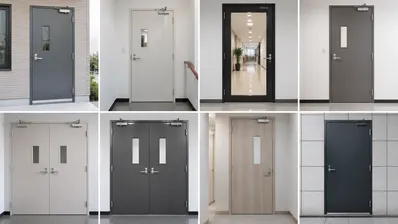
14 variants covering the full commercial and industrial fire door spectrum. Each product links to its dedicated specification page.
By Configuration
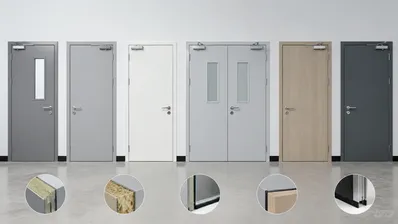
Steel Fire Door
Commercial buildings, stairwells, corridors
1.0–1.5mm SPCC body, mineral wool or vermiculite board core
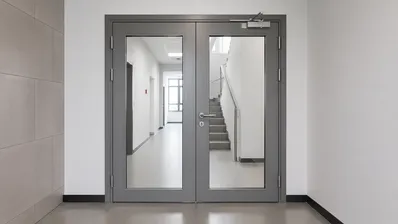
Glass Fire Door
Office lobbies, corridors requiring visibility
Fire-rated glazing panel, maintains integrity rating
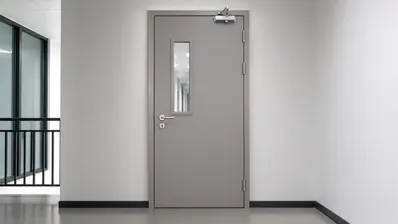
Single Fire Door
Standard openings, residential-scale commercial
Single leaf, most common configuration for stocking
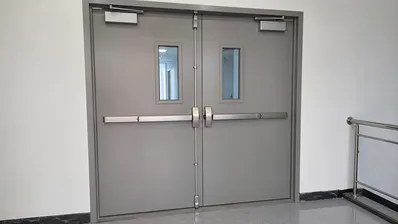
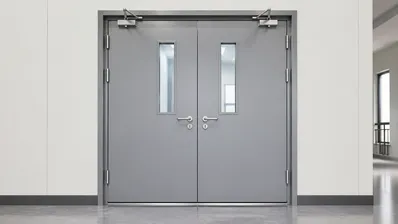
Double Leaf Fire Door
Wide openings, high-traffic corridors
Coordinated leaf sequencing, active/passive leaf hardware
Interior Fire Door
Internal compartmentation
Optimized for interior wall integration
Exterior Fire Door
Building perimeter, exit routes
Weather-resistant finish, threshold sealing
By Mechanism
By Application
Commercial Fire Door
Office buildings, retail, hospitality
Broad spec range, OEM-friendly
Industrial Fire Door
Factories, warehouses, logistics facilities
Heavy-gauge body, abuse-resistant hardware
Office Fire Door
Corporate interiors
Aesthetic finish options, vision panel variants
Kitchen Fire Door
Commercial kitchens, food service
Grease-resistant finish, stainless hardware option
Electrical Room Fire Door
Data centers, switchgear rooms, utilities
Tight sealing, no-vision-panel standard
Need full specifications across all 14 variants? Request a catalog with complete dimensional ranges, fire rating options, hardware configurations, and certification documentation.
Request a Catalog with Full SpecificationsFire Door Specifications: Category-Wide Parameter Ranges
These are the ranges across our fire door line. Individual product pages carry the exact specs for each variant.
| Parameter | Range / Options |
|---|---|
| Fire Resistance Rating | FD30 (30 min) · FD60 (60 min) · FD90 (90 min) · FD120 (120 min) |
| Door Leaf Thickness | 44mm · 54mm · 64mm (rating-dependent) |
| Steel Body Gauge | 1.0mm SPCC (standard) · 1.2mm (commercial) · 1.5mm (industrial/heavy-duty) |
| Core Material | Mineral wool board · Vermiculite board · Perlite composite |
| Door Width | 700–1200mm single leaf · up to 2400mm double leaf |
| Door Height | 2000–2400mm standard · custom heights available |
| Frame Type | Welded steel frame with intumescent seal · knock-down frame available |
| Surface Finish | Powder coat (60+ colors, 60–80μm) · primer-only for site finishing |
| Hardware | Stainless or zinc-alloy hinges · mortise lock · overhead closer · push bar |
| Glazing | No vision panel (standard) · fire-rated glass panel (optional on select models) |
| Certifications | NFPA 80 CE ISO 9001:2015 SGS |
We run door panels at 1.2mm SPCC for our standard commercial line — that's our recommendation for most distribution and project applications. The 1.5mm gauge is available for industrial and high-abuse environments, but it adds weight and freight cost; most buyers in office and hospitality segments don't need it.
If you're unsure which gauge fits your market, send us your target application and we'll spec it.
How Fire Door Ratings Work in Practice — and What to Specify for Your Market
This is where buyers lose time: ordering the wrong rating for their market's code requirement, then having to re-source or re-certify on arrival. Here's the practical breakdown.
FD30 — 30-Minute Integrity
Minimum interior compartmentation
The minimum rating for most interior compartmentation in commercial buildings. Suitable for office corridors, stairwell access doors in low-rise buildings, and residential-scale commercial projects.
Distributor note
The most common stocking SKU for distributors serving general construction.
FD60 — 60-Minute Integrity
Commercial construction workhorse
Required for stairwells in mid-rise buildings, plant rooms, and any opening in a fire-rated wall separating occupancies. This is the workhorse rating for commercial construction projects in North America and the Gulf.
Distributor note
If you're building a catalog for a contractor-facing distribution business, FD60 is the volume SKU.
FD120
FD90 / FD120 — 90 & 120-Minute Integrity
High-risk compartments
Specified for high-risk compartments: electrical rooms, server rooms, storage areas with flammable materials, and high-rise stairwells. These ratings require thicker core material and heavier-gauge steel — our FD90 and FD120 doors run at 64mm leaf thickness with a perlite composite core.
Commercial profile
- Smaller order volumes
- Higher unit value
- Less price sensitivity from the buyer
64mm leaf thickness · Perlite composite core · 1.5mm gauge steel available
Market-Specific Compliance Notes
North America
NFPA 80 governs installation and labeling. Doors must carry a label from a listed certification body.
Our NFPA 80 certification covers this requirement.
Europe / Middle East
EN 1634-1 fire test standard, CE marking required for EU-aligned codes.
Our CE certification covers structural and fire-rated products.
Southeast Asia / Australia
Market-specific standards vary. Our SGS documentation and CE certification are accepted as equivalent in most markets.
Confirm with your local authority having jurisdiction (AHJ) before specifying.
Not sure which rating and certification applies to your market?
Send us your target application and we'll confirm the right rating and certification for your region.
What Goes Wrong with Fire Doors — and How We Engineer Against It
Fire doors fail in the field in predictable ways. Buyers who've dealt with warranty claims or failed inspections know the list. Here's where the failures happen and what we do about each one.
Intumescent Seal Failure
Integrity Rating RiskThe intumescent strip expands under heat to seal the gap between door and frame — if it's poorly seated or the wrong grade, the door fails its integrity rating in a real fire event.
Our Engineering Response
We use a continuous perimeter intumescent seal rated to the door's fire resistance class, recessed into a machined channel in the door edge rather than surface-applied with adhesive. Surface-applied seals delaminate over time, especially in humid climates. The recessed channel keeps the seal mechanically retained regardless of humidity cycling.
Frame-to-Leaf Gap Inconsistency
Smoke Integrity RiskA fire door's rating depends on maintaining a consistent 3–4mm gap around the perimeter — too wide and the door fails smoke integrity; too tight and the door binds and won't close properly in an emergency.
Our Engineering Response
Our CNC forming holds panel and frame dimensions to ±0.5mm tolerance, and every door is test-fitted with its frame before packing. We've seen what happens when tolerances slip on long production runs — the 500th door off a poorly controlled line can be 2–3mm out of spec. Robotic welding on our standard lines eliminates that drift.
Closer Failure on Self-Closing Doors
Latching Failure RiskA fire door that doesn't close and latch is a failed fire door, regardless of its rating.
Our Engineering Response
We spec overhead closers to EN 1154 on all self-closing configurations, and every closer is cycled 50 times during final assembly inspection. The most common failure mode we see in the field isn't the closer mechanism itself — it's incorrect installation torque on the arm bracket. We include a torque specification sheet in every shipment and offer installation guidance to buyers who are distributing to contractors.
Powder Coat Adhesion Failure at Weld Seams
Coating Delamination RiskWeld seams are the highest-stress point for coating adhesion — the heat-affected zone changes the surface chemistry, and if the pre-treatment doesn't account for it, you get delamination starting at the seam within 12–18 months.
Our Engineering Response
We grind every weld seam flush before pre-treatment, and our zinc phosphate bath covers the full door surface including weld zones. The 500-hour salt spray test result is the proof — zero delamination at seams.
Hardware Misalignment After Shipping
Transit Damage RiskDoors that ship pre-hung can arrive with hardware out of alignment if the packaging doesn't control racking.
Our Engineering Response
We ship fire doors in foam-lined crates with corner guards on the frame and cross-bracing to prevent racking in transit. For KD (knock-down) shipments, hardware is packed separately and the frame is shipped flat — no alignment risk in transit, and your installer fits hardware on-site to the actual opening.
Fire Door Customization: OEM, Private Label, and Project-Specific Configurations
Our in-house R&D team runs 15 engineers. For fire door work, that team handles structural design, hardware integration, glazing specifications, and custom profile development.
If you're building a private-label fire door line or sourcing for a project with non-standard dimensions, the process is direct: you send us your spec or a reference product, our engineers review it for manufacturability, and we come back with a 3D rendering and a detailed quote — no charge for the design consultation.
MOQ Reference
Custom MOQ of 100 units is where powder line changeover and tooling cost makes sense for both sides. For project orders above 500 units, we can discuss dedicated production scheduling to protect your delivery timeline.

Custom Fire Door Development Covers
-
Non-standard dimensions
Heights above 2400mm, widths outside standard range, or custom aspect ratios for architectural projects
-
Vision panel configurations
Fire-rated glazing in custom sizes and positions, including full-lite and partial-lite options
-
Hardware packages
Specific lock brands, push bar configurations, electromagnetic hold-opens, access control integration
-
Surface finish
Custom RAL colors, primer-only for site finishing, stainless steel cladding on select models
-
Private label
OEM branding, custom labeling, packaging with your brand identity
-
Fire door panel replacement
Replacement leaf panels for existing frames, matched to your current frame dimensions
Explore Fire Door Product Lines
Market Segments Where Fire Door Demand Is Consistent
Fire doors aren't a discretionary purchase — they're a code requirement. That makes demand predictable and the buyer base less price-sensitive than general commercial doors. Here's where the volume is.
Commercial Construction & Fit-Out Contractors
Office buildings, hotels, and mixed-use developments specify fire doors at every stairwell, plant room, and compartmentation wall. A mid-size office tower can require 200–500 fire door sets.
Contractors sourcing direct from a manufacturer rather than through a local distributor protect 15–25% margin on that volume.
Building Materials Distributors
Fire doors are a recurring SKU for distributors serving the construction trade. FD30 and FD60 steel fire doors are the volume movers; glass fire doors and specialty configurations (kitchen, electrical room) are the margin items.
A distributor stocking both standard and specialty SKUs from one supplier reduces procurement complexity and consolidates compliance documentation.
Property Developers & Real Estate Groups
Large-scale residential and commercial developers in the Middle East, Southeast Asia, and Africa are building at scale, and fire door compliance is enforced at certificate of occupancy.
Developers sourcing factory-direct for multi-building projects get consistent product across all buildings and a single audit trail for compliance documentation.
Facilities Management & Retrofit
Existing buildings undergoing fire safety upgrades or change-of-use conversions need fire door replacement at scale. This segment values fast lead times and the ability to match existing frame dimensions.
Our custom sizing capability and 25–35 day lead time on standard orders serve this segment well.
Industrial & Logistics Facilities
Warehouses, manufacturing plants, and logistics hubs require industrial fire doors at loading dock areas, electrical rooms, and between fire compartments. These buyers specify heavier-gauge product and abuse-resistant hardware.
Our industrial fire door line is built for that spec.
Code-Driven, Not Discretionary
Across all five segments, fire door procurement is driven by building codes and certificate-of-occupancy requirements — not budget cycles. That makes this category resilient to economic softness that affects discretionary construction spend.
Container Loading and Export Logistics
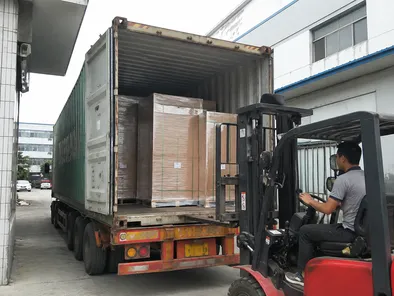
We've been loading fire door containers for export since the early years of the business. The numbers your freight team needs.
Format
KD (Knock-Down) Fire Doors
Standard Single Leaf
KD is the standard format for most export orders — it maximizes container utilization and eliminates alignment risk in transit.
Format
Pre-Hung Fire Door Assemblies
Door + Frame Assembled
Available for buyers whose end customers require ready-to-install product. Trade-off: roughly half the container loading efficiency vs. KD format.
Batch Traceability & Documentation
Every carton carries a barcode linked to our production batch record. If there's a quality question on arrival, you can trace the unit back to its production date, line, and inspection record.
Active Export Markets
Documentation Package
- Commercial invoice
- Packing list
- Bill of lading
- Certificate of origin
- NFPA 80 / CE test certificates
Lead Time
25–35 days
Standard catalog fire doors from deposit confirmation
Custom configurations are quoted individually.
Complete customs clearance documentation for all active markets
The documentation package is complete for customs clearance in all active markets. Contact us for a sample document set before placing your first order.
Frequently Asked Questions
Decision-support answers for importers, distributors, and project specifiers sourcing fire doors from China.
What fire resistance ratings do your fire doors carry, and which certification covers which market?
Our fire doors are available in FD30, FD60, FD90, and FD120 ratings. NFPA 80 certification covers the US market. CE certification (tested to EN 1634-1) covers Europe and EU-aligned markets including the Gulf. SGS third-party audit documentation is available for markets requiring independent verification. If your project specifies a particular listing body or local standard, contact us — we can advise on whether our existing certifications satisfy the requirement or whether additional testing is needed.
What is the difference between a fire door's integrity rating and its insulation rating?
Integrity (E) means the door prevents flame and hot gases from passing through for the rated period. Insulation (I) means the door also limits heat transfer to the unexposed face — typically required where people may be in contact with the door surface during evacuation. Most commercial fire doors are specified to integrity only (EI is less common and adds cost). If your project spec calls for EI-rated doors, confirm this before ordering — the core material and leaf thickness requirements are different.
What steel gauge should I specify for fire doors going into high-traffic commercial buildings?
1.2mm SPCC is the standard for most commercial applications — office buildings, hotels, retail. For high-abuse environments (schools, hospitals, industrial facilities), specify 1.5mm gauge with reinforced hinge pockets. The weight difference is meaningful for freight cost, so don't over-specify for low-abuse applications. We can advise based on your end-use environment.
How do I specify a fire door push bar (panic hardware) that maintains the fire rating?
The push bar (panic exit device) must be fire-rated and listed to the same standard as the door — a non-rated push bar on a fire door voids the door's certification. We supply fire-rated push bar hardware as part of the door package, tested and listed to EN 1125 (panic hardware) and compatible with our CE-certified fire door assemblies. For NFPA 80 markets, specify UL-listed panic hardware — we can source and integrate this on request.
What is your MOQ for fire doors, and can I mix ratings and configurations in one order?
Standard catalog fire doors: 50 units MOQ. Custom configurations: 100 units. You can mix ratings (FD30, FD60, FD90) and configurations (single leaf, double leaf, glass panel) within a single order as long as each line item meets the individual MOQ. For mixed orders below the per-SKU MOQ, contact us — we can often accommodate smaller quantities on existing production runs.
How do fire door frames with intumescent seals ship, and do they arrive pre-fitted?
Intumescent seals are factory-fitted into the door frame before shipment — the seal is recessed into a machined channel, not surface-applied. For KD shipments, the frame ships flat and the seal is protected by a foam sleeve. The seal does not need to be re-fitted on-site; it's ready to install as shipped. We include installation instructions with every shipment and can provide technical support for installers encountering fit issues.
What lead time should I plan for a 300-unit fire door order?
Standard catalog configurations: 25–35 days from deposit confirmation. A 300-unit order of standard FD60 steel fire doors falls within our normal production scheduling — no extended queue. Custom configurations (non-standard dimensions, special hardware, OEM branding) add 10–15 working days for engineering review and first-article approval. Contact us with your timeline and we'll confirm production availability before you commit.
Factory-Direct Fire Doors — Spec to Shipment
New to sourcing fire doors from China, or switching from a current supplier? The fastest path is to send us your target spec — door rating, dimensions, hardware requirements, and destination market. Our engineering team will review it and come back with a detailed quote, 3D rendering if custom work is involved, and the relevant certification documentation for your market.
If you're building a distribution catalog and aren't sure which SKUs to start with, tell us your target market and volume expectations. We see enough order patterns across our active markets to give you a useful read on what moves — FD60 steel fire doors are the volume SKU in most markets, but the mix shifts depending on whether you're serving contractors, developers, or facilities managers.

Explore Fire Door Product Lines