
[email protected] +86 152 3616 2255 Mon–Sat 8:00–18:00 (GMT+8)
Language
NFPA 80 + CE + SGS Certified · 18+ Years Manufacturing

Glass Fire Door | EUWOO

Certified glazed fire doors — fire-rated vision panels that maintain integrity ratings without sacrificing sightlines.

FD30 to FD120 ratings. CE and NFPA 80 certified. Custom panel sizes, positions, and configurations available from 50 units MOQ.

FD30–FD120 CE Certified NFPA 80 100% Pre-Shipment Inspection
EUWOO glass fire door with fire-rated vision panel — FD60 certified glazed steel door
FD30–FD120
Fire Rating Range
50 Units
Minimum Order
Product Overview

What a Glass Fire Door Is — and Where It Fits in the Fire Door Range

A glass fire door is a steel fire door with one or more fire-rated glazing panels integrated into the leaf. The steel body carries the structural and fire-resistance load; the glazing panel provides a sightline through the door while maintaining the door's certified integrity rating for the full rated period. That combination — visibility plus fire containment — is what separates this product from a standard steel fire door, and it's why architects and building code consultants specify it for corridors, lobbies, and stairwell access points where both fire compartmentation and visual openness are required.

Critical sourcing note: A glass fire door is not a standard steel fire door with a hole cut in it. The glazing unit must be fire-rated independently — tested to maintain integrity under the same thermal and pressure conditions as the door leaf itself.

The frame around the glazing panel, the intumescent seal at the glass perimeter, and the glass specification (typically borosilicate or ceramic glass, not standard float glass) are all part of the certified assembly. We manufacture the complete assembly — door leaf, glazing frame, fire-rated glass, and intumescent perimeter seal — as a single certified unit. Substituting components after the fact voids the certification.

Within our fire door range, the glass fire door occupies a specific niche: it's the product for openings where building codes require fire compartmentation but the design brief or occupant safety requirements also demand visibility. That rules out electrical rooms and plant rooms (no visibility needed, often no visibility wanted) and points squarely at office corridors, hotel lobbies, healthcare corridors, and commercial stairwells.

Get a Quote for Glass Fire Doors
Certified glass fire door assembly showing steel leaf, glazing frame, and intumescent seal components

Office Corridors

Fire compartmentation with maintained sightlines for occupant flow.

Hotel Lobbies

Design-forward fire separation without blocking visual openness.

Healthcare Corridors

Staff visibility requirements met alongside fire code compliance.

Commercial Stairwells

Egress visibility with certified fire integrity at stairwell access points.

Not the right product for:

Electrical Rooms Plant Rooms No-Visibility Required Openings

For those applications, see our electrical room fire door or standard steel fire door.

Engineering Detail

Fire-Rated Glazing: The Technical Core of This Product

The glazing panel is where most of the engineering complexity in a glass fire door lives — and where cheaper products cut corners in ways that don't show up until a fire event or a third-party inspection.

Glass Material by Fire Rating

Material selection is determined by thermal performance requirements at each rating tier.

FD30 / FD60

Borosilicate Fire-Rated Glass

Thermal expansion coefficient roughly one-third that of standard float glass. Survives thermal shock of a fire test without shattering.

FD90 / FD120

Ceramic Glass (Pyroceramic)

Near-zero thermal expansion coefficient. Service temperature above 700°C. Same material class used in fireplace viewing panels.

Why FD90 costs more than FD60: The material cost difference between borosilicate and ceramic glass is real and directly reflected in the price difference between FD60 and FD90 glazed doors.

Glazing Frame & Intumescent Seal

The frame and seal system is where assembly quality separates certified performance from field failure.

The glazing frame is a steel sub-frame welded into the door leaf, with an intumescent seal running the full perimeter of the glass panel. That seal expands under heat to fill the gap between glass and frame, maintaining integrity if the glass cracks or softens.

Our Method

Seal recessed into a machined channel in the frame — mechanically retained regardless of climate.

Common Shortcut

Surface-applied intumescent tape with adhesive. Delaminates in humid environments, fails to expand uniformly in fire events.

Cross-section detail of fire-rated glazing frame with recessed intumescent seal channel in steel sub-frame

Standard Vision Panel Sizes

Panel Size Type Availability
150 × 300 mm Small corridor light Catalog
Up to 600 × 900 mm Large vision panel Catalog
Full-lite Most of door leaf glazed FD30/FD60 Custom
Full-lite FD90/FD120 variant Uncommon — cost/weight

FD90 and FD120 full-lite configurations are technically possible but the glass cost and weight make them uncommon. Most buyers at those ratings specify a partial-lite panel.

Complete Certified Assembly — Not Components

We manufacture the complete assembly — door leaf, glazing frame, fire-rated glass, and intumescent perimeter seal — as a single certified unit. Substituting components after the fact voids the certification. This is the standard that separates a compliant product from a liability.

Door Leaf Glazing Frame Fire-Rated Glass Intumescent Perimeter Seal
Product Data

Technical Specifications

Standard values and ranges for our glass fire door range. Contact us for detailed product data sheets and custom configuration quotes.

Parameter Standard Value / Range
Fire Resistance Rating FD30 · FD60 · FD90 · FD120
Door Leaf Thickness 44mm (FD30/FD60) · 54mm (FD90) · 64mm (FD120)
Steel Body Gauge 1.2mm SPCC cold-rolled steel (standard) · 1.5mm available
Core Material Mineral wool board (FD30/FD60) · Perlite composite (FD90/FD120)
Door Width 700–1000mm single leaf (standard catalog) · custom widths available
Door Height 2000–2400mm (standard) · custom heights available
Vision Panel Glass Borosilicate fire-rated glass (FD30/FD60) · Ceramic glass (FD90/FD120)
Standard Panel Sizes 150×300mm · 200×400mm · 300×600mm · 400×700mm · 600×900mm
Panel Position Center · upper third · custom position on request
Glazing Frame Welded steel sub-frame with recessed intumescent perimeter seal
Frame Type Welded steel frame with intumescent seal · KD frame available
Surface Finish Powder coat (60+ colors, 60–80μm) · primer-only for site finishing
Hardware Stainless or zinc-alloy hinges · mortise lock · overhead closer (self-closing config)
Certifications NFPA 80 CE (EN 1634-1) ISO 9001:2015 SGS

Specifications shown are industry-standard values for this product type. Actual specifications may vary by configuration and rating. Contact us for detailed product data sheets and custom configuration quotes.

Glass fire door cross-section showing leaf thickness, core material, and glazing frame construction

Sourcing Note: 1.2mm vs 1.5mm Body Gauge

The 1.2mm SPCC body is our standard recommendation for glass fire doors going into office, hospitality, and healthcare corridors — it's the right balance of structural rigidity and freight weight.

The 1.5mm option is available if your buyers are specifying for higher-abuse environments, but the added weight increases shipping cost without meaningful benefit for most glazed door applications.

Request a Specification Sheet or Custom Quote
Market Intelligence

Where Glass Fire Doors Sell: Market Segments Worth Targeting

Decision-support context for distributors and project sourcing teams. Each segment below carries distinct volume patterns, buyer profiles, and specification drivers.

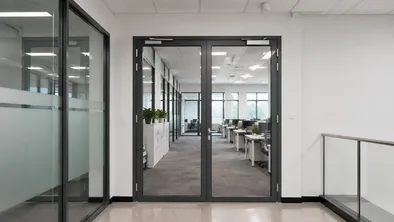
Glass fire door installed in modern office corridor with open sightlines

Office & Corporate Fit-Out

The primary volume segment for glazed fire doors. Modern office design favors open sightlines and natural light penetration — building owners and interior designers push back against solid steel fire doors in corridors and between zones.

Corporate fit-out contractors in North America, the Gulf, and Southeast Asia specify glazed fire doors at stairwell access points, server room corridors, and between open-plan zones and enclosed meeting areas.

Typical volume: 30–80 glazed fire door sets per 5,000–10,000 m² fit-out
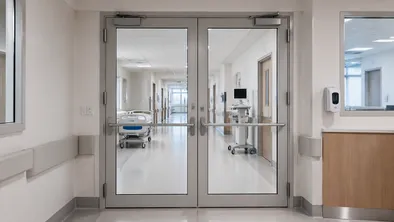
Glass fire door at hospital ward entrance enabling staff corridor visibility

Healthcare Facilities

Hospitals, clinics, and care homes are a high-value segment with specific requirements. Fire compartmentation is mandatory, but staff need visual access to corridors and patient areas for safety monitoring.

Glazed fire doors at ward entrances, corridor junctions, and stairwells are standard specification in healthcare construction. Procurement is centralized, and the buyer is typically a specialist healthcare contractor or facilities procurement team with repeat project flow.

Typical volume: 150–300 fire door sets per 200-bed hospital

Growing consistently in the Middle East and Southeast Asia as hospital construction accelerates.

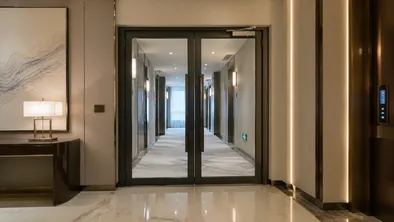
Glass fire door at hotel lobby-to-corridor transition with premium finish

Hospitality — Hotels & Serviced Apartments

Hotel brands increasingly specify glazed fire doors over solid steel for aesthetic reasons, and the fire code requirement means there's no option to substitute a non-rated product. Glazed doors appear at lobby-to-corridor transitions and stairwell access points.

Hotel chains building multiple properties in a region are a strong repeat-order segment.

Typical volume: 40–80 fire door sets per 150-room hotel
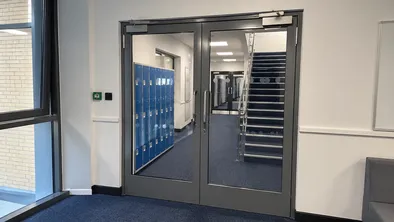
Glass fire door at school corridor junction providing supervision visibility

Educational Facilities

Schools, universities, and training centers require fire compartmentation at corridor junctions and stairwells. Glazed fire doors are increasingly specified for supervision visibility — a functional requirement that drives specification beyond pure compliance.

Education procurement in many markets runs on annual capital budgets, making it a predictable reorder segment for distributors with established relationships.

Typical volume: 60–120 sets per secondary school; larger for university campus projects
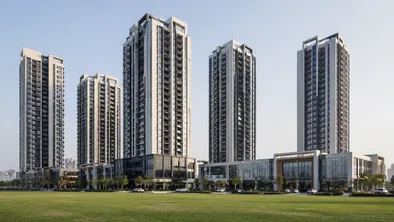
Multi-tower commercial real estate development requiring consistent fire door specification across buildings

Commercial Real Estate Developers

Developers building at scale in the Middle East, Southeast Asia, and Africa are sourcing fire doors factory-direct for multi-building projects. A developer building a 10-tower residential and commercial complex needs consistent product across all buildings and a single compliance documentation package.

Glazed fire doors appear in the common areas and commercial podium levels of these projects.

Typical volume: 50–200 sets per building depending on configuration

Serving Multiple Segments from One SKU Range

The same FD30–FD120 glass fire door range covers all five segments above. Distributors who establish relationships across office fit-out, healthcare, and hospitality can build consistent reorder volume from a single product line — without managing separate SKU families for each vertical.

OEM & Project Sourcing

Customization Options for OEM and Project Sourcing

Glass fire doors have more customization variables than standard steel fire doors, and getting the spec right before production starts matters — changes after first-article approval add lead time and cost. Here's what we can configure and where the limits are.

Vision Panel Size & Position

Any panel size within structural limits for the target rating. FD30 and FD60 allow larger panels (up to approximately 60% of leaf area for FD60); FD90 and FD120 have smaller maximum panel areas due to thermal load requirements. Panel position — center, upper third, lower third, or offset — is fully configurable. Multiple panels per leaf are possible on FD30 and FD60 configurations.

Full-Lite & Partial-Lite Configurations

Full-lite (floor-to-near-top glazing) is available for FD30 and FD60 on custom order. Popular for lobby and reception area applications where maximum visual openness is the design goal. Lead time for full-lite configurations is longer than standard partial-lite — the glazing frame fabrication is more complex and the glass unit is custom-cut.

Frame Profile & Finish

Standard frame profile is a flat steel sub-frame. Slim-profile frames (narrower sight-line border) are available for architectural applications where frame width is specified. Frame finish matches the door leaf — any RAL color from our 60+ color powder coat range, or primer-only for site painting.

Hardware Packages

Mortise lock with lever handle (standard), push bar (panic exit device, fire-rated), overhead closer (self-closing configuration), electromagnetic hold-open (automatic fire door configuration), and access control prep (conduit and strike box pre-installed). Hardware brand preferences can be accommodated on orders above 100 units.

OEM & Private Label

We manufacture glass fire doors under buyer brand identity — your label, your packaging, your documentation. The certification (NFPA 80, CE) remains on the product; the brand presentation is yours. MOQ for OEM programs is 100 units.

Non-Standard Dimensions

Heights above 2400mm and widths outside the standard catalog range are available on custom order. Structural review by our engineering team is required for non-standard dimensions to confirm the glazing panel size remains within the rating's tested parameters.

Standard Catalog
50 units
Standard catalog configurations. Standard panel sizes, catalog dimensions, standard hardware packages.
Custom & OEM
100 units
Custom panel sizes, non-standard dimensions, or OEM / private label programs with your brand identity.
Project Orders
300+ units
Dedicated production scheduling available to protect your delivery timeline on large project orders.
Send Us Your Spec — Free Design Consultation

Our engineers confirm feasibility and quote within 3 business days.

Manufacturing Process

How We Build Glass Fire Doors: Process Details That Affect Your Margin

The glazing frame integration is the step where production quality diverges most between manufacturers, and it's worth explaining what we do and why.

01

CNC-Cut Vision Panel Opening

After the door leaf is formed and welded, the vision panel opening is CNC-cut to the specified dimensions — tolerance on the opening is ±0.5mm. The steel sub-frame for the glazing is fabricated separately, with the intumescent seal channel machined into the inner perimeter before assembly.

02

Full-Penetration Weld-In Frame Construction

The sub-frame is welded into the door leaf opening with full-penetration welds at all four corners. We don't use mechanical fasteners (screws or rivets) to attach the glazing frame — weld-in construction is structurally superior and eliminates the risk of fastener loosening over the door's service life.

03

Zinc Phosphate Pre-Treatment Bath

After welding, the entire door — including the glazing frame — goes through our zinc phosphate pre-treatment bath before powder coating. This protects the weld heat-affected zones from corrosion. The glazing frame has more weld seams per unit area than the door body, so pre-treatment coverage matters more here.

04

Post-Coat Glass Installation

The fire-rated glass is installed into the frame after coating — not before — so there's no risk of coating overspray on the glass surface and no thermal stress on the glass from the cure oven. The intumescent perimeter seal is seated into its channel at this stage.

Glass fire door glazing frame weld-in integration process at EUWOO factory

5-Stage QC + 2 Glazing-Specific Checks

Every completed glass fire door goes through our standard 5-stage QC process, with two additional checks specific to glazed doors:

  • Glazing frame dimensional verification

    Confirming the glass-to-frame gap is within the certified tolerance.

  • Glass surface inspection under controlled lighting

    Checking for chips, scratches, or edge damage. A chipped glass edge on a fire-rated panel is a rejection — edge integrity affects how the glass performs under thermal stress in a fire event.

What This Means for Your Business

Doors arrive with intact glazing and consistent frame dimensions
No coating defects at the frame-to-leaf junction
Fewer damage claims and fewer installation complaints
A product your downstream customers can specify with confidence
Certification & Compliance

Certification and Compliance for Your Target Markets

Glass fire door assemblies carry the same certification stack as our steel fire door line, with one additional consideration: the glazing unit itself must be covered by the certification, not just the door leaf.

Our glass fire door assemblies are certified as complete units — door leaf, glazing frame, fire-rated glass, and intumescent seals. This matters because a certification that covers only the door leaf leaves the glazed assembly in a compliance grey zone. Every certification listed below applies to the full glazed assembly as shipped.

NFPA 80

US Market

Covers fire door assembly installation and labeling requirements. Our NFPA 80 certification applies to the complete glazed assembly, so the product is pre-qualified for US building code compliance without additional testing.

CE (EN 1634-1)

Europe & EU-aligned

Fire resistance test standard for door and shutter assemblies. CE marking covers our glazed fire door configurations for European, Gulf, and many Southeast Asian markets.

ISO 9001:2015

Quality System

Quality management system certification covering our full production process.

SGS

Third-Party Audit

Third-party audit and testing. SGS audit reports are available on request for buyers who need independent documentation for import compliance files.

Glass fire door certification documentation and compliance labels

Local Standards & Market-Specific Requirements

For markets with specific local standards — Australia's AS 1905.1, specific Gulf state requirements, or others — contact us with your target market. We'll advise on whether our existing certifications satisfy the local authority having jurisdiction or whether additional documentation is needed.

We've shipped glazed fire doors to enough markets to have a practical read on what's accepted where.

Request Certification Documentation
NFPA 80
US Market
CE
EN 1634-1
ISO
9001:2015
SGS
Third-Party Audit
Product Selection Guide

Glass Fire Door vs. Steel Fire Door: Choosing the Right Product for Your Buyer

The most common sourcing question we get on this product: "When should I stock glass fire doors versus standard steel fire doors?" The answer comes down to the end application and the design brief.

Standard steel fire doors are the volume SKU — they go into stairwells, plant rooms, electrical rooms, and any opening where fire compartmentation is required and visibility is not. Glass fire doors are specified when the design brief or occupant safety requirements demand sightlines through the fire-rated opening.

The price premium for glazed doors — driven by the fire-rated glass cost and the additional fabrication steps — is accepted by buyers in office, hospitality, and healthcare segments because there's no non-glazed alternative that meets both the fire code and the design requirement.

The Distribution Catalog Strategy

Stock FD60 steel fire doors as your volume SKU and FD60 glass fire doors as your margin SKU. The glazed version commands a higher selling price, has less price competition (fewer distributors stock it), and serves a buyer who is less price-sensitive because the specification is driven by design requirements rather than pure cost minimization.

Glass fire door versus steel fire door comparison for distributor selection

Steel Fire Door

Volume SKU
  • Stairwells, plant rooms, electrical rooms
  • Fire compartmentation required, visibility not
  • Industrial, warehouse, and utility applications
  • Price-sensitive buyers, cost-driven specification
View Steel Fire Door
Margin SKU

Glass Fire Door

Higher Margin
  • Office, hospitality, and healthcare construction
  • Design brief requires sightlines through fire-rated opening
  • Less price competition — fewer distributors stock it
  • Specification-driven buyers, less price-sensitive
Get a Quote

Not Sure Which Product Fits Your Buyers?

If your buyers are primarily serving industrial, warehouse, or utility applications, our steel fire door or industrial fire door is the right product. If they're serving office, hospitality, or healthcare construction, glass fire doors belong in your catalog.

Export Logistics

Packaging, Container Loading, and Export Logistics

Glass fire doors require more protective packaging than standard steel fire doors — the glazing panel is the vulnerability, and damage in transit is the most common complaint we hear from buyers who've sourced glazed fire doors from less careful suppliers.

Standard Export Packaging Spec

Glass Panel

Protected with foam corner guards and a full-surface foam sheet on both faces before the door is packed. The glass does not contact the steel frame during transit — foam spacers maintain a buffer.

Door Leaf

Packed in a reinforced carton with foam-lined interior. For pre-hung assemblies, foam-lined wooden crates with cross-bracing to prevent racking.

Hardware

Packed separately in a labeled inner carton within the main carton — no loose hardware rattling against the glass.

Frame (KD Shipments)

Shipped flat, wrapped in stretch film and foam edge protection.

Glass fire door export packaging with foam protection and reinforced carton

Batch Traceability

Every carton carries a barcode linked to our production batch record. If a glass panel arrives damaged, you can trace the unit back to its production date and inspection record immediately.

Proven Shipping Routes

We've shipped glazed fire doors to Los Angeles, Houston, Dubai, Singapore, Lagos, and Sydney without systematic glazing damage issues. The packaging spec is the reason.

Container Loading Figures

KD is the standard format for most export orders. The slightly larger CBM versus standard steel fire doors reflects the additional protective packaging around the glazing. Pre-hung assemblies are available for buyers whose customers require ready-to-install product.

Configuration Approx. CBM per Set 40HQ Loading
KD glass fire door (single leaf, standard size) 0.20–0.25 m³ ~140–160 sets
Pre-hung glass fire door assembly 0.40–0.50 m³ ~70–85 sets

Lead Time

25–35 days for standard catalog glass fire door configurations from deposit confirmation. Custom panel sizes or non-standard dimensions add 10–15 working days for engineering review and first-article approval.

Buyer FAQ

Frequently Asked Questions

Technical and sourcing questions we hear from importers, distributors, and project buyers — answered with the specifics that matter for your purchasing decision.

What type of glass is used in a fire-rated vision panel, and does it affect the fire rating?

Yes — the glass specification is part of the certified assembly and directly affects the achievable rating. We use borosilicate fire-rated glass for FD30 and FD60 configurations. Borosilicate has a low thermal expansion coefficient and survives the thermal shock of a fire test without shattering. For FD90 and FD120, we use ceramic glass (pyroceramic), which has near-zero thermal expansion and a service temperature above 700°C. Standard float glass cannot be used in a fire-rated vision panel — it shatters under thermal shock well before the rated period expires. If a supplier quotes you a glass fire door without specifying the glass type, ask before ordering.

Can the vision panel size be customized, and does a larger panel reduce the fire rating?

Panel size can be customized within the structural and thermal limits for each rating. Larger panels are achievable at FD30 and FD60; FD90 and FD120 have smaller maximum panel areas because the thermal load on the glass increases with panel size. We can confirm the maximum panel size for your target rating during the design consultation. A larger panel does not automatically reduce the rating — it depends on whether the panel size falls within the tested parameters for the certified assembly.

What is the difference between a glazed fire door and a fire-rated glass partition?

A glazed fire door is a door leaf with a fire-rated vision panel — it opens and closes, carries door hardware, and is installed in a door frame. A fire-rated glass partition is a fixed glazed wall element. They serve different functions and are tested to different standards. If your project spec calls for a fire-rated glass partition, that's a different product category. If it calls for a fire door with glazing, that's what we make.

Does the fire door certification cover the complete assembly including the glass?

Our NFPA 80 and CE certifications cover the complete glazed assembly — door leaf, glazing frame, fire-rated glass, intumescent seals, and hardware. The certification is not for the door leaf alone. This matters because some manufacturers certify the door body and source uncertified glass separately — the resulting assembly is not covered by the certification. Ask any supplier for the test report that covers the complete assembly, not just the door leaf.

What is your MOQ for glass fire doors, and can I mix panel sizes in one order?

Standard catalog configurations (catalog panel sizes and positions): 50 units MOQ. Custom panel sizes, non-standard dimensions, or OEM programs: 100 units. You can mix panel sizes and door dimensions within a single order as long as each line item meets the individual MOQ. For mixed orders below the per-SKU MOQ, contact us — we can often accommodate smaller quantities on existing production runs.

How do glass fire doors perform in humid or coastal environments?

The steel body and frame go through our zinc phosphate pre-treatment before powder coating — the same process we use across our fire door line, which passes a 500-hour salt spray test. The glazing frame has full pre-treatment coverage including all weld seams. The fire-rated glass itself is not affected by humidity. For coastal installations, specify our standard powder coat finish (60–80μm) — it's the right spec for high-humidity environments and eliminates finish warranty claims from your downstream customers.

Factory-Direct Sourcing

Start Sourcing Glass Fire Doors

The fastest path is to send us your target spec. Our engineering team will review it and come back with a detailed quote and 3D rendering — no charge for the design consultation.

Have a Spec Ready?

Send us your target spec and we'll come back with a detailed quote and 3D rendering at no charge. Include:

  • Fire rating (FD30, FD60, FD90, FD120)
  • Door dimensions (leaf width × height, frame depth)
  • Vision panel size and position
  • Hardware requirements
  • Destination market and applicable certification standard
Get a Quote for Glass Fire Doors

New to This Category?

Tell us your target market and the segments your buyers serve. We'll suggest the configurations that move in those markets and help you build a starter SKU mix based on what we're shipping to similar distributors in your region.

What we'll provide:

  • Regional SKU mix recommendations based on active distributor shipments
  • Configuration guidance matched to your buyer segments
  • No-charge design consultation and 3D rendering
Talk to Our Engineering Team

Explore More Fire Door Products