

Interior Fire Door Built for Internal Compartmentation
FD30 to FD120 ratings. 1.0–1.5mm SPCC steel body. NFPA 80, CE, and ISO 9001:2015 certified. Minimum 50 units, custom sizes and OEM programs available.

What Makes an Interior Fire Door Different from the Rest of the Line
An interior fire door is built specifically for internal wall openings — the compartmentation boundaries inside a building rather than its perimeter. That distinction shapes every design decision: the door doesn't need weather sealing or threshold drainage, but it does need to integrate cleanly with interior wall construction, maintain tight frame-to-leaf tolerances for smoke integrity, and carry a finish that holds up in occupied corridors and stairwells where it gets touched and cycled hundreds of times a day.
Where our exterior fire door is engineered around weather resistance and our industrial fire door is built for abuse-heavy environments, the interior fire door is optimized for the interior building envelope: consistent gap geometry, clean powder coat finish, and hardware configured for the access control and self-closing requirements that interior compartmentation codes typically mandate.
The core is mineral wool or vermiculite board — both are effective fire barriers, and we select between them based on the target rating and the buyer's weight preference. Vermiculite board runs slightly heavier but gives better acoustic performance as a secondary benefit, which matters in office and hospitality applications where buyers are selling into spec-conscious projects.
The result is a door that fits the way interior construction actually works — standard wall thicknesses, standard frame profiles, and a hardware package that a contractor can install without custom shimming or field modification.
Tight Frame-to-Leaf Tolerances
3–4mm perimeter gap maintained to fire rating requirement. Consistent gap geometry is critical for smoke integrity in interior compartmentation — not an afterthought.
Mineral Wool or Vermiculite Core
Core selection is based on target rating and buyer weight preference. Vermiculite board adds acoustic performance — a real secondary benefit for office and hospitality specs.
Interior-Grade Powder Coat Finish
60+ RAL colors, 60–80μm film thickness. Engineered for occupied corridors and stairwells — surfaces that get touched and cycled hundreds of times daily.
Contractor-Ready Hardware Package
Standard wall thicknesses, standard frame profiles. Hardware configured for access control and self-closing requirements — no custom shimming or field modification needed.

Interior Fire Door Specifications
Standard parameters for our interior fire door line. Exact values for your order depend on the rating and configuration selected — contact us to confirm specs for your specific requirement.
Standard Configuration Parameters
| Parameter | Standard Options |
|---|---|
| Fire Resistance Rating |
FD30 FD60 FD90 FD120
|
| Door Leaf Thickness | 44mm (FD30/FD60) · 54mm (FD60/FD90) · 64mm (FD90/FD120) |
| Steel Body Gauge | 1.0mm SPCC (FD30 standard) · 1.2mm SPCC (FD60 commercial) · 1.5mm SPCC (FD90/FD120) |
| Core Material | Mineral wool board · Vermiculite board · Perlite composite (FD90/FD120) |
| Standard Door Width | 700mm · 800mm · 900mm · 1000mm · 1200mm (single leaf) |
| Standard Door Height | 2000mm · 2100mm · 2200mm · 2400mm |
| Frame Type | Welded steel frame with intumescent seal · KD (knock-down) frame available |
| Frame Depth | 100mm · 120mm · 150mm (to match wall thickness) |
| Perimeter Gap | 3–4mm (maintained to fire rating requirement) |
| Intumescent Seal | Continuous perimeter, recessed channel-mounted, rated to door's fire class |
| Surface Finish | Powder coat, 60+ RAL colors, 60–80μm film thickness · Primer-only available |
| Hardware (standard) | Steel or stainless hinges · Mortise lock · Overhead door closer |
| Hardware (optional) | Push bar · Electromagnetic hold-open · Access control prep · Vision panel |
| Certifications |
NFPA 80 CE (EN 1634-1) ISO 9001:2015 SGS
|
Specifications shown are standard values for this product line. Actual specifications may vary by configuration. Contact us for a detailed data sheet on your specific requirement.
Rating vs. Leaf Thickness
Core Material Selection Guide
Lighter weight. Standard choice for FD30–FD90. Preferred where weight is a constraint on frame or wall loading.
Slightly heavier. Better acoustic performance — a real secondary benefit for office and hospitality specs where acoustic isolation is part of the project requirement.
FD90/FD120 only. Used where the highest sustained fire resistance is required and the rating demands a denser, more thermally stable core.

How We Build the Interior Fire Door: Process Details That Affect Your Order
The fire performance of an interior fire door comes down to three things: the core material, the intumescent seal, and the dimensional consistency of the frame-to-leaf fit. We've been building fire doors long enough to know where each of these fails in production — and what it costs a buyer when it does.
Core Filling and Leaf Construction
Door panels are CNC-formed from SPCC cold-rolled steel coil, then filled with mineral wool or vermiculite board cut to fit the internal cavity. The fill is continuous — no voids, no gaps at the corners.
We check fill density and coverage before the second face panel is welded on, because once the door is closed you can't inspect it without destructive testing.
The weld seam around the perimeter is ground flush before pre-treatment, which matters for both coating adhesion and the dimensional consistency of the door edge where the intumescent seal seats.
Intumescent Seal Installation
The seal is recessed into a machined channel in the door edge — not surface-applied with adhesive tape. Surface-applied seals are faster to install in production, but they delaminate in humid environments and can be knocked loose during handling and installation.
The recessed channel keeps the seal mechanically retained. We use a continuous perimeter seal rated to the door's fire resistance class, so there are no gaps at corners where integrity failures typically initiate.
Frame-to-Leaf Fit and Gap Control
Interior fire doors are rated to maintain a 3–4mm perimeter gap — tight enough for smoke integrity, wide enough that the door closes freely without binding. Our CNC forming holds panel and frame dimensions to ±0.5mm tolerance.
Every door is test-fitted with its frame before packing. We run robotic MIG welding on the standard production lines, which eliminates the dimensional drift you get on long manual welding runs — your 200th door off the line is the same as your first.
Competitor comparison: We've seen competitor product arrive with 6–8mm gaps on one side and 1mm on the other. That's a manual welding tolerance problem, and it fails smoke integrity testing.
Powder Coat on Interior Doors
Interior doors get the same automated electrostatic powder line as the rest of our range — 60–80μm film thickness, zinc phosphate pre-treatment, convection cure.
For interior applications, the 500-hour salt spray result is more than you need, but it means zero finish warranty claims from your downstream customers regardless of the installation environment.

Market Segments: Where Interior Fire Doors Generate Consistent Volume
Interior fire doors are a code-mandated product in virtually every commercial building type — they're not a discretionary specification. That makes the demand base predictable and the buyer less price-sensitive than on general commercial doors.
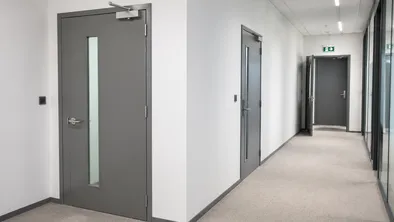
Commercial Office and Mixed-Use
Every stairwell access door, plant room door, and compartmentation wall opening in a commercial office building requires a rated interior fire door. A mid-size office tower — 10 to 20 floors — typically specifies 150 to 400 interior fire door sets, with FD60 as the dominant rating for stairwells and FD30 for corridor compartmentation.
Contractors sourcing direct from a manufacturer rather than through a local distributor protect 15–25% margin on that volume, and the repeat pattern is strong.
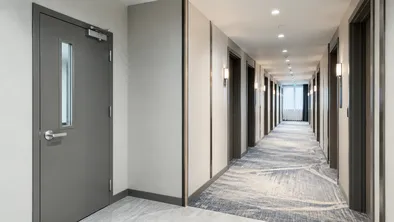
Hospitality and Hotel Development
Hotel projects in the Middle East, Southeast Asia, and Africa are building at scale, and fire door compliance is enforced at certificate of occupancy. A 200-room hotel typically requires 80–150 interior fire door sets for corridor compartmentation, stairwells, and back-of-house areas.
Hospitality buyers are more finish-conscious — they want specific RAL colors to match interior design schemes, and they often want a vision panel option for corridor doors. Our 60+ color range and optional glazing configurations serve this segment without custom tooling.

Healthcare and Education Facilities
Hospitals and schools are among the most heavily fire-door-specified building types — compartmentation requirements are strict, and the doors cycle constantly. A mid-size hospital can require 300–600 interior fire door sets across wards, stairwells, and service corridors.
These buyers specify 1.2mm gauge as a minimum for high-traffic areas, and often require specific hardware configurations. Our NFPA 80 and CE certifications satisfy procurement documentation requirements for institutional buyers in most markets.
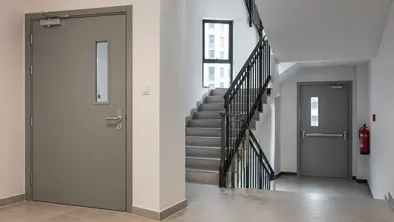
Residential Apartment and Condominium
High-rise residential construction in Southeast Asia and the Middle East requires interior fire doors at stairwells, service corridors, and between residential and commercial occupancies.
Developers sourcing for multi-building projects want consistent product across all buildings and a single compliance documentation package. FD30 and FD60 are the standard ratings; the volume per project is high and the specification is relatively standardized, making this a good fit for a stocking distributor with a defined SKU set.
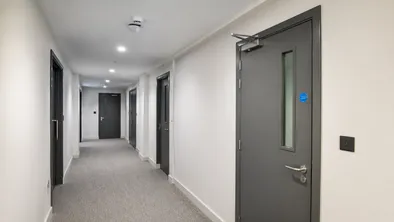
Facilities Management and Retrofit
Existing buildings undergoing fire safety upgrades or change-of-use conversions need interior fire door replacement at scale. This segment values fast lead times and the ability to match existing frame dimensions.
Our custom sizing capability and 25–35 day lead time on standard orders serve it well. Retrofit buyers often need to match a specific frame depth or door width that falls outside standard catalog dimensions; our 15-engineer R&D team handles non-standard sizing without extended lead time on most configurations.
Tell us your target market and volume — we'll recommend the right SKU mix for your catalog and compliance documentation requirements.
Request a QuoteCustomization: What You Can Specify, What Affects MOQ
Interior fire doors are one of the more customizable products in our line — the interior application means buyers frequently need specific dimensions, finishes, or hardware configurations to match a project spec or a private-label catalog. Here's what's available and where the constraints are.
Dimensions
Standard widths run 700–1200mm single leaf; standard heights run 2000–2400mm. Non-standard dimensions — wider openings, taller doors for high-ceiling spaces, or reduced-width doors for narrow corridors — are available from 100 units.
Most non-standard sizing doesn't require new tooling; it's a CNC program adjustment. Lead time impact is typically 5–7 working days for engineering review on the first order of a new size.
Fire Rating
FD30, FD60, FD90, and FD120 are all available. Rating selection affects leaf thickness, core material, and steel gauge — these are fixed by the certification requirement, not adjustable.
If you need a specific rating for a market that uses a different rating nomenclature (e.g., EI60 under EN 13501-2 rather than FD60), contact us — the underlying product is the same, and we can advise on the certification documentation that applies.
Surface Finish
Any RAL color is available from our powder line at standard MOQ. Primer-only finish (for site painting or cladding) is available on request.
Stainless steel cladding on the face panel is available for specific applications — typically healthcare or food service environments where hygiene cleaning is a factor.
Hardware Packages
Standard hardware is steel or stainless hinges, mortise lock, and overhead closer. Hardware packages are specified at order — we don't retrofit hardware after production.
Vision Panel
Fire-rated glazing is available on FD30 and FD60 configurations. Panel size and position are configurable within the structural limits of the door leaf.
FD90 and FD120 vision panels are available but require a larger glazing unit and affect the door weight — confirm with us before specifying.
OEM / Private Label
We run OEM programs for distributors and overseas manufacturers building their own door brands. Custom labeling, packaging with your brand identity, and documentation under your brand name are all available.
MOQ for OEM programs is 100 units per SKU. Free design consultation and 3D rendering before you commit.
Compliance and Certification for Your Market
Interior fire doors are a compliance-driven purchase — your downstream customer, the building inspector, or the project specification will name a standard, and the door either meets it or it doesn't. Here's what our certifications cover.
NFPA 80
North AmericaThe US standard for fire door assemblies, covering installation, labeling, and performance requirements. Our NFPA 80 certification covers the door assembly including frame and hardware.
For buyers supplying the North American market, this is the primary compliance requirement. SGS audit reports are available on request for buyers who need third-party documentation for their import compliance files.
CE (EN 1634-1)
Europe & EU-alignedEuropean conformity, tested to the EN 1634-1 fire resistance standard. Covers Europe and EU-aligned markets including the Gulf states and parts of Southeast Asia.
CE marking applies to both the door leaf and the frame assembly.
ISO 9001:2015
Global QMSQuality management system certification covering our full production process.
This is the documentation that institutional buyers — hospitals, government projects, large developers — typically require as a baseline supplier qualification.
SGS
Third-Party AuditThird-party audit and testing by SGS, one of the most widely recognized inspection bodies globally.
SGS documentation is accepted as equivalent certification in markets where NFPA 80 and CE are not the primary standard — including parts of Africa, Southeast Asia, and Australia.
Market-Specific Standards
For markets with specific local standards, contact us before specifying. We can advise on whether our existing certifications satisfy the requirement or whether additional testing documentation is needed.
We don't claim certifications we don't hold. If there's a gap, we'll tell you directly.

Certification Documents Available
- NFPA 80 assembly certification with SGS audit report
- CE Declaration of Performance (EN 1634-1)
- ISO 9001:2015 certificate (full scope)
- SGS third-party test reports on request
Installation Fit: What Your Contractors Need to Know
Installation errors are the most common cause of field failures — not manufacturing defects. Providing your buyers with the right installation information reduces warranty claims and callbacks, protecting your margin on repeat business.
Frame Rough Opening
Standard frame profiles require a rough opening 20–30mm wider and taller than the door leaf size to allow for frame installation and shimming. Confirm frame dimensions from the product data sheet with your contractor before the opening is framed.
Frame Depth and Wall Thickness
Frame depth must match the wall construction. We supply frames in 100mm, 120mm, and 150mm depths as standard, with custom depths available. A frame that doesn't match the wall thickness creates a reveal gap that affects both aesthetics and the intumescent seal geometry.
Gap Consistency
The 3–4mm perimeter gap is a fire rating requirement, not a preference. Contractors who shim the frame unevenly to compensate for an out-of-square opening can create gaps outside this range. Our installation instructions include a gap check procedure — include these with your product when distributing to contractors.
Closer Adjustment
The overhead closer must be adjusted so the door closes and latches fully from any open position, including 90°. Incorrect closer adjustment is the most common cause of fire door inspection failures in occupied buildings. We include a torque specification sheet and closer adjustment guide in every shipment.
Hardware Torque Specifications
Hinge screws and lock strike plate screws must be torqued to specification. Under-torqued hardware works loose under cycling and creates alignment drift over time. Torque specs are included in the installation package shipped with every order.

Installation Package Included With Every Shipment
- Gap check procedure for perimeter 3–4mm compliance
- Closer torque specification sheet and adjustment guide
- Hinge and strike plate torque specifications
- Frame depth selection guide for wall construction matching
Distribute installation instructions to contractors with every product delivery to reduce inspection failures and warranty callbacks.
Frame depth options: 100mm · 120mm · 150mm standard. Custom depths available on request — specify wall construction at order stage to confirm frame selection before production.
Packaging, Container Loading, and Landed Cost Planning
A 40HQ container of interior fire doors in KD format holds approximately 160–200 sets depending on door size and configuration — that's the number your freight team needs for landed cost calculations.
KD Format
Knock-Down — Standard for Export
Door leaf, frame, and hardware packed separately in reinforced cartons. Foam corner protection on frame sections. Hardware packed separately, labeled by door set.
Why KD: Maximizes container utilization and eliminates alignment risk in transit. Most experienced importers use KD and have contractors fit hardware on-site.
Pre-Hung Assemblies
Door + Frame Assembled
Foam-lined wooden crate, cross-braced frame, corner guards. Available for buyers whose end customers require ready-to-install product.
When to use: End customers who require ready-to-install product. Pre-hung roughly halves container efficiency — factor this into landed cost calculations.
Batch Traceability
Every carton carries a barcode linked to our production batch record. If there's a quality question on arrival, you can trace the unit back to its production date, line, and inspection record.
Complete Documentation
Commercial invoice, packing list, bill of lading, CO, and NFPA 80 / CE test certificates — complete for customs clearance in all active markets.
Lead Times
25–35 days for standard catalog interior fire doors from deposit confirmation. Custom configurations add 10–15 working days for engineering review and first-article approval.
Container Loading Summary
Use these figures for freight planning and landed cost calculations. CBM ranges are size-dependent — confirm exact figures with your product data sheet for the specific door leaf dimensions ordered.

Frequently Asked Questions
What is the difference between an interior fire door and an exterior fire door?
An interior fire door is designed for internal wall openings — compartmentation boundaries inside a building. It doesn't require weather sealing, threshold drainage, or the heavier-gauge steel that exterior applications demand for corrosion resistance. The fire performance requirements are the same (FD30 to FD120 ratings), but the construction is optimized for interior installation: standard frame depths matched to interior wall thicknesses, finish options suited to occupied interior spaces, and hardware configured for interior access control and self-closing requirements. If your application is a building perimeter opening or an exit route to the outside, see our exterior fire door.
What fire rating do I need for interior compartmentation in a commercial building?
FD30 covers most interior corridor compartmentation in low-rise commercial buildings. FD60 is required for stairwells in mid-rise buildings, plant rooms, and openings in walls separating different occupancies — this is the volume rating for most commercial construction projects. FD90 and FD120 are specified for high-risk compartments: electrical rooms, server rooms, storage areas with flammable materials.
If you're unsure which rating applies to your project or market, send us the building type, occupancy, and destination country — we'll advise based on the applicable code.
Can interior fire doors be supplied with a vision panel without affecting the fire rating?
Yes, on FD30 and FD60 configurations. Fire-rated glazing panels are available in various sizes and positions within the door leaf. The glazing unit is tested as part of the door assembly — the rating applies to the complete door including the glass. FD90 and FD120 vision panels are available but require a larger glazing unit and affect door weight; confirm the configuration with us before specifying. Vision panels are not available on all leaf sizes — minimum leaf width for a standard vision panel is 800mm.
What is the standard lead time for interior fire doors, and can you handle urgent project timelines?
Standard catalog interior fire doors ship in 25–35 days from deposit confirmation. A 200-unit order of standard FD60 interior fire doors falls within normal production scheduling — no extended queue. For urgent project timelines, contact us with your required delivery date before placing the order; we can advise on current line loading and whether expedited scheduling is possible. Custom configurations (non-standard dimensions, special hardware, OEM branding) add 10–15 working days for engineering review and first-article approval.
What is the MOQ for interior fire doors, and can I mix ratings in one order?
Standard catalog configurations: 50 units MOQ. Custom dimensions or OEM programs: 100 units. You can mix ratings (FD30, FD60, FD90) and hardware configurations within a single order as long as each line item meets the individual MOQ. For mixed orders where some line items fall below MOQ, contact us — we can often accommodate smaller quantities on existing production runs.
Do your interior fire doors comply with NFPA 80 for the US market?
Yes. Our fire door assemblies — door leaf, frame, and hardware — are certified to NFPA 80. For US market supply, the door must carry a label from a listed certification body; our NFPA 80 certification covers this requirement. SGS audit reports are available on request for buyers who need third-party documentation for their import compliance files. If your project specifies a particular listing body (UL, Intertek, etc.) beyond our current certifications, contact us to discuss.
What internal fire door hardware configurations are available for access control integration?
We can pre-install conduit runs and strike box prep for electric strike or magnetic lock integration during production — this is cleaner than field-drilling and eliminates the risk of compromising the door's fire rating with post-production modifications. Specify access control prep at order.
For electromagnetic hold-open (door held open during normal use, released by fire alarm signal), we supply EN 1155-compliant hold-open devices integrated with the overhead closer. If you have a specific access control brand or system requirement, send us the hardware spec and we'll confirm compatibility before production.
Other Fire Door Products in the EUWOO Line
Interior compartmentation is one application — if your project or catalog requires other configurations, these are the closest alternatives.
Steel Fire Door
The broadest-spec product in the line, covering commercial and industrial applications with the full rating range. If you need a general-purpose fire door without the interior-specific optimization, start here.
View ProductOffice Fire Door
Interior fire door with a stronger emphasis on aesthetic finish options and vision panel configurations, suited for corporate interior fit-out projects.
View ProductSelf Closing Fire Door
If your project spec mandates self-closing hardware as a code requirement — common in stairwells and high-traffic corridors — this variant is pre-configured with EN 1154-compliant overhead closers.
View ProductDouble Leaf Fire Door
For wide interior openings requiring a double-leaf assembly with coordinated leaf sequencing hardware.
View ProductGlass Fire Door
If visibility through the door is a design or safety requirement, the glass fire door carries fire-rated glazing as the primary feature rather than an option.
View ProductView Full Fire Door Line
Browse all fire door configurations — single leaf, double leaf, glass, self-closing, industrial, and more — in one place.
Browse AllGet a Quote for Interior Fire Doors
Send us your requirement — door rating, dimensions, hardware configuration, destination market, and target volume. Our engineering team will review it and come back with a detailed quote and, for custom configurations, a 3D rendering. No charge for the design consultation.
If you're building a distribution catalog and aren't sure which interior fire door SKUs to lead with, tell us your target market. We see enough order patterns across our active markets to give you a useful read on what moves — FD60 at 900mm × 2100mm is the volume SKU in most commercial construction markets, but the mix shifts depending on whether you're serving contractors, developers, or facilities managers.
Contact Our Sales Team
What to include in your inquiry for the fastest turnaround:
- Fire rating required (FD30, FD60, FD90, FD120)
- Door dimensions (width × height in mm)
- Hardware configuration preferences
- Destination market and applicable standards
- Target volume / order quantity