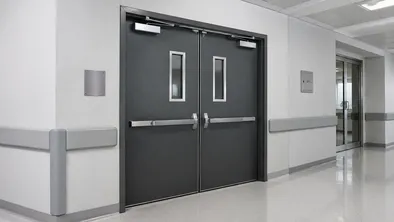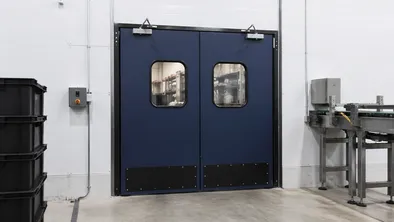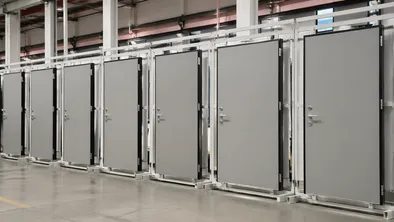

Certified fire-rated steel doors for commercial and industrial applications.
Heavy-duty security doors with multi-point locking systems.
Durable commercial door solutions for offices, retail, and warehouses.
General-purpose steel doors for industrial and institutional use.
Custom Door Solutions
15+ engineers for custom specs, private-label programs, and project support.
Start a Project →Not just heavier steel — engineered resistance at the lock, frame, and hinge. Multi-point locking, anti-pry frame reinforcement, and anti-drill hardware prep, factory-direct from EUWOO.
100% pre-shipment inspection · MOQ from 50 units · NFPA 80 · CE · SGS

Most commercial doors keep people out through inconvenience. A security commercial door keeps people out through engineered resistance — and the difference shows up in your downstream warranty claims, your project approval process, and your ability to sell into regulated market segments.
The security rating on a commercial door is determined by three independent systems working together: the door body's resistance to forced entry (gauge, internal reinforcement, and panel stiffness), the frame's resistance to pry attack (steel thickness, anchor point spacing, and corner construction), and the lock system's resistance to picking, drilling, and cylinder extraction. A door that upgrades only one of these — say, heavier body steel with a standard mortise lock — doesn't actually improve the security rating in any meaningful way.
We see this mistake in competitor products regularly, and it's the first thing an experienced specifier will catch.
Our security commercial doors are engineered as a complete assembly. The 1.5mm SPCC cold-rolled steel body, the 2.0mm reinforced frame with welded anchor plates, and the multi-point locking prep are specified together — because that's how security ratings are tested and how building inspectors evaluate compliance.
When your buyer submits this door for project approval, the documentation package covers the assembly, not just the leaf.
We've had buyers come to us after sourcing "security doors" from suppliers who were essentially selling standard commercial doors with a deadbolt upgrade. The frame steel was 1.0mm, the hinges were standard 3-bearing, and the lock prep was single-point. That's not a security door — it's a liability.
Standard parameters for our security commercial door line. Custom configurations — heavier gauge, wider openings, specific lock prep — are available; see the customization section below.
| Parameter | Standard Specification |
|---|---|
| Door leaf body gauge | 1.5mm SPCC cold-rolled steel |
| Door frame gauge | 2.0mm cold-rolled steel, welded construction |
| Door thickness | 50mm (standard); 60mm available |
| Standard leaf sizes | W800–1000mm × H2000–2200mm (single leaf) |
| Double leaf | W1400–2000mm available |
| Internal reinforcement | Full-perimeter steel channel, lock block reinforcement at latch and deadbolt zones |
| Core fill | Mineral wool (standard) — acoustic + thermal; polyurethane foam available |
| Hinge specification | 4-bearing heavy-duty hinges, 3 per leaf minimum; continuous hinge prep available |
| Lock prep | Multi-point locking (3-point standard: latch + 2 deadbolts); 5-point available |
| Lock cylinder | Anti-drill, anti-pick cylinder prep; specific cylinder brands available on request |
| Anti-pry reinforcement | 3mm steel anti-pry plates at lock zone and frame rebate |
| Surface finish | Powder coat, 60–80μm, 60+ color options; 500-hour salt spray standard |
| Hardware standards | ANSI, EN, AS/NZS prep available |
| Certifications |
ISO 9001:2015 CE SGS
|
| MOQ | 50 units (standard); 100 units (custom configurations) |
Specifications shown are standard values for this product line. Contact us for exact data sheets and custom configuration options.

Get exact data sheets, custom configuration options, and pricing for your order volume.
Request Spec Sheet / QuoteThe body steel gets the most attention in spec sheets, but the lock zone and frame construction are where forced-entry resistance is actually determined. Here is how we engineer these components — and where our product differs from what most buyers encounter at this price point.
The lock block is a solid steel insert — 6mm plate — welded into the door body at the latch and deadbolt positions. This is the component that absorbs the shear force when someone tries to kick a door open. On a standard commercial door, the lock prep is just a cutout in the door skin with a thin backing plate. Under kick-force, that backing plate deforms and the lock pulls through. Our welded lock block doesn't deform — the force transfers to the door body and frame instead, which is where the multi-point locking system distributes it across three engagement points.
The frame is where most security door assemblies fail in the field, and it's the component buyers most often underspecify. We run our security door frames at 2.0mm cold-rolled steel with welded corner gussets — not mechanically fastened corners, which can rack under lateral load. The frame anchor plates are 3mm steel, pre-drilled for masonry anchors at 300mm spacing. When this frame is installed correctly, the anchor pattern distributes forced-entry load across the wall structure rather than concentrating it at two or three points. We include an installation anchor pattern drawing with every order, because a correctly specified door installed in an undersized frame opening with inadequate anchoring is still a security failure.
The anti-pry rebate is a 3mm steel plate that runs the full height of the lock stile on both the door and frame. The overlap between door and frame at this point is 15mm minimum — enough that a standard pry bar can't get purchase without deforming both the door and frame simultaneously, which requires significantly more force and time than a standard commercial door. Most forced entries on commercial doors happen in under 60 seconds using a pry bar at the lock stile. The anti-pry rebate design is specifically engineered to push that time past the threshold where most opportunistic intrusions are abandoned.

A correctly specified door installed in an undersized frame opening with inadequate anchoring is still a security failure. Every order includes an installation anchor pattern drawing. Frame anchor plates are 3mm steel, pre-drilled for masonry anchors at 300mm spacing.
Security is a project specification requirement in several commercial segments that order in predictable volume — which matters for how you build your product line and inventory strategy.
Courthouses, administrative offices, police stations, and public service buildings specify security-rated doors as a baseline requirement, not an upgrade. Procurement cycles are annual or tied to capital improvement budgets, and approved vendor lists are sticky — once you're on the list with a compliant product, reorder volume is consistent. Our CE and SGS certifications, combined with the documentation package we provide, are what gets your product through the approval process in most markets.
Bank branches, currency processing facilities, server rooms, and data center access points require security-rated doors at perimeter and internal access control points. A mid-size bank branch fit-out typically specifies 8–15 security doors across vault, server room, and staff-only zones. Data center builds run higher — 20–50 doors per facility depending on the security zone architecture. These projects are specification-driven and repeat on a 7–10 year renovation cycle.
Pharmacy storage, controlled substance rooms, and medical records areas in hospitals and clinics require access-controlled, security-rated doors under regulatory frameworks in most markets. A regional hospital system can represent 50–200 security door units across multiple facilities. The regulatory requirement creates a non-negotiable demand floor — these doors get specified regardless of budget pressure.
Bonded warehouses, cash-in-transit facilities, jewelry and electronics distribution centers. Security door requirements here are driven by insurance underwriting standards — the insurer specifies the minimum door rating as a condition of coverage. This creates a direct commercial incentive for the building operator that doesn't depend on their own security judgment. Orders in this segment tend to be 20–80 units per facility, with repeat orders as facilities expand.
Holding facilities, immigration processing centers, and secure institutional buildings. This is a specialized segment with demanding specs — typically requiring doors rated to specific forced-entry resistance standards (EN 1627 RC3 or equivalent). We can manufacture to these standards; if you're building a product line for this segment, contact us to discuss the specific configuration.
Security commercial doors have more customization variables than standard commercial doors, and the interactions between those variables affect both the security rating and the production economics. Here's how we handle the main customization dimensions.
Standard body is 1.5mm; we can go to 2.0mm body steel for applications requiring higher forced-entry resistance (EN 1627 RC3 and above). Frame upgrades to 2.5mm are available on the same basis.
No MOQ change — affects lead time only. Heavier stock requires scheduling against coil inventory.
Standard is 3-point multi-point locking (top, middle, bottom engagement). 5-point is available, adding two additional horizontal bolt engagement points. We can also prep for specific lock brands — Abloy, ASSA Abloy, Mul-T-Lock, and others.
Specify brand and model at RFQ stage. We'll confirm compatibility before production.
Laminated security glass panels (6.38mm minimum, tempered-laminated) in standard sizes: 150×300mm and 200×400mm. Vision panels reduce the door body's forced-entry resistance rating — we reinforce the panel frame with a steel surround and specify laminated rather than standard tempered glass.
Laminated glass holds together under impact rather than shattering — matters for both security rating and liability.
Electrified strike prep, magnetic lock mounting plates, card reader conduit routing, and electric hinge prep are all available. Most new commercial security door installations include electronic access control — this is increasingly standard in the segments above.
Send us the access control hardware spec and we'll prep accordingly.
Full 60+ color range available at standard MOQ. Custom RAL or proprietary brand colors on runs of 100+ units. For government and institutional markets, RAL 7016 (anthracite grey) and RAL 9005 (jet black) are the most common specifications — we stock both as standard colors.
Standard colors: 50-unit MOQ. Custom RAL / proprietary brand colors: 100-unit MOQ.
Non-standard opening sizes are handled on our press brake without dedicated tooling on runs of 100 units or more. Oversized single-leaf doors (up to W1200mm × H2400mm) and double-leaf configurations (up to W2000mm total) are within our standard production capability.
Non-standard sizes: 100-unit MOQ minimum.

If you're evaluating this product for a specific project and the volume is below MOQ, contact us anyway — we sometimes have production runs we can attach small quantities to, depending on timing.
Send Us Your Configuration RequirementsSecurity commercial doors are heavier than standard commercial doors — a 50mm door with 1.5mm body steel and mineral wool core runs approximately 55–70kg per leaf depending on size. That weight affects container loading density and your freight cost calculation.

Use the conservative planning numbers for landed cost modeling. Exact CBM calculations provided with your quote. Pre-hung assemblies take more cubic volume — the assembled frame is the limiting factor.
Each door ships in a reinforced corrugated carton with foam corner protection on the frame and a stretch-wrap outer layer. The lock zone and hinge areas get additional foam padding — these are the surfaces most likely to take impact during port handling, and a dented lock block means a door that won't pass installation inspection.
For markets with rough port handling, we add a wooden pallet base and additional corner reinforcement at no extra charge. We've shipped enough containers to West Africa and Southeast Asian ports to know where the damage risk is.
Every carton carries a barcode linked to our production batch record. If there's a quality question on arrival, you can trace the unit back to its production date, line, and inspection record within minutes — useful when you're dealing with a project contractor who needs documentation for a building inspection.
Use 180 KD sets per 40HQ as your conservative planning number. We'll provide exact CBM calculations with your quote — door size variation affects actual loading density, and we calculate per-order rather than using a single average.
Our security commercial doors ship with the following certification coverage. Documentation packages are available within 24 hours of request.
Quality management system certification covering the full production process. Applicable to all security door configurations.
European conformity for structural performance. Applicable for EU markets and markets that accept CE as a compliance reference.
Third-party audit and testing. SGS reports available on request for buyers who need independent verification for import compliance files.
US fire door assembly standard. Applicable on security doors specified with fire-rated core — mineral wool fill and intumescent seals.
Our NFPA 80 certification covers the assembly standard for buyers supplying into North American projects. For projects requiring UL listing on specific fire-rated security door configurations, contact us for current listing documentation.
For projects requiring EN 1627 forced-entry resistance classification, we manufacture to RC2 and RC3 specifications. Contact us to confirm the exact configuration and documentation package for your target classification.
SGS audit reports and test certificates are available on request. Most of our distributor partners in North America and Australia include these in their import compliance files as a matter of course. We keep the documentation current and can turn around a certificate package within 24 hours of request.
Security commercial doors sit within a broader commercial door range. Depending on your project requirements, these sibling products may be relevant.
Reinforced frame and panel construction for high-traffic and high-abuse environments. If your requirement is durability under heavy use rather than forced-entry resistance, this is the right product.
View Heavy Duty Doors
Heavy-gauge construction for manufacturing and processing facilities. Suited for environments where impact resistance from equipment is the primary concern.
View Industrial Doors
Standard commercial door line. If your project doesn't require a security rating and cost efficiency is the priority, this is the workhorse of our range.
View Steel DoorsFor projects that require both security rating and fire rating in the same door assembly, contact us. We manufacture combined security/fire-rated assemblies with mineral wool core, intumescent seals, and multi-point locking. This is a common requirement in government and healthcare projects and we have the configuration documented.
A heavy-duty commercial door is engineered for durability under high-cycle use — thicker steel, reinforced hinges, abuse-resistant frame construction. A security commercial door is engineered for forced-entry resistance — the design priorities are different. Security doors specify multi-point locking, anti-pry frame rebates, anti-drill cylinder prep, and lock block reinforcement at the latch zone. A heavy-duty door can withstand 500,000 open-close cycles; a security door is designed to resist a pry bar attack at the lock stile. For applications where both are required (a high-traffic secure access point), we can combine the specifications — contact us to discuss.
The most widely referenced standard is EN 1627, which classifies doors from RC1 (basic resistance) to RC6 (high-security). For most commercial applications — office buildings, retail back-of-house, healthcare storage — RC2 is the appropriate specification. RC3 is required for applications with higher risk profiles: government facilities, financial services, pharmaceutical storage. RC4 and above are specialist applications (embassies, high-security government) that require a different product category. Our standard security commercial door line covers RC2; RC3 configurations are available on request with upgraded body gauge and lock specification.
Yes — electrified strike prep, magnetic lock mounting plates, card reader conduit routing, and electric hinge prep are all standard customization options. Specify the access control hardware brand and model at the RFQ stage and we'll confirm compatibility and prep accordingly. Most new commercial security door installations in the segments we supply include electronic access control as a baseline requirement, so we've prepped for most major systems (Lenel, Genetec, HID, Allegion, and others).
MOQ is 50 units for standard catalog configurations and 100 units for custom specs (non-standard dimensions, custom lock prep, access control prep, vision panels). The process: send us your project specs or drawings, our R&D team reviews and returns a production-ready spec with 3D rendering within 3 business days, we align on specs and pricing, then produce a pre-production sample for your approval before committing the full run. Lead time from confirmed order to shipment is 30–40 days for standard configurations and 40–50 days for custom specs, depending on current line loading.
Combined security/fire-rated assemblies are available. The configuration uses mineral wool core fill (for fire resistance), intumescent seals at the door perimeter (which expand under heat to seal the gap between door and frame), and multi-point locking hardware rated for fire door use. The fire rating and security rating are tested independently — the door must pass both the fire resistance test (EN 1634 or NFPA 252) and the forced-entry resistance test (EN 1627). We manufacture combined assemblies to FD60/RC2 and FD60/RC3 specifications; FD90 combined assemblies are available on request. Contact us with your project's specific requirements and we'll confirm the configuration and certification documentation.
Security commercial doors are a specification-driven product — the right configuration depends on your target market's regulatory requirements, the access control system your downstream customers are running, and the forced-entry resistance rating the project calls for. The most useful first step is usually a technical consultation rather than a generic quote request.
Send us your project specs, your target market, and the security rating requirement — our engineering team will recommend the exact configuration, confirm the certification documentation package, and send back a detailed quote with CAD drawings. If you're building a product line for a new market segment, tell us the segment and we'll suggest a starter SKU mix based on what's moving for our existing distributors in that region.