
[email protected] +86 152 3616 2255 Mon–Sat 8:00–18:00 (GMT+8)
Language
Sliding Commercial Doors

Space-Efficient Sliding Commercial Doors Direct From Factory

Top-hung, bottom-track, and automatic configurations built for B2B volume. When swing clearance is a constraint, sliding doors solve the opening without sacrificing door performance.

EUWOO manufactures sliding commercial doors in steel, aluminum, and glass configurations — standard catalog and full OEM/ODM — direct from our 18,000 m² facility in Luoyang, China.

ISO 9001:2015 CE SGS 450,000 units/year OEM/ODM Supported
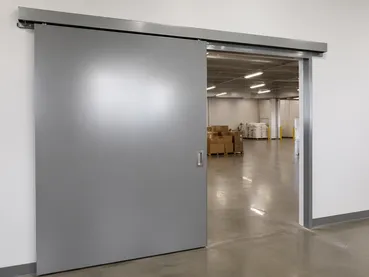
EUWOO sliding commercial door — top-hung aluminum configuration in a commercial corridor
18,000 m²
Production Facility
450K+
Units / Year
Product Context

Where Sliding Doors Fit —
and Why That Matters for Your Orders

Sliding commercial doors occupy a specific niche in the commercial door category: they solve the swing-clearance problem. In space-constrained interiors — hospital corridors where gurneys need full-width passage, retail environments where a swinging door interrupts customer flow, office partitions where the door arc would eat into usable floor area — a sliding configuration is the spec, not a preference.

That constraint-driven demand pattern is commercially useful for your business. Buyers who specify sliding doors aren't shopping on price alone; they're solving a layout problem, and the door that fits the opening wins the order. That gives you margin room that commodity swing-door segments don't offer.

We produce sliding commercial doors in two primary mechanical configurations — top-hung and bottom-track — and in both manual and automatic drive variants. The construction runs across steel, aluminum, and glass-panel bodies, so the same product family covers industrial utility applications and high-visibility retail or office entrances. Most of our distributor partners carry 2–3 SKUs from this line and find they cover the majority of their project inquiries without needing to source from a second supplier.

Browse Full Commercial Door Range

Hospital & Healthcare Corridors

Gurney and equipment passage requires full-width clearance. A swinging door is a liability; a sliding door is the only viable spec.

Retail & Storefront Environments

A swinging door interrupts customer flow and creates collision risk at high-traffic entrances. Sliding configurations keep the threshold clear and the experience seamless.

Office Partitions & Interior Dividers

Where the door arc would consume usable floor area, a sliding panel reclaims that space. Common in open-plan offices, conference rooms, and co-working buildouts.

The Margin Advantage

Buyers specifying sliding doors are solving a layout problem, not hunting for the lowest price. That positions your order as a solution sale — with the margin profile to match.

Product Data

Technical Specifications

These are industry-standard values for this product type. Actual specifications vary by configuration — contact us for a detailed product data sheet on your target SKU.

Standard Configuration Parameters

Parameter Standard Values
Body material Cold-rolled SPCC steel (0.8–1.2mm), aluminum 6063-T5, stainless steel 304
Door thickness 40mm / 45mm / 50mm
Standard leaf width 700–1200mm per leaf
Standard leaf height 1800–2400mm
Custom sizing Available; non-standard dimensions on runs ≥100 units, no tooling surcharge
Track system Top-hung (overhead track, no floor channel) or bottom-track (floor-mounted guide rail)
Drive type Manual (push/pull) or automatic (electromechanical drive with sensor package)
Surface finish Powder coat 60+ colors (60–80μm), anodized (aluminum), stainless brushed/mirror
Core fill Honeycomb paper (standard), mineral wool (acoustic upgrade), polyurethane foam (thermal)
Hardware Soft-close damper, anti-jump safety device, adjustable top hanger carriages
Certifications
ISO 9001:2015 CE SGS
MOQ 50 units (standard) / 100 units (custom configurations)

Specifications shown are industry-standard values for this product type. Contact us for exact product data sheets and configuration-specific parameters.

Top-hung sliding commercial door track and hanger carriage hardware detail

Core Fill Options at a Glance

  • Honeycomb paper — standard spec, lightweight, cost-efficient for most commercial applications
  • Mineral wool — acoustic upgrade for office partitions, conference rooms, healthcare
  • Polyurethane foam — thermal performance upgrade for climate-controlled environments

Need a Configuration-Specific Data Sheet?

Tell us your target SKU — track type, body material, drive type, and finish — and we'll return a full product data sheet with tolerances and load ratings.

Request a Quote with Your Specs
Configuration Guide

Top-Hung vs. Bottom-Track: The Configuration Decision Your Buyers Will Ask About

This is the first question that comes up on almost every sliding door inquiry, and getting it right upfront saves your buyers a costly site modification later.

Recommended

Top-Hung

Suspends the door leaf from an overhead track with no floor channel. The floor stays clean and unobstructed — no trip hazard, no channel to collect debris, no conflict with floor finishes.

Healthcare environments — infection control protocols make floor channels a problem
Food service — cleaning requirements demand unobstructed floors
Applications where the floor surface is a design element

Load Engineering Note

The overhead structure must carry the door weight. We size hanger carriages and track gauge to the door leaf weight — a 1.2mm steel door at 1000mm × 2100mm runs approximately 35–45 kg. The track assembly is engineered accordingly.

Trade-off: The ceiling or header must be structurally adequate to carry the door weight.

Industrial Standard

Bottom-Track

Uses a floor-mounted guide rail with a top guide channel. More forgiving on the structural side — the floor carries the load, not the header — and it's the standard configuration for heavier doors and wider openings.

Industrial and warehouse applications — standard configuration
Heavier doors and wider openings where top-hung load ratings become a concern
Applications where header structural reinforcement is not feasible

Buyer Conversation Note

The floor channel is a minor inconvenience in most industrial settings. In retail or office environments, it's worth the conversation with your buyer before specifying.

Trade-off: Floor channel may conflict with cleaning protocols or floor finish aesthetics.

From the Field

We've had buyers spec top-hung for a warehouse application and then come back after installation asking about the header reinforcement cost. The configuration conversation upfront is worth having — we include a load calculation note with every quote.

For automatic sliding commercial door configurations, both track types are available. The drive unit mounts overhead in either case; the difference is in the floor guide arrangement.

Top-hung and bottom-track sliding door configuration comparison showing overhead track suspension versus floor-mounted guide rail
Automatic Drive Systems

Automatic Sliding Commercial Door: What the Drive Package Includes

The automatic variant adds an electromechanical drive unit, sensor package, and control board to the manual sliding door base. Here's what the standard package covers, and where the configuration decisions sit.

Drive Unit

Brushless DC motor with belt or rack-and-pinion transmission. We specify based on door weight and expected daily cycle count.

Belt Drive

Quieter operation — recommended for office and healthcare environments. Standard for most commercial applications under 80 kg leaf weight and under 500 cycles/day.

Rack-and-Pinion

Handles heavier door weights and higher cycle frequencies without belt wear issue. Specified for industrial-grade applications.

Sensor Package

Standard and safety sensors included on all automatic units.

Standard

Microwave (radar) sensors for hands-free activation

Required

Infrared presence sensors for the safety zone — prevents door from closing on an obstruction. Included on all automatic units (CE requirement and basic liability protection)

Optional

Push-button activation as alternative or supplement for accessibility compliance

Control Board

All parameters are field-adjustable. No factory reconfiguration required for site-specific tuning.

Open/close speed adjustment
Hold-open time configuration
Obstacle detection sensitivity

Power Failure Behavior

Default

Fail-Safe Open

Door stays open on power loss. Correct default for most commercial egress applications. Included on all standard units.

Available

Fail-Secure

Door closes on power loss. Available for access-control applications where securing the opening on power failure is required.

Distributor Revenue Note

Automatic Doors as a Service-Revenue Product

Automatic sliding door maintenance is a recurring revenue opportunity. Drive belts and sensor calibration are annual service items. If you're selling to contractors who also do service contracts, the automatic variant is worth positioning as a service-revenue door, not just a product sale.

Annual

Drive belt service interval

Annual

Sensor calibration interval

Automatic sliding commercial door drive unit with brushless DC motor, belt transmission, and overhead sensor package installed
Market Segments

Application Segments: Where Sliding Commercial Doors Generate Repeat Orders

Understanding which segments drive volume — and what each segment's buyers actually specify — is the difference between a one-time order and a recurring supply relationship.

Sliding commercial door installed in hospital corridor for infection control
Highest Volume Segment

Healthcare Facilities

Hospitals and clinics specify sliding doors for patient room entrances, corridor separations, and clean-room access. The no-floor-channel requirement and hands-free automatic operation are driven by infection control protocols.

Typical Order Volume

150–400 sliding door units per mid-size hospital fit-out

Healthcare procurement cycles are long but predictable. Once you're on an approved vendor list, replacement and expansion orders follow the facility's maintenance schedule.

CE Certified ISO 9001:2015 Hands-Free Auto
Sliding commercial door at retail storefront entrance
Volume Rollout Segment

Retail & Commercial Interiors

Retail chains order in volume across multiple locations — storefront entrances, fitting room corridors, and back-of-house access points. A regional rollout for a mid-size retail brand can mean 80–200 identical door sets.

Key Spec Driver

Finish consistency across the batch. Our automated powder line holds ΔE < 1.5 across a full production run — store #47 matches store #1.

Finish consistency across the batch is what keeps that relationship. Buyers need confidence that every unit in a multi-location rollout is visually identical.

ΔE < 1.5 Powder Line Batch Consistency
Sliding commercial door used as office meeting room partition
Fit-Out Segment

Office Fit-Out & Corporate Interiors

Sliding doors are specified for meeting room partitions, executive suite entrances, and open-plan dividers where swing clearance conflicts with furniture layout. Corporate fit-out projects typically run 30–120 sliding door units per floor plate.

Best-Fit Configuration

Aluminum and glass-panel configurations — clean profiles, vision panel options, compatible with standard office hardware ecosystems.

30–120 Units / Floor Glass Panel Options Vision Panel
Heavy-duty sliding commercial door for industrial cold storage and logistics zone separation
Growth Segment — SEA & Middle East

Industrial & Logistics

Bottom-track sliding doors for internal zone separation, cold storage access, and personnel doors adjacent to large vehicle openings. These buyers prioritize cycle durability and ease of maintenance over aesthetics.

Spec Drivers

Heavy-gauge steel body, robust track hardware, and accessible replacement parts. This segment has grown steadily in Southeast Asia and the Middle East.

Heavy-Gauge Steel Cycle Durability Cold Storage
Material Selection

Steel, Aluminum, or Glass Panel: Matching Body Material to Your Market

The body material decision drives both the price point and the market segment the door sells into. Here's how to match material to buyer.

Steel body sliding commercial door SPCC powder coat finish
Workhorse Configuration

Steel Body

Specification

SPCC 0.8–1.2mm — cost-competitive, durable, available in the full powder coat color range.

Best For

Industrial, warehouse, back-of-house, and utility applications where aesthetics are secondary to function.

Catalog Role

Volume SKU for broad-market distribution catalogs

Coastal Markets
Aluminum body sliding commercial door 6063-T5 anodized finish
Corrosion-Resistant

Aluminum Body

Specification

6063-T5 alloy — specified for corrosion-sensitive environments and markets where weight matters. Roughly 30–40% lighter than equivalent steel.

Best For

Coastal markets — Gulf, Southeast Asia, Australia — where corrosion resistance profile exceeds steel even with powder coat protection. Weight reduction also simplifies the top-hung structural requirement.

Finish Options

Powder Coat Anodized (Premium)
Glass panel sliding commercial door tempered glass retail and office interior
Premium Margin SKU

Glass Panel

Specification

Full-glass or partial-glass with aluminum or steel frame. Tempered glass minimum 10mm standard; laminated glass available where safety glazing is a code requirement.

Best For

Retail and corporate interior specification. Commands a meaningful price premium over solid-body configurations — useful for buyers who need margin differentiation within their sliding door SKU range.

Glass Options

Tempered 10mm+ Laminated Safety

Mixed-Material Orders for Multi-SKU Catalogs

We can mix body materials within a single order if you're building out a multi-SKU catalog. You don't need to run separate orders for steel, aluminum, and glass-panel configurations — minimum quantities apply per configuration, but the logistics are consolidated.

This is particularly useful for distributors building a tiered product line: steel body as the entry-level SKU, aluminum as the mid-tier, and glass panel as the premium offering — all sourced from one factory relationship.

Material Quick Reference

Steel (SPCC) Volume / Utility
Aluminum (6063-T5) Coastal / Weight
Glass Panel Retail / Premium
Mixed Order Multi-SKU Catalog
OEM & Private-Label Programs

Customization Options for OEM and Private-Label Programs

The sliding commercial door line supports the same OEM/ODM scope as our broader commercial door range. Below are the customization parameters that come up most often with distributor and OEM accounts.

Dimensional Customization

Leaf width up to 1500mm and height up to 2700mm are achievable without dedicated tooling on runs of 100+ units. Wider openings — double-leaf sliding configurations up to 3000mm clear opening — are available. Track engineering changes for wider spans; we review structural requirements with you before quoting.

Finish and Color

60+ standard powder coat colors with no MOQ premium. Custom RAL or proprietary brand colors on runs of 100+ units — color match sample before production run commitment. For aluminum body doors, custom anodizing colors are available on runs of 200+ units (anodizing bath setup cost drives that minimum).

Drive and Hardware Configuration

Automatic drive packages can be specified with different sensor types, activation modes, and control board settings to match your target market's accessibility codes. For North American markets, ADA-compliant activation height and force requirements are standard on automatic units. For European markets, EN 16005 compliance documentation is available.

Branding

OEM brand plates, private-label packaging, and custom documentation are standard for distributor partners. Most of our North American and Australian distributor accounts run this line under their own brand.

50 units
MOQ — standard catalog configurations
100 units
MOQ — custom dimensions or finishes
Free
Design consultation & 3D rendering included

Send us your project drawings or target spec and our R&D team will turn around a production-ready quote with CAD drawings.

Send Us Your Specs
Logistics & Container Loading

Packaging and Container Loading

Sliding commercial door components ship in flat-pack KD configuration where possible, maximizing container loading density and simplifying customs clearance.

Flat-Pack Configuration

The door leaf, track assembly, hardware pack, and installation hardware ship as separate components in a single carton set. Components vs. assembled units can affect import duty classification in some markets — worth checking with your customs broker before finalizing your order structure.

Standard Packaging Spec

  • Corrugated carton with foam corner protection on door leaf
  • Bubble wrap on glass panels
  • Stretch-wrap outer layer
  • Wooden pallet base + additional corner reinforcement for rough-handling markets
  • Passes 1.2m drop test on all four faces
Flat-pack sliding commercial door sets loaded in 40HQ container
300–450
door sets per 40HQ
(manual, flat-pack)
200–280
door sets per 40HQ
(automatic drive units)

Container Loading Plan (300+ Units)

For orders of 300+ units, we provide a container loading plan with exact CBM calculations before order confirmation. This is useful for freight booking and landed cost modeling — you get the numbers before committing to a shipping schedule.

Freight Coverage

We work with regular forwarders to North America, the Middle East, Southeast Asia, Africa, and Australia. A freight estimate to your destination port is available on request — include your port of discharge when you send your inquiry.

North America Middle East Southeast Asia Africa Australia
Buyer FAQ

Frequently Asked Questions

Technical and sourcing questions we hear most from distributors and project specifiers evaluating sliding commercial doors.

What is the difference between top-hung and bottom-track sliding commercial doors, and which should I specify?

Top-hung suspends the door from an overhead track with no floor channel — the right choice for healthcare, food service, and any application where floor cleanliness or finish continuity matters. Bottom-track uses a floor-mounted guide rail and is better suited for heavier doors and industrial applications where the floor channel isn't a concern.

The structural requirement differs: top-hung needs an adequate header or ceiling structure to carry the door weight; bottom-track loads to the floor. For most commercial interior applications under 80 kg leaf weight, top-hung is the cleaner installation. For industrial doors above 100 kg or in high-abuse environments, bottom-track is more reliable long-term.

What maintenance does an automatic sliding commercial door require?

Annual service items on the automatic drive unit: drive belt inspection and replacement (belt drive units), sensor calibration check, and control board firmware update if applicable. The track and hanger carriages should be cleaned and lubricated every 6 months in high-cycle applications (500+ cycles/day).

Rack-and-pinion drive units have longer service intervals than belt drive but require periodic gear lubrication. Most automatic sliding door failures in the field trace back to deferred sensor calibration — an obstacle detection sensor that drifts out of calibration causes nuisance stops that generate service calls. Budget for annual preventive maintenance when quoting total cost of ownership to your buyers.

What certifications are required for automatic sliding commercial doors in European markets?

EN 16005 is the European standard for power-operated pedestrian doorsets — it covers safety requirements for automatic sliding doors including obstacle detection, safety sensor performance, and emergency operation. CE marking on automatic sliding doors in Europe requires EN 16005 compliance documentation.

Our automatic sliding door units are CE certified; EN 16005 compliance documentation is available on request. For fire-rated automatic sliding door applications, additional fire door assembly certification applies — contact us with your specific fire rating requirement.

CE EN 16005 Fire-Rated Available

What is the maximum custom size available for sliding commercial doors?

Single-leaf: up to 1500mm wide × 2700mm high without dedicated tooling on runs of 100+ units. Double-leaf configurations achieve clear openings up to 3000mm. Above these dimensions, we can still produce, but the track engineering and structural requirements need to be reviewed case by case — send us the opening dimensions and we'll advise on feasibility and any tooling implications.

For very large openings (industrial-scale), our industrial commercial doors or warehouse commercial doors lines may be a better fit depending on the application.

Single-Leaf Max
1500 × 2700 mm
Double-Leaf Clear
Up to 3000 mm

What is the MOQ and lead time for sliding commercial doors?

MOQ is 50 units for standard catalog configurations, 100 units for custom dimensions, finishes, or drive configurations. Automatic drive units add approximately 5–7 days to the lead time for drive package assembly and testing. Sample orders (2–4 units) are available before committing to volume — typical sample lead time is 10–15 days.

MOQ — Standard
50 units
Catalog configurations
MOQ — Custom
100 units
Custom dims / finishes / drive
Lead Time — Standard
25–35 days
From confirmed order
Lead Time — Custom
35–45 days
Depending on line loading
Start Your Sourcing Conversation

Start Your Sliding Door Sourcing Conversation

If you're evaluating sliding commercial doors for a new market or adding this line to an existing commercial door catalog, the most useful first step is usually a 2–4 unit sample order across the configurations you're considering — steel body, aluminum body, or glass panel; top-hung or bottom-track; manual or automatic.

Test them against your project spec or with your own downstream customers before committing volume. Send us your target opening dimensions, body material preference, and destination market. We'll recommend the configuration that fits your application and margin target, and send back a detailed quote with CAD drawings within 3 business days.

Sample Before You Commit

2–4 unit sample orders available. Typical sample lead time 10–15 days. Test steel body, aluminum body, or glass panel configurations against your spec before placing volume.

Quote + CAD in 3 Business Days

Send opening dimensions, body material preference, and destination market. We return a detailed quote with CAD drawings — enough to take to your project team or downstream customer for sign-off.