
The Standard on Your Test Report Determines Where You Can Sell
A fire door that passes testing under one standard can be rejected under another — even if the physical door is identical. If you're sourcing fire doors for multiple markets, the standard printed on the test report is the single most important line item on your compliance file. Get it wrong and your shipment clears customs fine but fails the building inspector's review, which is a far more expensive problem.
A fire door standard defines how a door assembly is tested for fire resistance, what performance thresholds it must meet, and what documentation must travel with the product. It covers the complete assembly — leaf, frame, glazing, hardware, seals — not just the door panel. The standard dictates the test protocol (furnace type, pressure conditions, hose stream exposure), the rating intervals (20, 45, 60, 90 minutes or more), and the labeling and inspection requirements that follow the door through its installed life.
We've been manufacturing fire doors to multiple standards since we added the dedicated fire door line in our Luoyang facility. The certification process for NFPA 80 alone took us the better part of a year — not because the manufacturing was difficult, but because the documentation, test specimen control, and follow-up inspection program are rigorous. That experience is exactly why standard selection matters so much at the sourcing stage: the cost of certification is baked into the product, and ordering against the wrong standard means you're paying for compliance your market doesn't recognize.
The Four Standards You'll Encounter in Export Markets
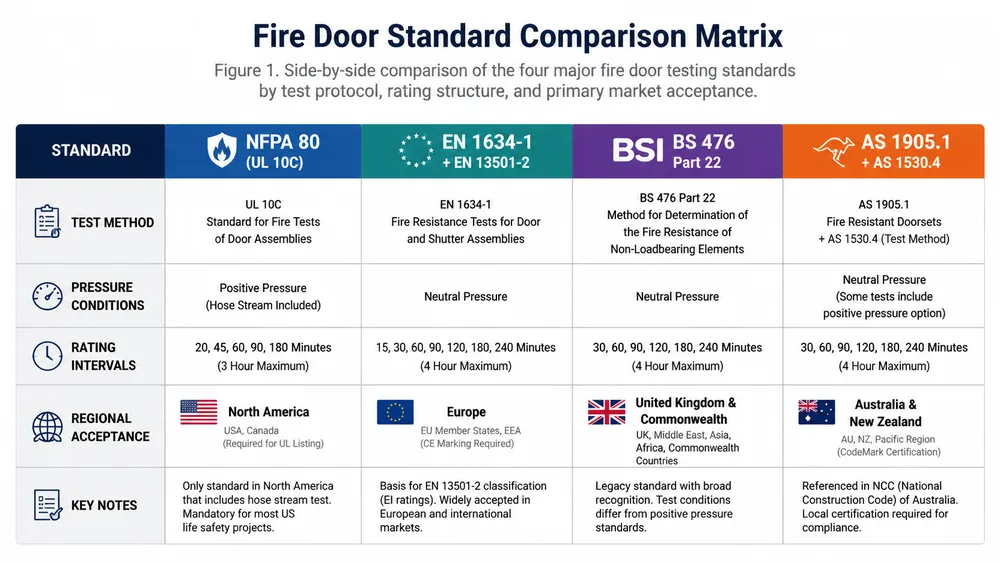
Most B2B fire door orders we handle fall under one of four testing and compliance frameworks. Your target market determines which one applies — and in some cases, more than one.
| Standard | Region | Test Method | Common Ratings | Key Requirement |
|---|---|---|---|---|
| NFPA 80 / UL 10C | USA, Canada | Positive pressure furnace + hose stream | 20, 45, 60, 90 min | Listed and labeled by accredited agency (UL, WHI, Intertek) |
| EN 1634-1 | EU, UK, Middle East (adopted) | EN standard fire curve, positive pressure | EI 30, EI 60, EI 90, EI 120 | CE marking under EN 16034 + DoP |
| BS 476 Part 22 | UK (legacy), parts of Asia, Africa | BS fire curve, neutral pressure | 30, 60, 90, 120 min | Still accepted in many Commonwealth markets |
| AS 1905.1 | Australia, New Zealand | Based on AS 1530.4 test | -/60/60, -/120/120 | Must reference test to AS 1530.4 |

The distinction between these isn't academic. A door tested to BS 476 Part 22 under neutral pressure conditions may behave differently under the positive pressure protocol required by UL 10C. We've had buyers assume a BS 476-tested door would satisfy a US project — it won't, because the test conditions and listing requirements are fundamentally different. (This is the single most common compliance mistake we see from first-time fire door importers.)
NFPA 80 and UL 10C — What the US Market Actually Requires
If you're supplying fire doors into the United States, the compliance chain runs through three layers: the test standard (UL 10C or UL 10B), the installation and maintenance standard (NFPA 80), and the listing/labeling program run by an accredited agency.
UL 10C is the fire test itself — a positive-pressure furnace test that simulates real fire conditions more aggressively than older neutral-pressure methods. The door assembly (leaf, frame, hardware, glazing if any) is exposed to a standard time-temperature curve, and the assembly must maintain integrity for the rated duration. After the fire exposure, a hose stream test hits the assembly with high-pressure water to check structural integrity under thermal shock. Doors that survive both phases earn their fire rating.
NFPA 80 governs everything around the test: how fire door assemblies must be installed, inspected, tested, and maintained throughout their service life. For you as a sourcing buyer, the critical NFPA 80 requirements are:
- The door must carry a permanent label from an accredited listing agency (UL, WHI, or Intertek)
- All components — closer, hinges, latch, frame, glazing, seals — must be listed for use in fire door assemblies
- Annual inspection is required per NFPA 80 Chapter 5, which means your downstream customers need doors that arrive with correct labeling and documentation intact
We manufacture to UL 10C test requirements and carry NFPA 80 compliance documentation. The label isn't something we print in-house — it's issued through the listing agency's follow-up inspection program, which means an independent auditor visits our facility to verify that production doors match the tested specimens. That third-party verification is what gives the label its legal weight in US building code enforcement.
What this means for your import business: if you're stocking fire doors for the US market, every unit needs to ship with the listing label already applied and a matching test report reference available. Doors without labels are non-compliant regardless of their actual fire performance — building inspectors check the label, not the door construction.
EN 1634 and CE Marking — The European Framework
The European fire door compliance system works differently from the US model. Testing happens under EN 1634-1, and the results feed into a CE marking process governed by EN 16034 (the harmonized product standard for fire-rated doorsets).
EN 1634-1 tests fire resistance using the standard EN fire curve with positive pressure conditions. The rating system uses a two-letter classification:
- E = integrity (the door prevents flame passage)
- I = insulation (the unexposed face stays below temperature thresholds)
- EI 30, EI 60, EI 90 = the assembly maintains both integrity and insulation for 30, 60, or 90 minutes
Some markets accept E-only ratings (integrity without insulation), but most commercial building codes in the EU require the full EI classification. If your buyer's project spec says "EI 60," the door must pass both criteria for 60 minutes — an E 60 rating alone won't satisfy it.
CE marking under EN 16034 requires a Declaration of Performance (DoP) issued by the manufacturer, backed by test reports from a notified body. The DoP is the legal document that travels with the product and declares its performance characteristics. Without it, the door cannot legally be placed on the EU market for fire-rated applications.
For Middle Eastern markets — particularly the Gulf states — EN 1634 testing is increasingly accepted alongside or instead of BS 476. We've seen this shift accelerate over the past five years as UAE and Saudi building codes align more closely with European standards. If you're supplying into Dubai or Riyadh, confirm whether the project spec references EN 1634 or BS 476 before you place the order. (We can produce to either, but the test documentation is different and not interchangeable.)
BS 476 Part 22 — Still Relevant in More Markets Than You'd Expect
BS 476 is the older British standard, and while the UK has largely moved toward EN 1634 for new construction, BS 476 Part 22 test reports remain widely accepted across Commonwealth markets: parts of Southeast Asia, Africa, the Indian subcontinent, and Hong Kong.
The key technical difference: BS 476 Part 22 uses neutral pressure conditions in the furnace, while EN 1634 and UL 10C use positive pressure. Positive pressure pushes hot gases through gaps in the assembly, which is a more demanding test condition. A door that passes BS 476 at 60 minutes may not automatically pass EN 1634-1 at the same duration — the positive pressure exposes edge seal weaknesses and gap tolerances that neutral pressure doesn't stress as aggressively.
For your sourcing decisions, BS 476 certification is typically less expensive to obtain and the test reports are accepted in a wider range of developing markets. If your distribution covers Africa or Southeast Asia, BS 476 Part 22 reports may be all you need. But if you're also targeting EU or US projects with the same product, you'll need separate test documentation — one test report doesn't cover both frameworks.
How Fire Ratings Map to Building Code Requirements
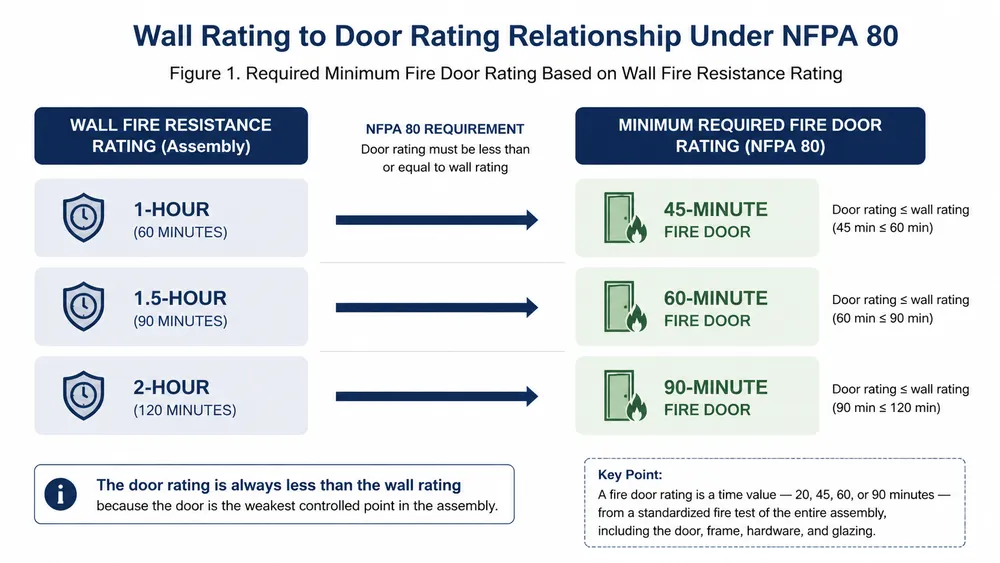
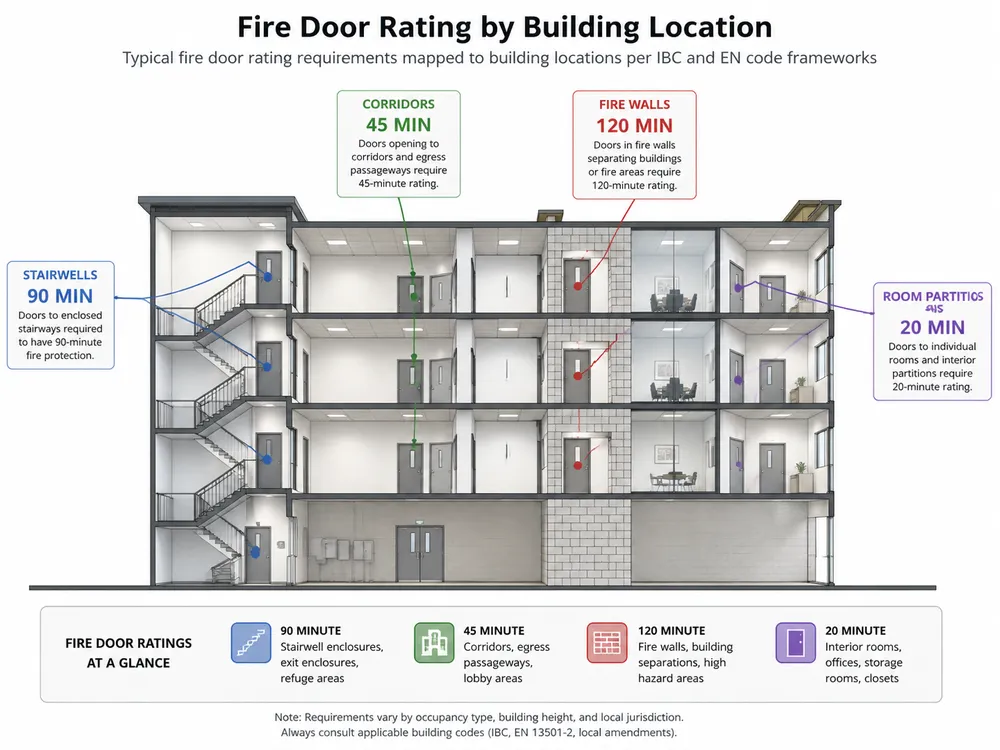
Fire door ratings aren't arbitrary numbers — they correspond to specific locations within a building as defined by local building codes. Understanding this mapping helps you stock the right mix of ratings for your market.
| Rating | Typical Building Code Application | Common Order Pattern |
|---|---|---|
| 20 min | Corridor doors, room partitions in sprinklered buildings (US) | High volume, standard commercial |
| 45 min | Corridor and room separations (US, per IBC) | Most common US commercial rating |
| 60 min (EI 60) | Stairwell enclosures, shaft walls, EU commercial | High volume in EU and Middle East |
| 90 min (EI 90) | Exit stairways, high-rise separations, industrial | Project-specific, larger orders |
| 120 min | Fire walls, occupancy separations, high-hazard | Specialty, lower volume |
The 45-minute and 60-minute ratings account for roughly 70% of the commercial fire door volume we ship. If you're building initial inventory for a distribution business, those two ratings cover the broadest range of project requirements. The 90-minute and 120-minute ratings are typically ordered against specific project specs rather than stocked — the unit cost is higher and the application is narrower.
What Actually Gets Tested — The Assembly, Not Just the Door
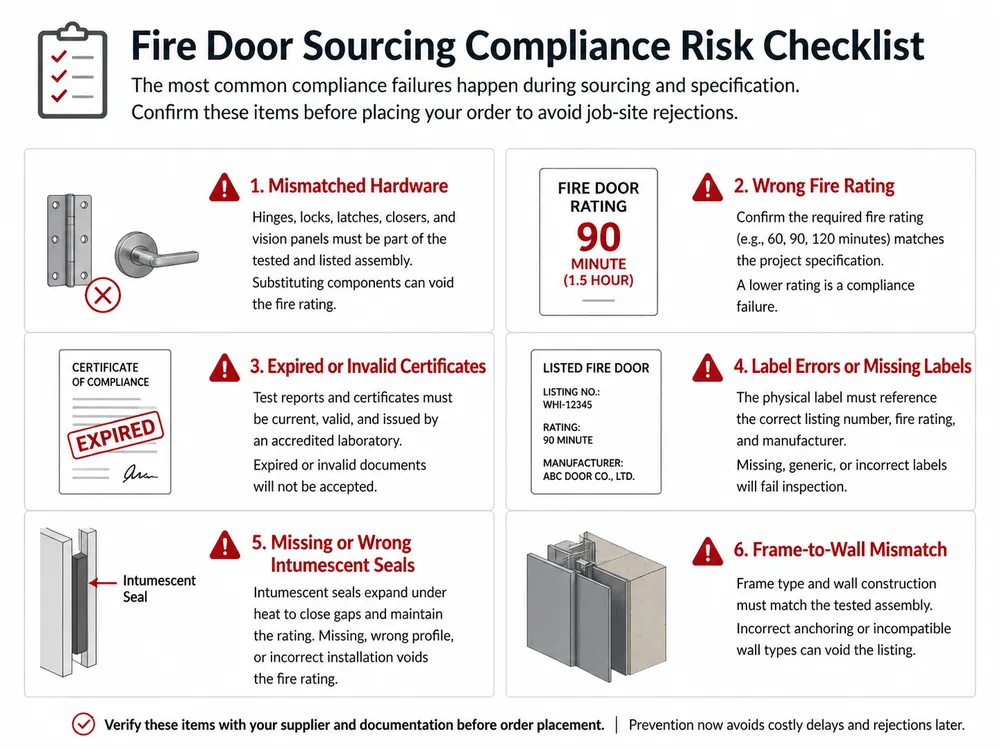
One of the most consequential misunderstandings in fire door sourcing: the fire rating applies to the complete assembly, not the door leaf alone. The test specimen includes the leaf, frame, hinges, closer, latch, intumescent seals, and any glazing. Change any one of those components and the rating may no longer apply.
This matters for your business in two specific ways:
Hardware substitution risk. If your customer installs a fire-rated door leaf with non-listed hinges or a closer that wasn't part of the tested assembly, the door loses its fire rating. We ship fire door assemblies with all hardware pre-specified and documented against the test report — the listing label covers the complete package. If you're selling door-only (leaf and frame without hardware), make sure your documentation clearly states which listed hardware must be used to maintain the rating.
Glazing limitations. Fire-rated vision panels require fire-rated glazing — standard tempered glass will shatter within minutes of fire exposure. The glazing type, size, and frame must match the tested configuration. We use ceramic glass rated to the same duration as the door assembly, with steel glazing beads and intumescent gaskets. Maximum vision panel size is limited by the test report — typically 100 × 100 mm for 90-minute ratings, larger openings available at 60 minutes depending on the glazing system. (If your buyer wants a full-lite fire door, confirm the rating and glazing spec early — it significantly affects unit cost.)
Intumescent Seals and Edge Gap Tolerances
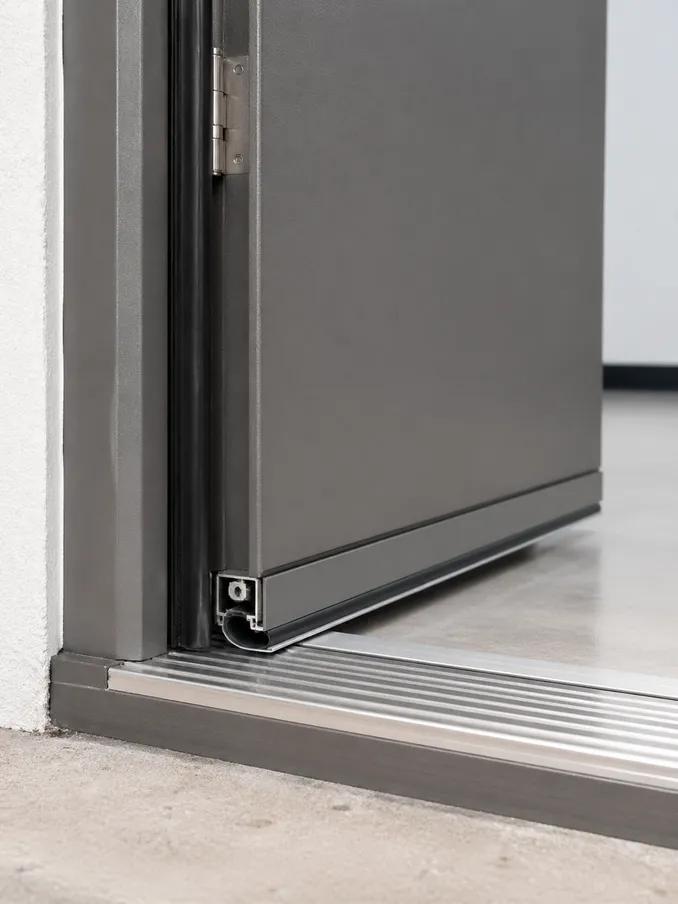
Intumescent seals are the component that makes a fire door work as a fire barrier rather than just a heavy door. These seals expand when exposed to heat — typically activating between 150–200°C — and fill the gap between the door leaf and frame, blocking smoke and flame passage.
The seal configuration must match the tested assembly. For most fire door assemblies we produce:
- Single-leaf doors: intumescent seal in a routed groove on the door edge or frame rebate, continuous around three sides (both jambs and head)
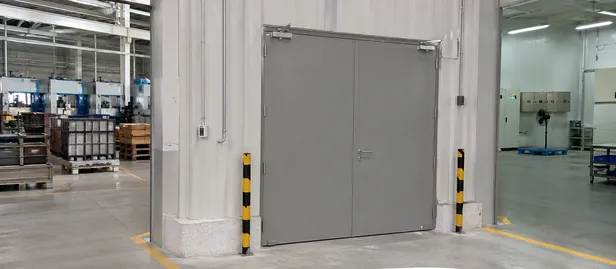
- Double-leaf doors: additional intumescent meeting stile seal where the two leaves overlap
- Smoke seals: combined intumescent + brush or blade smoke seal for assemblies that require both fire and smoke ratings (common in corridor applications)
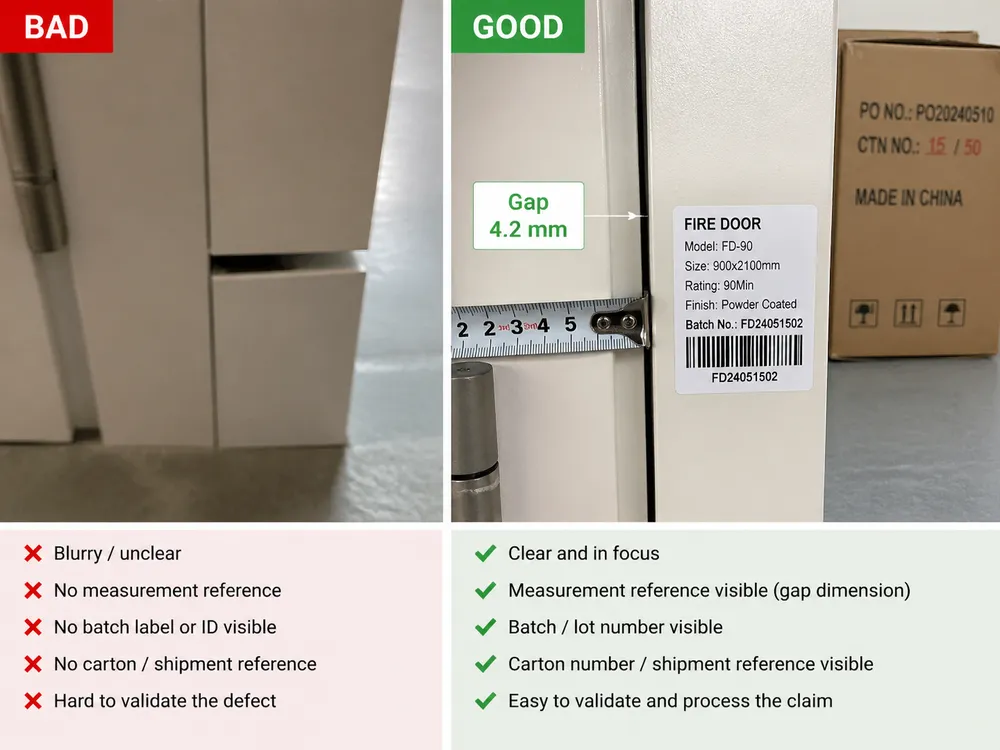
Edge gap tolerances are specified in the test standard and enforced by building inspectors. NFPA 80 allows a maximum clearance of 3.2 mm (⅛ inch) at the frame-to-leaf interface and 6.4 mm (¼ inch) at the bottom. EN standards specify similar tolerances. We hold our frame-to-leaf fit within ±1.0 mm during manufacturing, which gives your installer a margin of error during field installation without exceeding the code maximum.
Gaps that exceed tolerance are the number-one reason fire doors fail field inspection. If you're distributing fire doors, the quality of the frame-to-leaf dimensional consistency at the factory directly determines your pass rate on job-site inspections — and your warranty exposure.
The Documentation Package That Travels With Your Order
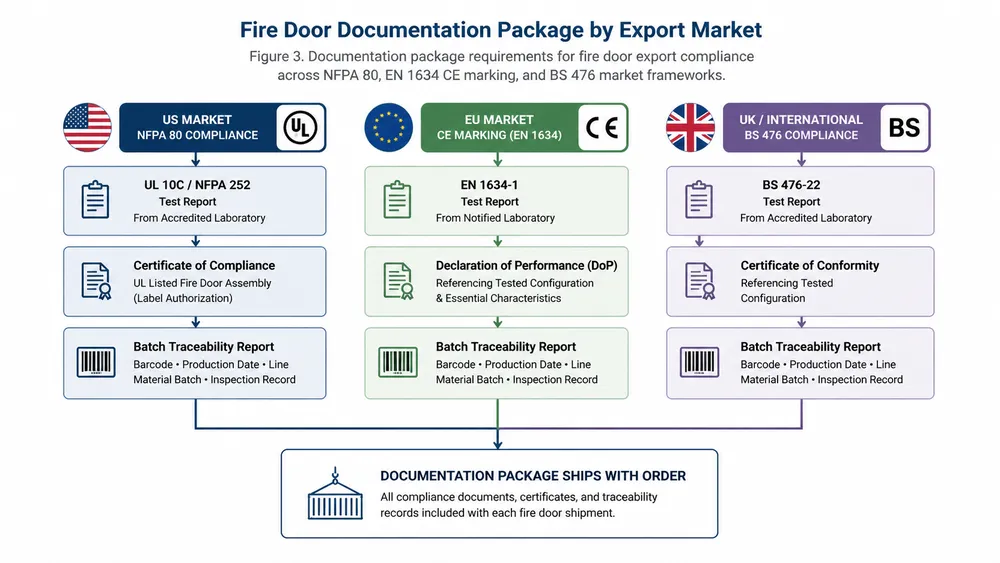
Fire door compliance isn't just about the physical product — it's about the paper trail. Missing or incomplete documentation can hold up your project delivery even when the doors themselves are fully compliant.
For US-market orders (NFPA 80 / UL), each door ships with:
- Permanent listing label (UL, WHI, or Intertek) applied at the factory
- Test report reference number traceable to the listing agency
- Hardware schedule confirming all components are listed for fire door use
For EU-market orders (EN 1634 / CE), each door ships with:
- CE marking on the product
- Declaration of Performance (DoP) referencing the EN 1634-1 test report
- Notified body certificate number
For BS 476 markets, each door ships with:
- Test report from an accredited laboratory
- Certificate of conformity referencing the tested configuration
We maintain batch traceability on every fire door we produce — each unit carries a barcode linked to its production date, line, material batch, and inspection record. If a compliance question comes up six months after delivery, you can trace any individual door back to its full production history within minutes. That traceability is what protects your business when a building inspector or end client asks for verification.
Common Sourcing Mistakes That Create Compliance Failures
After 11 years of shipping fire doors to multiple markets, the failure patterns are predictable. These are the sourcing shortcuts that generate the most expensive problems:
Assuming one test report covers all markets. A BS 476 Part 22 report does not satisfy NFPA 80 requirements. An EN 1634 test does not produce a UL listing. If you're sourcing for multiple regions, you need market-specific documentation — or you need to confirm upfront which standards your supplier actually holds. Ask for the test report and listing certificate before you place the order, not after the container ships.
Ordering fire-rated doors from a supplier who subcontracts the fire door production. Fire door certification is tied to a specific manufacturing facility and production process. If your supplier farms out fire door production to a subcontractor, the listing may not transfer. We manufacture every fire door in our own facility under our own certification — the listing label is issued against our production line, our QC process, and our tested specimens.
Ignoring hardware compatibility. A fire door leaf tested with specific hinges, closer, and latch hardware loses its rating if different hardware is installed. We've seen buyers source doors from one factory and hardware from another, then discover at the job site that the combination isn't listed. Every fire door assembly we ship includes a hardware schedule that matches the tested configuration.
Skipping the intumescent seal specification. Some suppliers ship fire doors with generic or undersized intumescent seals to reduce cost. The seal must match the tested assembly — wrong seal profile, wrong expansion ratio, or missing seals on the meeting stile of double doors will fail inspection. We use the same seal specification that was present in our test specimens, verified during our Stage 5 pre-shipment inspection.
Not confirming the rating duration matches the project spec. A 60-minute door installed where the code requires 90 minutes is a failed inspection and a door replacement at your cost. Confirm the required rating with your buyer's project architect or code consultant before ordering. (This sounds obvious, but we get rating-change requests after production has started at least twice a quarter.)
How We Control Fire Door Quality at the Factory Stage
Our 5-stage quality control process applies to all door production, but fire doors get additional checkpoints because the compliance stakes are higher.
Core fill verification. Fire door cores use mineral wool, vermiculite board, or perlite-based fill depending on the rating and standard. We verify core material density and thickness against the tested specification before the door leaf is closed. A core that's 5mm thinner than spec might look identical from the outside but will fail a fire test — and more importantly, fail in an actual fire.
Intumescent seal inspection. Every fire door is checked for correct seal profile, continuous application without gaps, and proper seating in the routed groove. We run this check after seal installation and again during final assembly — seals that get displaced during hardware installation are caught before the door leaves the line.
Hardware torque and function check. Fire door hardware — particularly closers and latching mechanisms — must function correctly under the thermal expansion that occurs during a fire. We cycle-test closers and verify latch engagement on every unit. A closer that doesn't fully latch the door is a fire barrier that's already breached before the fire starts.
Label and documentation audit. Before packing, every fire door is verified for correct label placement, label legibility, and matching documentation. The label is the legal proof of compliance — a door without a readable label is, from a code enforcement perspective, not a fire door.
Choosing the Right Standard for Your Market Mix
If you're distributing fire doors across multiple regions, your standard selection directly affects your inventory strategy and landed cost.
Single-market distribution: straightforward. Match the standard to your market — NFPA 80/UL for the US, EN 1634/CE for Europe, BS 476 for Commonwealth markets. One certification, one documentation package, one inventory pool.
Multi-market distribution: this is where it gets commercially interesting. A door tested to EN 1634-1 with CE marking covers the EU and is increasingly accepted in the Middle East and parts of Asia. If you add a BS 476 test on the same product, you extend coverage to African and Southeast Asian markets without changing the physical door — only the documentation changes. Adding US market coverage requires UL listing, which is a separate certification with its own follow-up inspection program.
We hold certifications across NFPA 80, CE, and can produce to BS 476 test requirements. For buyers building a multi-market fire door program, we can configure your orders with the correct documentation package for each destination — same production line, same quality standard, different compliance paperwork. That consolidation reduces your supplier count and simplifies your QC oversight.
If you're evaluating whether to add fire doors to your product line or expanding into a new regional market, send your target market list and volume expectations to our team through the RFQ page — we'll map the certification requirements and quote accordingly.
FAQ
What is the difference between NFPA 80 and UL 10C?
UL 10C is the fire test standard — it defines the furnace conditions, time-temperature curve, and hose stream test that the door assembly must survive. NFPA 80 is the installation, inspection, and maintenance standard that governs how fire doors are used throughout their service life. You need both: UL 10C proves the door can resist fire, NFPA 80 ensures it's installed and maintained so it actually will. For sourcing purposes, your supplier must provide a UL-listed product (tested to UL 10C) with documentation that supports NFPA 80 compliance in the field.
Can a fire door tested to BS 476 be used in the US market?
No. US building codes require fire doors to be tested and listed under UL 10B or UL 10C, with labeling from an accredited agency (UL, WHI, or Intertek). A BS 476 test report, regardless of the rating achieved, does not satisfy US code requirements. If you're sourcing for both US and Commonwealth markets, you need separate test documentation for each. The physical door construction may be similar, but the certification and labeling are distinct.
How do I verify that a fire door supplier's certification is legitimate?
Request the listing certificate or test report number and verify it directly with the issuing body. For UL-listed products, check the UL Product iQ database. For CE-marked products, request the Declaration of Performance and verify the notified body number. For BS 476, request the full test report from the accredited laboratory. Any credible supplier will provide these documents before you place an order — if there's hesitation or delay in producing certification paperwork, treat that as a sourcing risk signal.
What fire door rating should I stock for general commercial distribution?
45-minute and 60-minute ratings cover the widest range of commercial building code requirements across most markets. The 45-minute rating is the most common specification for US commercial corridor and room separation applications under IBC. The 60-minute (EI 60) rating is the standard commercial specification in EU and Middle Eastern markets. Stocking both gives you coverage for the majority of project inquiries without overcommitting capital to specialty ratings. Add 90-minute inventory only if you have confirmed project demand — it's a higher unit cost with narrower application.
Do intumescent seals need to be replaced during the door's service life?
Intumescent seals have a functional lifespan, and NFPA 80 requires them to be inspected annually as part of the fire door assembly inspection. Seals that are painted over, damaged, missing, or show signs of degradation must be replaced with the same specification used in the original tested assembly. This is relevant to your after-sales business: if you're distributing fire doors, stocking replacement intumescent seal kits in the correct profile for your product line creates a recurring revenue stream and keeps your installed base compliant. We can supply seal kits matched to our fire door assemblies as a separate line item.