
The compliance problem that costs more than the door itself
A fire door that fails inspection at the job site costs you far more than the unit price. You eat the freight, the storage, the project delay, and sometimes the re-order at rush pricing. I've seen containers of fire-rated doors held at customs in Dubai because the test certificate referenced the wrong standard. I've seen a 600-unit shipment rejected on a U.S. school project because the label was missing a single line of required text. The doors were fine. The paperwork wasn't.
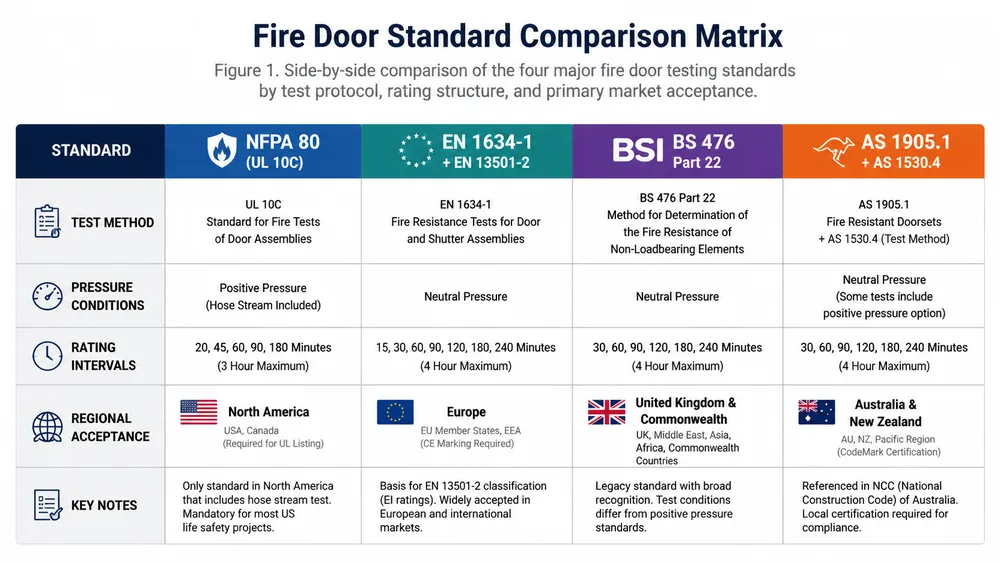
Fire door certification requirements change depending on where the door gets installed, what building code the authority having jurisdiction (AHJ) enforces, what fire rating the project spec calls for, and what hardware is part of the assembly. There is no single global fire door certificate. If your RFQ doesn't specify the destination market and the applicable standard, you're leaving compliance to chance — and chance doesn't pass inspection.
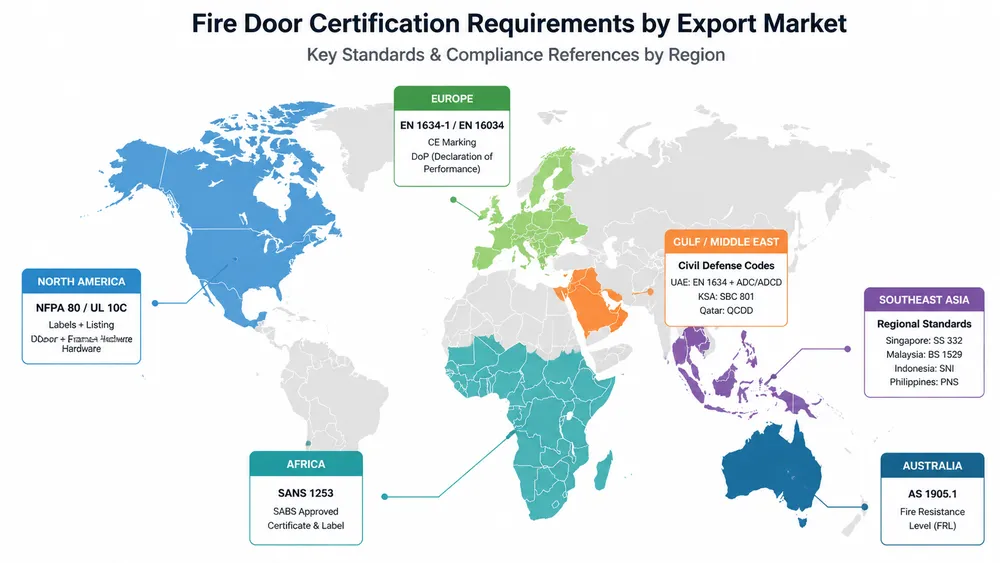
This breakdown maps the certification expectations across the markets we ship to most: North America, Europe, the Gulf, Southeast Asia, Africa, and Australia. The goal is to give you a sourcing checklist — what to confirm, what documents to request, and where the common mistakes happen — so your order arrives with the right paperwork the first time.
What "fire door certification" actually means in a sourcing context
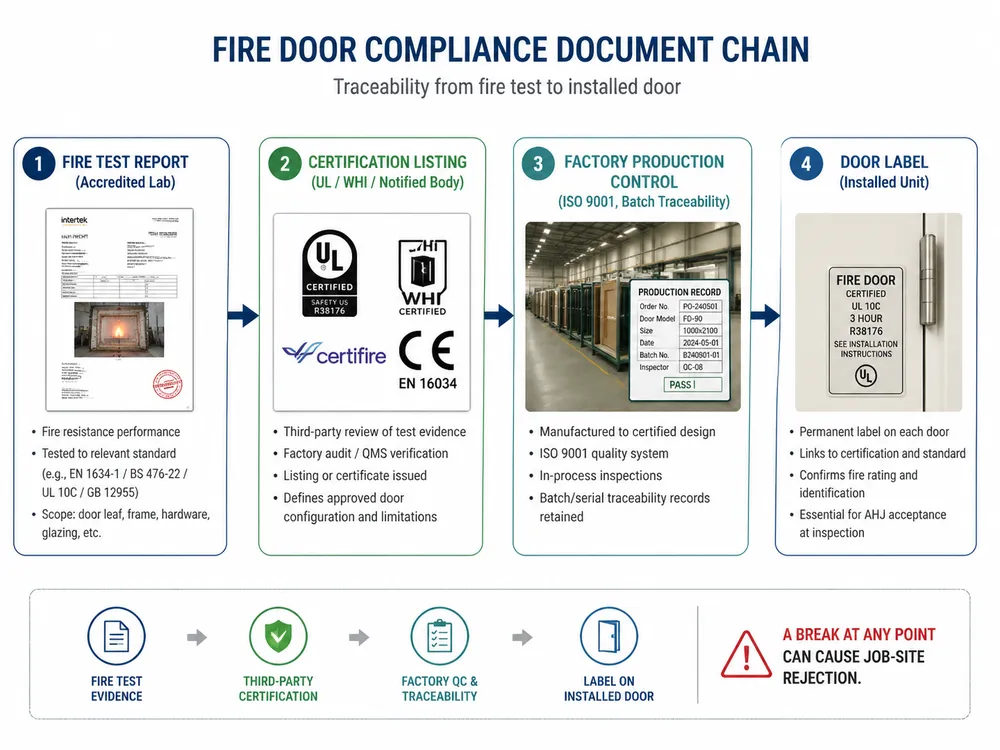
When a project spec says "certified fire door," it's referencing a chain of evidence — not a single document. That chain typically includes:
- A fire test report from an accredited lab, proving the door assembly (leaf, frame, glazing, seals, hardware) survived the required duration under a specific test standard
- A product listing or classification from a certification body (UL, Intertek/WHI, a European Notified Body, etc.) confirming ongoing production compliance
- A label on the physical door that ties the installed unit back to the tested and listed assembly
- Factory production control documentation showing the manufacturer maintains consistent quality between the tested sample and the production run you're buying
Miss any link in that chain and the door may be physically fire-resistant but legally non-compliant. The AHJ at the job site doesn't test your door — they check the label, the listing, and the documentation trail. If those don't match, the door gets rejected regardless of how well it would actually perform in a fire.
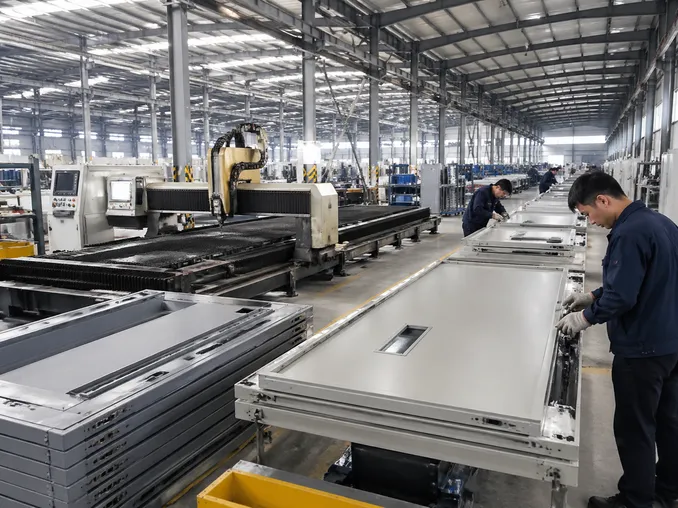
We manage this chain across multiple standards at our facility. Our fire door production line runs under documented procedures for NFPA 80, CE (EN 1634-1), and SGS-verified quality controls, so the test-to-production traceability is built into the manufacturing process, not bolted on after the fact.
Market-by-market certification expectations
The table below covers the most common fire door certification requirements across our active export markets. Use it as a starting checklist for your RFQ — but always confirm the specific requirements with your local AHJ or project consultant, because building codes get amended and local authorities sometimes enforce stricter interpretations than the national standard.
| Market | Primary test standard | Common certification / listing | Label requirements | Key documents to request |
|---|---|---|---|---|
| United States | NFPA 252 (test method), NFPA 80 (installation/maintenance) | UL or Intertek/WHI listing | UL or WHI label on door and frame, showing fire rating, manufacturer, and listing number | UL/WHI listing report, fire test report, NFPA 80 compliance letter |
| Canada | CAN/ULC-S104 | ULC listing | ULC label with fire rating and listing reference | ULC listing certificate, test report |
| European Union | EN 1634-1 (fire resistance test) | CE marking under CPR (Construction Products Regulation) | CE mark + DoP (Declaration of Performance) reference | DoP document, EN 1634-1 test report, factory production control certificate |
| United Kingdom | BS 476-22 or EN 1634-1 | Third-party certification (Certifire, BWF-Certifire, BM TRADA) | Certifire or equivalent label, fire rating, and certificate number | Third-party certificate, test evidence, chain-of-custody documentation |
| Gulf (UAE, Saudi, Qatar) | Referenced standards vary — often NFPA 252 or BS 476 | Civil Defense approval in the specific emirate or municipality | Label matching the approved submission, fire rating clearly marked | Civil Defense approval letter, fire test report matching the referenced standard, manufacturer's declaration |
| Southeast Asia (Singapore, Malaysia, Philippines) | BS 476-22 or EN 1634-1 (varies by country) | SCDF approval (Singapore), BOMBA (Malaysia), BFP (Philippines) | Label with fire rating and test reference | Local authority approval, test report, manufacturer's QMS certificate |
| Australia | AS 1530.4 (test method), AS 1905.1 (installation) | Listing with a JAS-ANZ accredited body or CodeMark | Label with fire rating, test evidence reference, and manufacturer ID | AS 1530.4 test report, FRL (Fire Resistance Level) documentation, CodeMark or equivalent |
| Africa (Nigeria, Kenya, South Africa) | SANS 1253 (South Africa), BS 476 (commonly referenced elsewhere) | SABS approval (South Africa), SON (Nigeria) | Varies — often requires fire rating and manufacturer identification | Test report referencing the applicable standard, ISO 9001 certificate, SGS or equivalent third-party report |
(A note on the Gulf market specifically: Civil Defense requirements can differ between Dubai, Abu Dhabi, Sharjah, and Riyadh. We've had orders where the same door model needed different documentation packages for two projects in the same country. Always get the specific Civil Defense office requirements before finalizing your order.)
The documents you should request before placing an order
Asking "do you have fire door certification?" is not specific enough. That question gets you a PDF of an ISO 9001 certificate and a vague assurance. Here's what to actually request, and why each document matters for your compliance file:
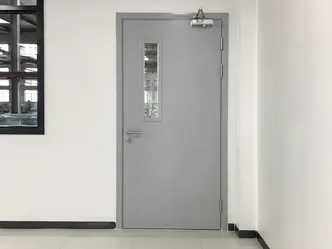
Fire test report — This is the foundation. It should reference the specific test standard (NFPA 252, EN 1634-1, BS 476-22, or AS 1530.4) and describe the exact assembly that was tested: door leaf construction, frame type, glazing (if any), intumescent seals, hinges, closer, and lock. If the test report describes a different assembly than what you're ordering, the certification may not cover your configuration.
Certification listing or classification report — From UL, Intertek/WHI, a European Notified Body, or the relevant regional body. This confirms the manufacturer is authorized to produce fire doors under ongoing surveillance, not just that a single sample passed a test once.
Declaration of Performance (DoP) — Required for CE-marked fire doors entering the EU market. The DoP ties the product to its tested performance characteristics and is a legal document under the Construction Products Regulation.
Factory production control (FPC) certificate — For CE-marked products, this is issued by the Notified Body after auditing the manufacturer's production process. It confirms the factory maintains the same construction, materials, and quality controls as the tested sample.
ISO 9001:2015 certificate — Not fire-specific, but it tells you the manufacturer operates under a documented quality management system. For markets where fire door certification infrastructure is less developed, ISO 9001 plus an SGS or equivalent third-party audit report is often the strongest evidence available.
SGS or third-party inspection report — Independent verification of production quality. We make our SGS reports available on request — they cover material verification, dimensional checks, and finish quality across production batches.
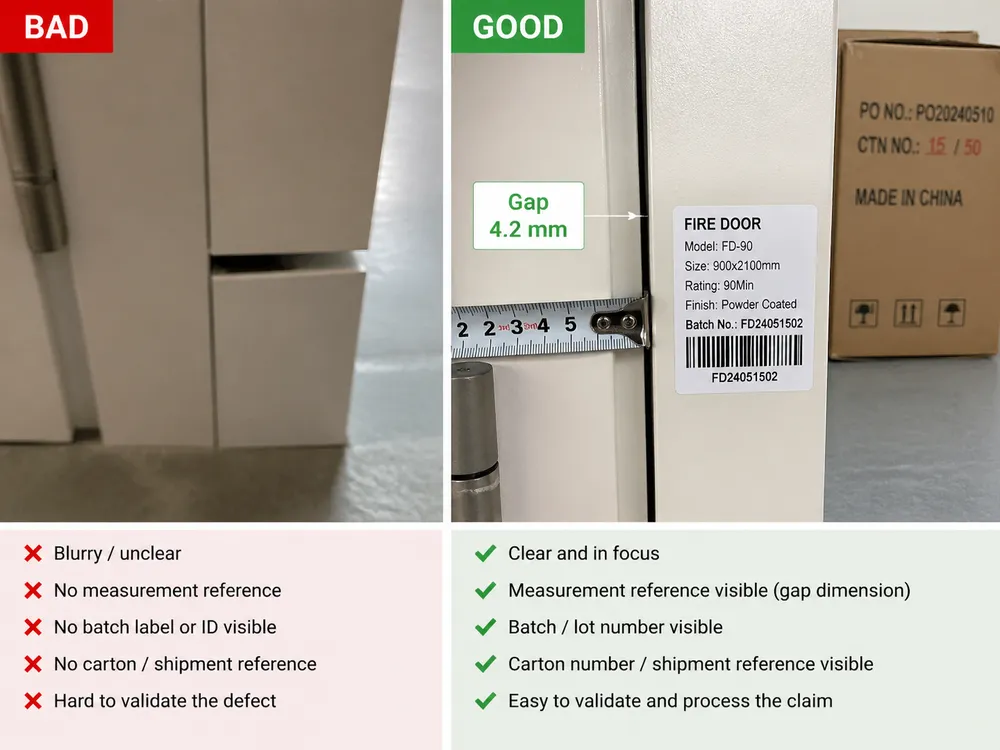
Batch traceability records — Every door in your shipment should trace back to a production batch with documented material inputs, inspection records, and test data. If a question comes up at the job site or during a building inspection, batch traceability is how you answer it. At our facility, every carton carries a barcode linked to the production batch record — material source, production date, line, and inspection sign-off are all retrievable.
Where sourcing mistakes actually happen
The fire door itself is rarely the problem. The compliance failures I see most often come from gaps between what was tested and what was ordered, or between what was ordered and what was shipped. Here are the patterns:
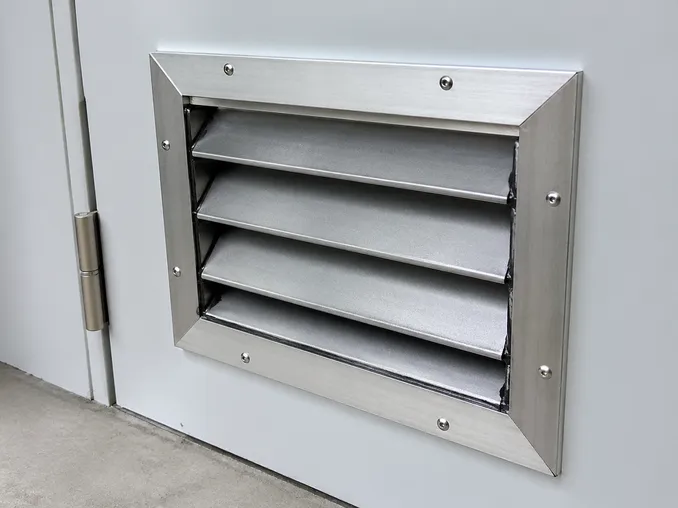
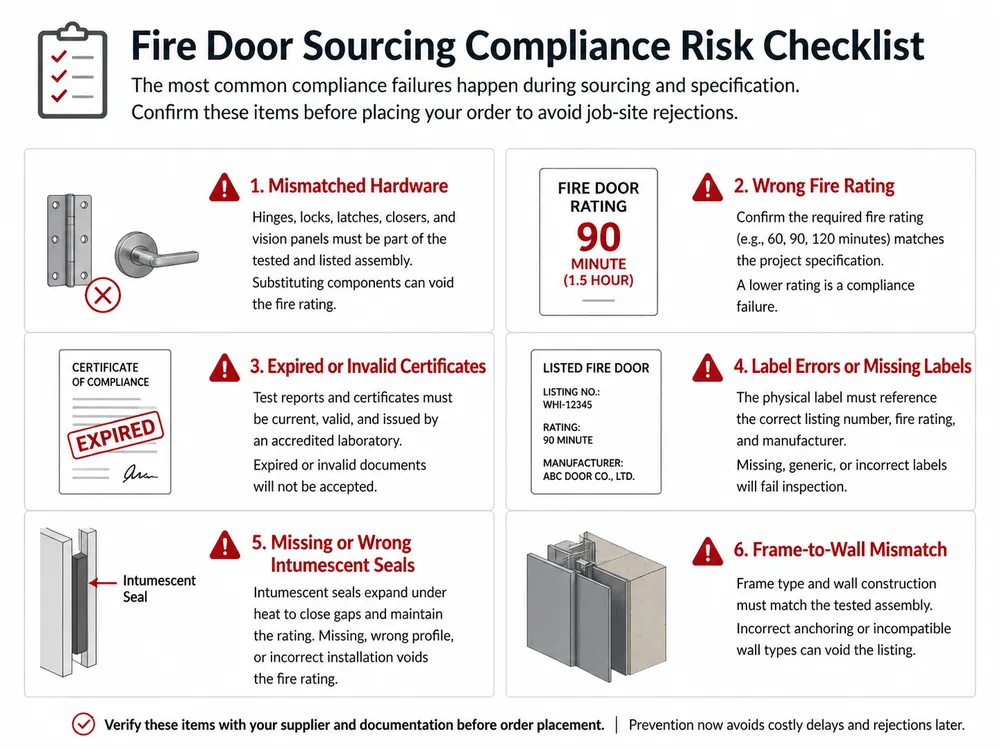
Mismatched hardware sets. A fire door is tested as a complete assembly — leaf, frame, hinges, closer, lock, and seals. If you swap any component after testing, the certification may no longer apply. The most common version of this: a buyer specifies a different lock or closer than what's on the test report, and the AHJ catches it during inspection. Your door certifications and standards page should be part of your pre-order review for exactly this reason.
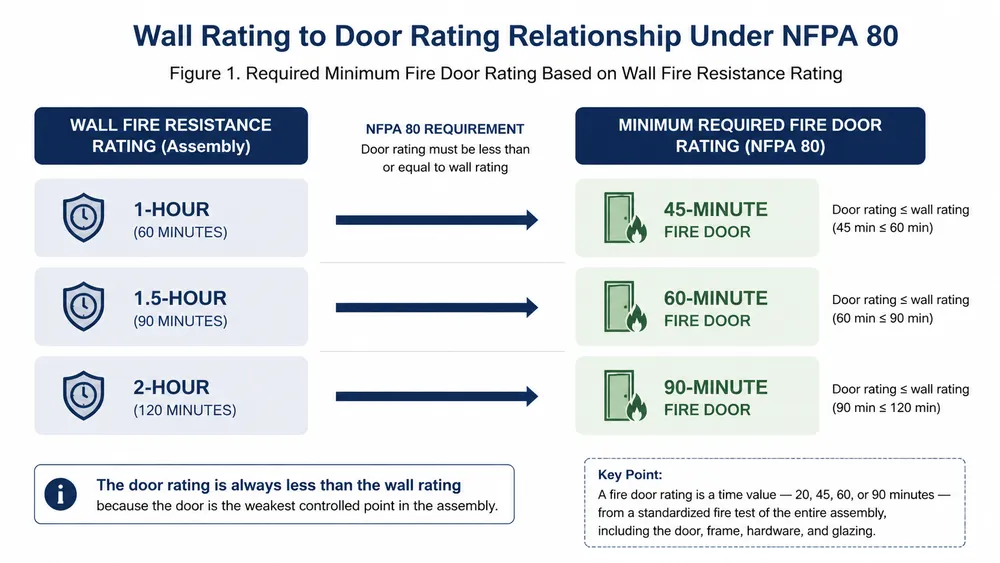
Wrong fire rating for the application. A 60-minute door where the code requires 90 minutes. Or a door tested for fire resistance only (integrity) when the project spec requires insulation performance too. In EN 1634-1 terminology, that's the difference between an E rating and an EI rating — and it's a detail that gets missed in RFQs more often than it should.
Invalid or expired certificates. Certification listings require periodic renewal and factory surveillance audits. If the manufacturer's listing lapsed or the certificate references an old facility address, the AHJ may reject it. Always check the issue date and validity period.
Labels that don't match the listing. The physical label on the door must reference the correct listing number, fire rating, and manufacturer. If the label is generic, missing, or references a different product line, the door fails inspection even if it's physically identical to the tested assembly.
No intumescent seals or wrong seal specification. Intumescent seals expand under heat to close the gap between door and frame. They're part of the tested assembly. If they're missing, the wrong profile, or installed incorrectly, the fire rating is void. We install intumescent seals at the factory as part of the assembly process — they're not a field-install afterthought.
Frame and wall condition mismatch. A fire door is tested in a specific frame type installed in a specific wall construction. If your project has a different wall condition (masonry vs. drywall vs. concrete block), confirm the test report covers that installation scenario. This is one of the most overlooked details in fire door procurement.

How to build an RFQ that prevents compliance problems
The quality of your fire door order starts with the quality of your RFQ. A vague request gets a vague quote — and vague quotes are where compliance gaps hide. Here's what your RFQ should specify:
- Destination market and applicable standard — "NFPA 80 for a U.S. commercial project" or "EN 1634-1 EI60 for a UAE Civil Defense submission" — be specific
- Required fire rating and performance class — 30, 60, 90, or 120 minutes; integrity only (E) or integrity plus insulation (EI) where applicable
- Door size and configuration — single leaf, double leaf, with or without transom, vision panel dimensions if glazed
- Frame type and wall condition — pressed steel frame, welded frame, or adjustable frame; masonry, drywall, or concrete block wall
- Hardware schedule — hinges (number, type, fire-rated), closer (overhead or concealed, hold-open if permitted), lock (mortise, cylindrical, panic hardware), and any access control integration
- Intumescent seal specification — profile type and location (leaf edge, frame rebate, or both)
- Finish and color — powder coat color (RAL number if possible), surface texture
- Quantity and delivery schedule
- Required documentation package — list every certificate, test report, and label requirement your project or import authority needs
When you send us an RFQ with this level of detail, our engineering team can confirm whether the requested configuration falls within our tested and certified assemblies, flag any components that would need substitution or additional testing, and quote accurately the first time. We have 15 engineers on staff who handle exactly this kind of spec review — it's a standard part of our quote process, not an extra service.
(One thing I'd add from experience: if you're importing fire doors for a market you haven't shipped to before, get the local AHJ requirements in writing before you finalize the order. Verbal confirmations from project managers have a way of changing between the order date and the inspection date.)
How factory-level controls connect to your compliance confidence
Certification starts at the test lab, but compliance is maintained on the production floor. The gap between a tested sample and a production run of 2,000 doors is where quality control either holds or breaks.
At our facility, fire door production runs on a dedicated line with documented procedures that mirror the tested assembly. The core fill material, steel gauge, seal specification, and hardware mounting positions are controlled by work instructions tied to the specific certification. When we run an NFPA 80 fire door, the line follows the NFPA 80 assembly protocol — not a generic door assembly process with a fire door label stuck on at the end.
Our 5-stage QC process applies to every fire door unit. Incoming steel is verified for gauge and grade. Formed panels are dimensionally checked against the certified assembly tolerances. Weld integrity is inspected with dye penetrant testing on fire door production specifically. Coating thickness is measured. And every completed door is test-fitted with its frame, hardware is cycled, and the unit is checked for squareness and gap consistency before it gets a label and goes into packing.
100% of outgoing fire doors are individually inspected — we don't use statistical sampling on fire-rated products. That practice came from our QC manager's background in automotive stamping, where safety-relevant parts get 100% inspection as a non-negotiable standard. The same logic applies here: a fire door is a life-safety product, and the inspection standard should reflect that.
Every unit ships with batch traceability. If a question comes up during your building inspection six months after delivery, you can give us the barcode from the carton and we'll pull the full production record — material source, production date, line assignment, and inspection sign-off — within the same day.
Frequently asked questions
What is the difference between a fire test report and a fire door certification?
A fire test report documents a single test event — one assembly, one lab, one date. A certification (UL listing, CE marking, Certifire certificate) means a certification body has verified that the manufacturer's ongoing production matches the tested assembly, typically through periodic factory audits. The test report proves the design works. The certification proves the factory consistently builds what was tested. You need both.
Can I use an NFPA 80 fire door in a project that requires EN 1634-1 compliance?
Not directly. NFPA 80 references NFPA 252 as the test method; EN 1634-1 is a different test protocol with different performance classifications (E, EI, EW). Some test labs can run both standards on the same assembly, and some certification bodies accept cross-referenced test data, but the AHJ in your destination market makes the final call. If your project requires EN 1634-1, confirm the door has been tested to EN 1634-1 specifically. We hold certifications under both NFPA 80 and CE (EN 1634-1), so we can supply against either standard from the same production line.
How do I verify that a manufacturer's fire door certification is still valid?
Check the certificate's issue date and expiry. For UL-listed products, you can search the UL Product iQ database online. For CE-marked products, ask for the current DoP and FPC certificate with the Notified Body's reference number. For Certifire, the certificate number is searchable on the Certifire website. If a manufacturer can't provide a current, verifiable certificate — or if the certificate references a different factory address than where your doors are being made — treat that as a red flag.
What happens if the hardware on my fire door doesn't match the tested assembly?
The fire rating is void for that unit. Fire doors are tested as complete assemblies. If you substitute a closer, lock, hinge, or seal that wasn't part of the original test, the certification no longer applies to that configuration. Some certification bodies maintain lists of approved alternative components, but you need to verify compatibility before ordering, not after installation.
Do I need a separate fire door certification for each export market?
In most cases, yes. A UL listing satisfies U.S. and often Canadian requirements, but it won't satisfy EU CE marking requirements or Australian AS 1905.1 requirements. Some markets accept test reports from internationally accredited labs as supporting evidence, but the certification or approval itself is market-specific. Build your documentation package around the destination market's requirements, and confirm with the local AHJ before you commit to a large order.
What fire door ratings does EUWOO manufacture?
We produce fire doors rated from 30 minutes to 120 minutes, tested under NFPA 252 and EN 1634-1. Standard production covers 60-minute and 90-minute ratings, which account for the majority of commercial project requirements across our export markets. For specific rating and configuration questions, send your project spec to our engineering team — they'll confirm whether the configuration falls within our certified assemblies or requires additional testing.