EUWOO

DNOOO blank theme is active for local preview.

Fire Door Rating Guide for Procurement — 20, 45, 60 and 90-Minute Ratings Compared

Wrong rating, wrong wall, failed inspection

A fire door rating is a time value — 20, 45, 60, or 90 minutes — that tells you how long the assembly held during a standardized furnace test. The assembly, not just the leaf. That distinction trips up more procurement teams than any other single detail in fire door sourcing.

When you specify a 60-minute fire door but pair it with a frame, seal, or closer that was tested to a different rating, the entire opening fails code inspection. The door leaf might be fine. The assembly is not. And the inspector doesn't care which component was correct — the opening either passes or it doesn't.

We see this play out in export shipments regularly. A buyer orders 500 doors at the right rating, installs them with locally sourced frames or hardware that weren't part of the tested assembly, and the building authority rejects the openings. The rework cost dwarfs the original door price. The fix is straightforward: specify the complete assembly at the RFQ stage, not just the leaf.

This guide breaks down what each rating actually requires in terms of construction, hardware, glazing, and documentation — and what you need to confirm before placing an order.

What the rating number actually controls

The minute value on a fire door rating comes from a furnace test conducted under a recognized standard — NFPA 252 and UL 10C in North America, EN 1634-1 in Europe, or AS 1905.1 in Australia. The test subjects a complete door assembly (leaf, frame, glazing, seals, hardware) to a controlled fire curve and measures how long the assembly maintains integrity and, depending on the standard, insulation.

Two things matter for your sourcing decisions here:

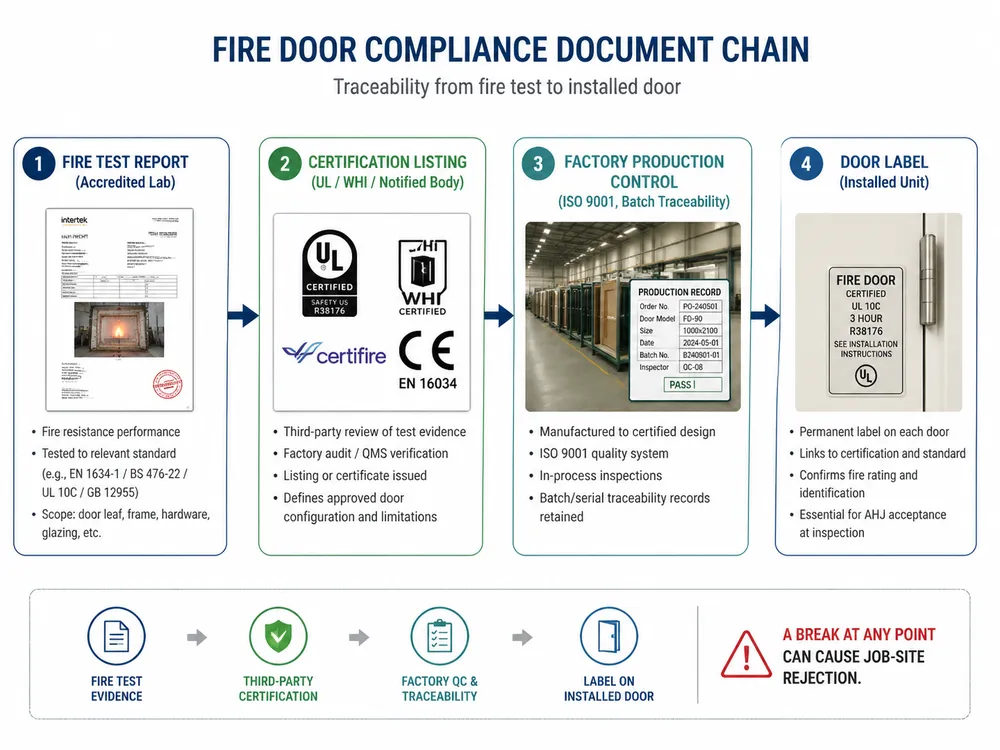
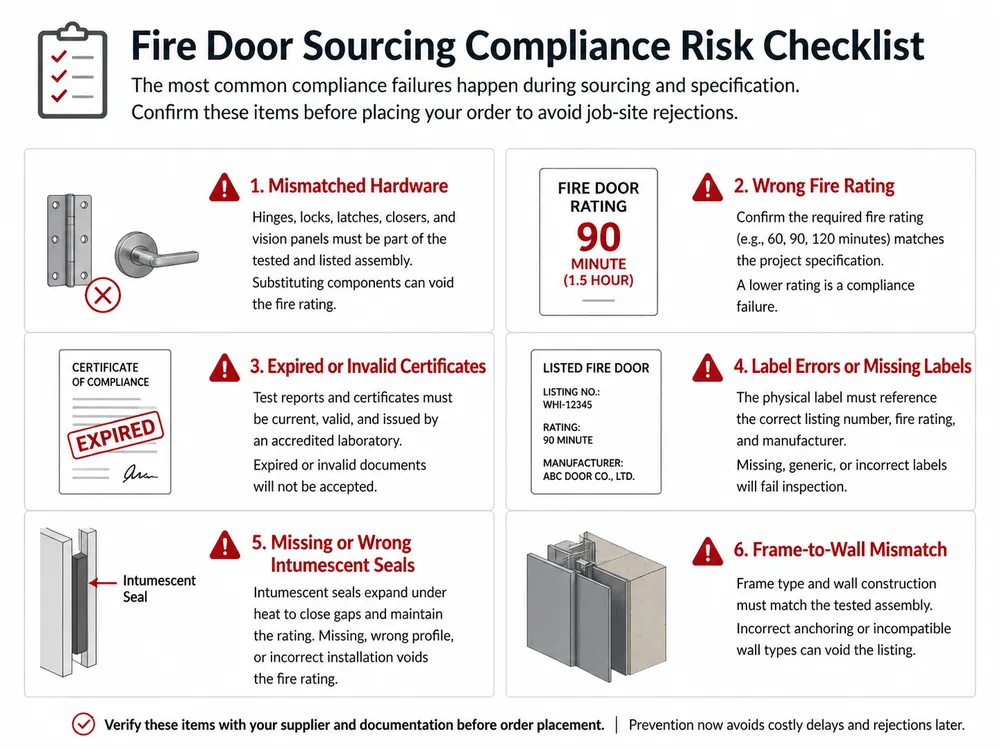
The rating applies to the tested assembly configuration. Change the frame profile, swap the intumescent seal brand, use a different closer, and the test certificate no longer covers what you're installing. This is why we always ship fire doors with matched frames and pre-installed seals — it keeps the tested configuration intact through to the job site.

The rating must match or exceed the wall's fire resistance rating. A 2-hour fire-rated wall typically requires a minimum 90-minute fire door. A 1-hour wall typically requires a 45-minute door (under NFPA 80) or a 60-minute door (under some regional codes). The wall dictates the door, not the other way around. If you're sourcing for a project and the architect hasn't confirmed the wall rating, you're guessing — and guessing on fire ratings creates liability.
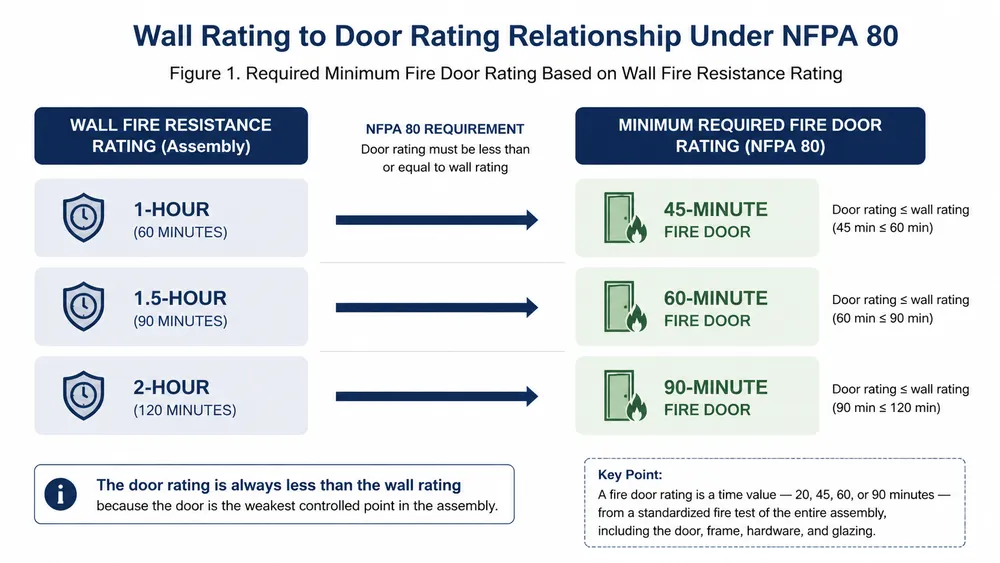
Chart showing the relationship between wall fire resistance ratings and required fire door ratings under NFPA 80

Fire door rating chart — 20, 45, 60, and 90 minutes compared

Here's where the ratings diverge in ways that directly affect your order spec, landed cost, and project risk.

Specification 20-minute 45-minute 60-minute 90-minute
Typical wall rating 1-hour (corridor/room) 1-hour 1.5-hour 2-hour
Common applications Corridor doors, room separations, low-risk interior openings Stairwell doors, office separations, most commercial interiors Hospital corridors, school stairwells, higher-risk separations Shaft walls, high-hazard separations, industrial fire barriers
Leaf construction Single-skin steel or mineral core, thinner profile Mineral core with steel skins, standard profile Denser mineral core, heavier gauge steel skins Maximum-density core, heaviest gauge skins, often reinforced stiles
Typical leaf thickness 40-44 mm 44-50 mm 50-54 mm 54-60+ mm
Intumescent seal Single-layer perimeter seal Full perimeter intumescent seal Full perimeter + smoke seal combination Full perimeter + smoke seal, often dual-layer
Glazing allowance Up to 929 cm² (1 sq ft) wired glass or rated ceramic Up to 929 cm² standard; larger with rated ceramic Reduced area limits; rated ceramic or intumescent-laminate only Minimal or no glazing; rated ceramic with strict area limits
Frame requirement Standard pressed steel frame Tested steel frame with intumescent seal groove Heavier gauge frame, deeper seal groove, tested configuration Heaviest gauge frame, reinforced anchoring, full tested assembly
Closer requirement Standard overhead closer UL-listed closer, minimum size 3 UL-listed closer, size 4+, backcheck recommended UL-listed closer, size 4-5, backcheck and delayed action common
Hinge requirement Steel butt hinges, minimum 2 Steel ball-bearing hinges, minimum 3 Steel ball-bearing hinges, minimum 3, heavier gauge Steel ball-bearing hinges, minimum 3, spring hinges common
Latch/lock Standard latch or passage set Fire-rated latch set, positive latching required Fire-rated mortise lock, positive latching Fire-rated mortise lock, positive latching, panic hardware common
Unit weight (approx.) 25-35 kg 35-50 kg 50-65 kg 65-90+ kg
Freight impact Standard KD packing Standard KD packing Heavier cartons, fewer units per 40HQ Heaviest cartons, significantly fewer units per container

The weight column matters more than most buyers expect. A 90-minute fire door at 80+ kg per leaf changes your container loading math — you'll fit roughly 30-40% fewer units per 40HQ compared to a 20-minute door. That shifts your landed cost per unit, and it changes the hardware spec on site (heavier hinges, stronger closers, reinforced frame anchoring). Factor this into your cost model early, not after the container is booked.

How rating selection changes what you're actually buying

Core fill and leaf construction

The rating drives the core. A 20-minute fire door can use a relatively thin mineral wool or honeycomb core between steel skins. Move to 45 minutes and the core density increases — we typically use a perlite-vermiculite composite board at this rating, which gives consistent thermal performance without the weight penalty of solid calcium silicate.

At 60 and 90 minutes, the core becomes the most expensive component in the door. We're using high-density calcium silicate or ceramic fiber board, and the steel skin gauge goes up to handle the thermal expansion stress during the test. (The core material is where most of the cost difference between ratings lives — a 90-minute door isn't just a thicker version of a 45-minute door. The internal construction is fundamentally different.)

Intumescent seals and smoke control

Every fire-rated door needs an intumescent seal — the strip that expands under heat to close the gap between leaf and frame. At 20 minutes, a single-layer graphite-based seal in a routed groove handles the job. At 45 and 60 minutes, you're looking at a combined intumescent-plus-smoke seal, because most codes require smoke control at these ratings.

At 90 minutes, we often run a dual-layer seal configuration: intumescent on the leaf edge and a secondary smoke seal on the frame stop. The seal has to survive the full 90-minute test without losing expansion capacity, which limits your material options and means the seal groove dimensions change. If you're sourcing frames separately from leaves, confirm the seal groove spec matches — a 3mm groove cut for a 20-minute seal won't accept the 5mm seal needed for a 90-minute assembly.

Glazing limits tighten as ratings climb

This is where buyer expectations and code reality collide. Many project specs call for vision panels in fire doors, but the allowable glazing area shrinks as the rating increases.

A 20-minute door can accept up to roughly 929 cm² of wired glass or fire-rated ceramic. At 45 minutes, the same area is possible but only with rated ceramic glazing — wired glass alone won't pass the test at this duration in most standards. At 60 minutes, the glazing area drops and the glass must be intumescent-laminate or rated ceramic with a tested frame kit. At 90 minutes, many tested configurations allow no glazing at all, or only a very small rated vision lite.

If your project requires large vision panels in a high-rated opening, you may need to rethink the opening design — split it into a door-plus-sidelight configuration, or use a rated curtain wall system adjacent to the door. We can advise on tested configurations that maximize vision area within the rating, but the physics of the furnace test set hard limits. Better to know this at the RFQ stage than after the doors are manufactured.
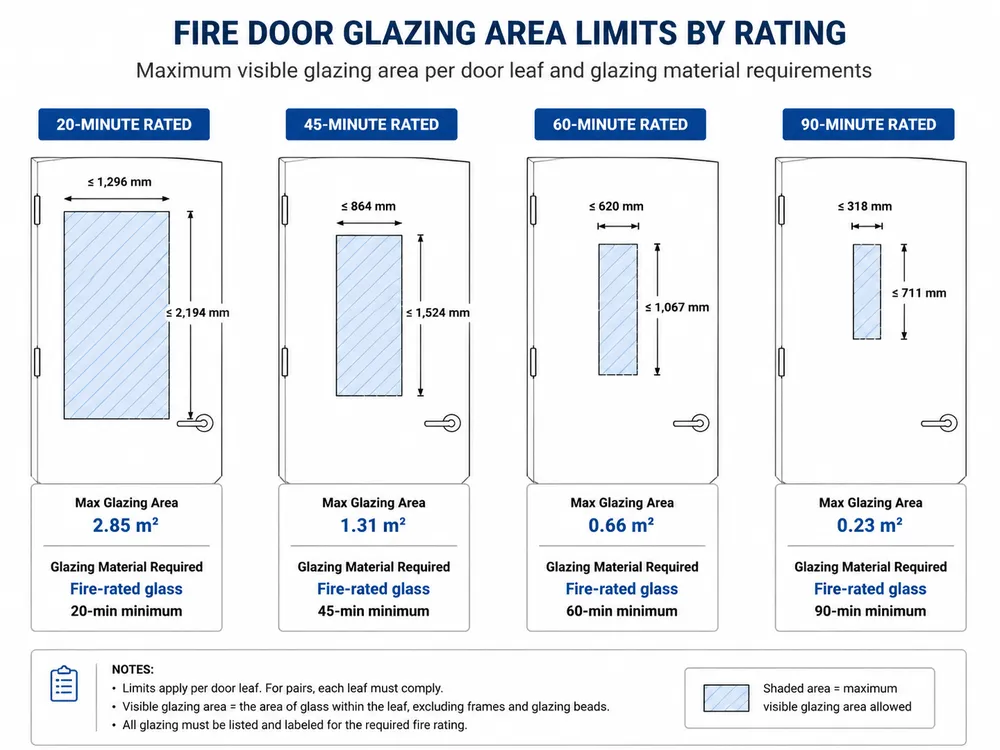
Diagram showing maximum glazing area allowed in fire doors at 20, 45, 60, and 90-minute ratings

Hardware gets heavier and more specific

A 20-minute fire door works with standard commercial hardware. Once you cross into 45-minute territory, every piece of hardware on the door must be fire-rated and listed for that specific rating duration.

Closers are the most common failure point in fire door inspections. The closer must be UL-listed (or CE-marked, depending on your market), sized correctly for the door weight and width, and capable of latching the door fully from any open position. At 60 and 90 minutes, the door weight alone demands a size 4 or 5 closer — undersized closers won't latch a 70 kg door reliably, and an unlatched fire door during a fire event is the same as no door at all.

Hinges follow the same logic. Heavier doors need ball-bearing hinges rated for the weight, and most codes require a minimum of three hinges on fire-rated openings. At 90 minutes, spring hinges or continuous hinges become common because the door weight makes standard butt hinges a long-term reliability risk.

Panic hardware (push bars, exit devices) adds another layer. If the opening requires panic hardware, it must be fire-rated to the same duration as the door. Not all panic hardware is available at all ratings — 90-minute rated panic devices are a smaller product category with fewer manufacturers, which can affect your lead time and cost.

Standards and certifications — what your RFQ must reference

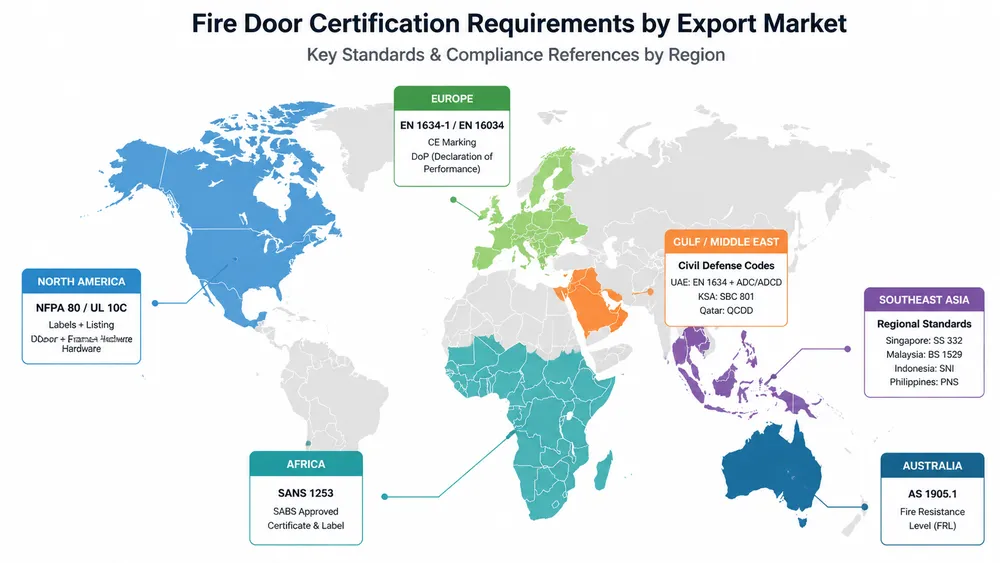
Fire door ratings don't exist in a vacuum. The rating is only valid under a specific test standard, and different markets recognize different standards. Specifying "60-minute fire door" without naming the standard is like ordering steel without naming the grade — you'll get something, but it might not be what your project needs.

Market Primary standard Test method Notes for procurement
North America NFPA 80, NFPA 252 UL 10C, UL 10B Positive latching required. Door must be listed by a NRTL (UL, Intertek, etc.). Label on every door.
Europe / UK EN 16034, EN 1634-1 EN 1634-1 CE marking required. Performance declared in classification report. Integrity (E) and insulation (I) rated separately.
Middle East Often references EN or NFPA Varies by emirate/country Dubai Civil Defence has specific requirements. Confirm local AHJ acceptance before ordering.
Australia / NZ AS 1905.1 AS 1530.4 FRL rating format: -/60/30 (structural adequacy/integrity/insulation). Different notation system.
Southeast Asia Varies — often EN or BS EN 1634-1 or BS 476 Part 22 Singapore SCDF, Malaysia BOMBA each have specific acceptance criteria.

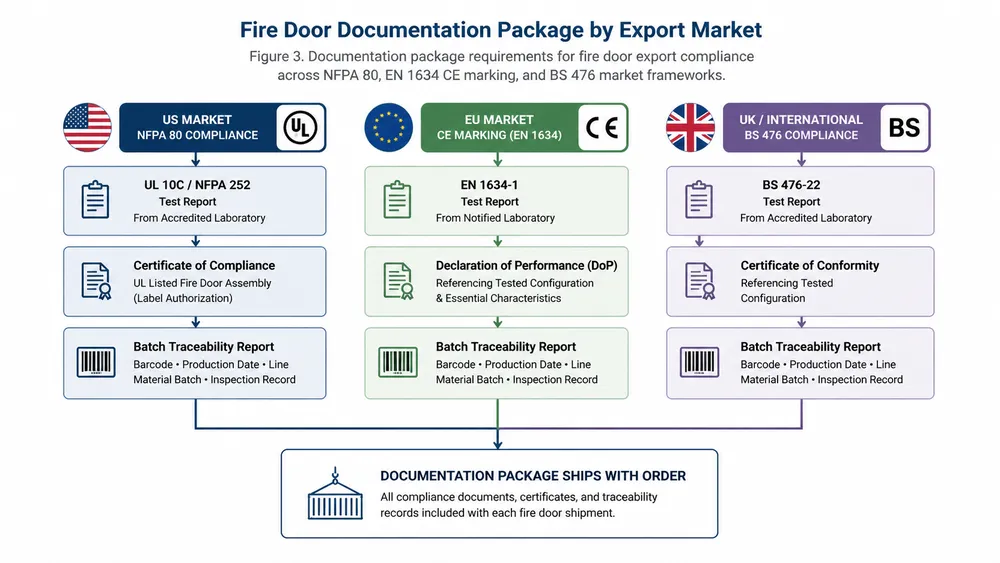
We hold NFPA 80 certification and CE marking, and we've shipped fire doors into all five of these market regions. The documentation package changes by destination — a North American shipment includes UL-format test reports and NRTL listing labels; a European shipment includes the Declaration of Performance and CE label. When you send an RFQ, include your destination market so we can confirm which certification and documentation package applies to your order.

(One thing we've learned from 11 years of export fire door work: the standard listed on the project spec and the standard the local authority actually enforces are not always the same. If you're shipping to a market you haven't supplied before, verify acceptance with the local Authority Having Jurisdiction before committing to a large order.)

Specification mistakes that cost you on site

After more than a decade of producing and shipping fire doors, we've seen the same sourcing mistakes repeat across markets. These aren't obscure edge cases — they're the errors that show up in 20-30% of first-time fire door orders.

Specifying the leaf rating without the frame. The most common one. You order a 60-minute door leaf, install it in a locally fabricated frame that was never tested with that leaf, and the assembly has no valid test certificate. The inspector is right to reject it. Always specify leaf and frame as a tested pair.

Mixing hardware from different test reports. A closer tested with Door Assembly A and a hinge tested with Door Assembly B don't automatically combine into a valid Assembly C. If you're sourcing hardware separately, confirm that every component appears on the same test report or listing.

Ignoring the positive latching requirement. NFPA 80 requires fire doors to positively latch — the latch bolt must engage the strike plate without manual intervention. Passage-function locksets (no latch bolt) fail this requirement. We've seen entire floors of doors rejected because the lockset spec was copied from a non-rated door schedule.

Ordering the wrong seal groove dimension. If you source frames from one supplier and leaves from another, the intumescent seal groove width and depth must match. A 3mm x 15mm groove won't accept a 5mm x 20mm seal. We machine our seal grooves to match the specific seal profile for each rating — if you're mixing sources, get the groove spec in writing.

Assuming all ratings ship on the same lead time. A 20-minute door uses standard materials and runs on our regular steel fire door production line. A 90-minute door uses specialty core materials and heavier gauge steel that may need to be ordered separately. Plan for longer lead times on higher ratings, especially on large-quantity orders.
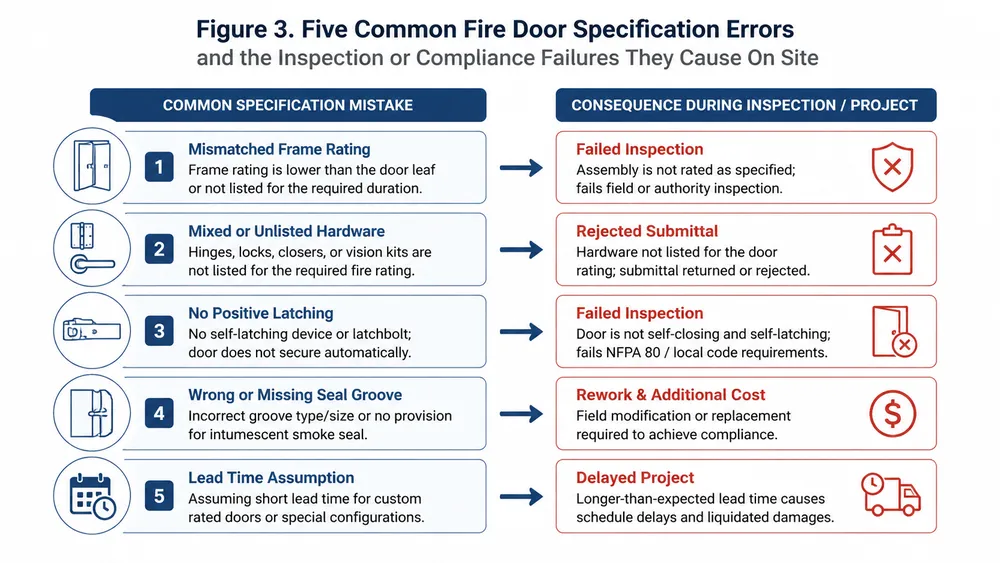
Flowchart showing common fire door specification mistakes and their consequences during inspection

RFQ checklist — what to include when you request a quote

A complete fire door RFQ eliminates back-and-forth and gets you an accurate quote faster. Here's what we need to confirm a compliant specification:

  • Fire rating: 20, 45, 60, or 90 minutes
  • Applicable standard: NFPA 252/UL 10C, EN 1634-1, AS 1905.1, or project-specific
  • Door size: Width x height, single or double leaf
  • Opening direction: Left-hand, right-hand, or pair configuration
  • Frame type: Knock-down, welded, or wrap-around; wall condition (masonry, drywall, concrete)
  • Material gauge: Leaf and frame steel thickness
  • Core type: If you have a preference or project spec requirement
  • Glazing: Vision panel size, glass type, and whether the vision lite kit must be included
  • Intumescent seal: Included in assembly or supplied separately
  • Closer: Brand/model preference, or specify by size and function
  • Lockset/latch: Function (passage, storeroom, classroom, panic), brand preference
  • Hinges: Quantity, type (butt, continuous, spring), weight rating
  • Panic hardware: If required — specify function and rating
  • Finish: Powder coat color (RAL number), primer only, or galvanized
  • Quantity: Total units, broken down by configuration if multiple specs
  • Destination market: Country and port — this determines certification, labeling, and documentation requirements
  • Project timeline: When doors need to arrive on site

Missing any of these creates ambiguity, and ambiguity on a fire door order creates risk. If you don't have all the answers yet, send what you have — our engineering team can help you fill in the gaps based on the applicable code and your project conditions. Request a quote with your available specs and we'll respond with a detailed specification review.

How we build and verify fire-rated doors at EUWOO

We produce fire doors across all four standard ratings on our dedicated fire door production lines. The construction process changes meaningfully between ratings, which is why we run fire doors on separate lines from our standard steel door production — the core materials, seal configurations, and QC checkpoints are different enough that mixing them on the same line creates quality risk.

Our 5-stage quality control process applies to every fire door, but the inspection criteria tighten at higher ratings. At 90 minutes, we're checking core density with a calibrated scale at the assembly station, verifying seal compression with a gap gauge at every frame-to-leaf junction, and cycling the closer 10 times to confirm full positive latching before the door moves to packing. (We added the closer cycling step after a batch of 60-minute doors shipped with closers that latched on the test bench but didn't latch consistently once mounted on the heavier production doors. Small difference in arm geometry — caught it in QC, not on site.)

Every fire door ships with batch-traceable documentation: test certificate reference, production date, line number, QC sign-off, and the specific seal and hardware configuration installed. If an inspector on your job site has a question about a specific door, you can trace it back to the production record within minutes.

For commercial fire door projects with mixed ratings across different openings — which is most commercial buildings — we can produce and pack by floor or zone, so your installation crew isn't sorting 500 doors on site to figure out which rating goes where.

Frequently asked questions

Can I use a higher-rated door in a lower-rated wall?

Yes. A 90-minute door installed in a 1-hour wall exceeds the minimum requirement and will pass inspection. The practical question is whether the cost and weight premium are justified. A 90-minute door costs more, weighs more, and requires heavier hardware — if the wall only needs a 45-minute door, you're paying for performance you don't need and adding installation complexity. Match the rating to the wall requirement unless the project spec explicitly calls for over-rating.

What's the difference between an E rating and an EI rating?

Under EN 1634-1, fire doors receive separate classifications for integrity (E) and insulation (I). An E-rated door prevents flame and hot gas passage for the rated duration. An EI-rated door also limits heat transfer through the unexposed face. North American standards (NFPA 252, UL 10C) test for both but report a single rating. If you're sourcing for a European or Middle Eastern project, confirm whether the spec requires E only or EI — the construction and cost differ.

Do intumescent seals need to be replaced over the door's lifetime?

Intumescent seals have a service life, and most manufacturers recommend inspection every 12 months and replacement if the seal shows cracking, compression set, or damage. For your buyers and end users, this is a maintenance item — worth noting in your product documentation if you're distributing fire doors. We use graphite-based intumescent strips that maintain expansion capacity for 10+ years under normal interior conditions, but physical damage from door abuse is the more common replacement trigger.

How do I verify that a fire door test certificate is legitimate?

Request the full test report number, the testing laboratory name, and the NRTL listing number (for North American markets) or the notified body number (for CE-marked products). Cross-reference the listing number on the NRTL's online database — UL, Intertek, and other bodies maintain searchable public listings. If the supplier can't provide a traceable test report number, treat that as a red flag. We provide full test certificate references with every fire door shipment and can supply the complete test report on request.

What's the typical lead time difference between ratings?

On our lines, 20-minute and 45-minute fire doors run on standard production schedules — typically 25-35 days from deposit confirmation for catalog configurations. 60-minute doors may add 5-7 days depending on core material availability. 90-minute doors often require 35-45 days because the specialty core board and heavier gauge steel may need to be ordered from approved suppliers. Custom sizes or non-standard hardware at any rating add time. Send your quantity and spec to get an accurate lead time for your specific configuration.
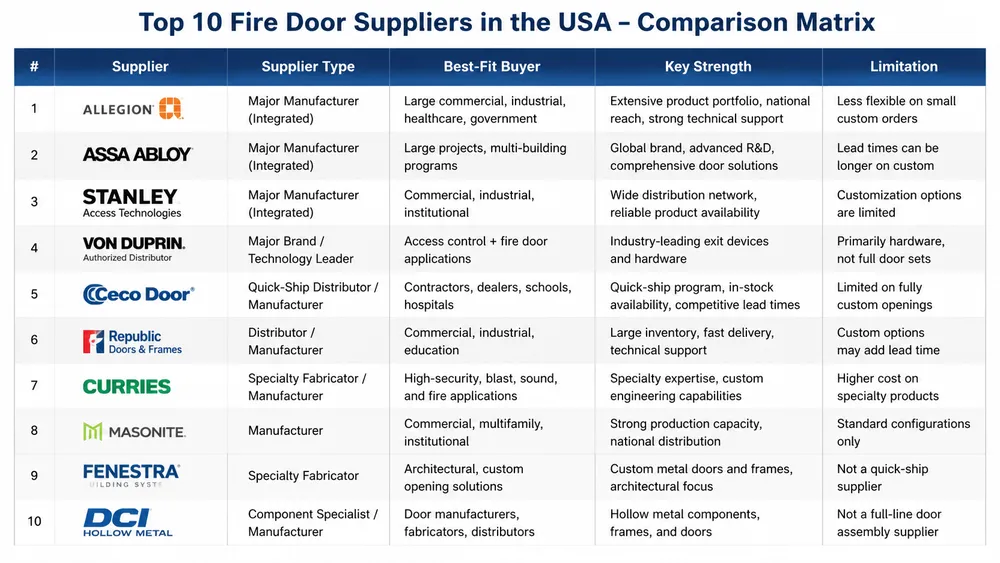
Top 10 Fire Door Suppliers in the USA for Commercial and Industrial Projects

The Sourcing Problem Behind Every Fire Door RFQ

If you're sourcing fire-rated doors for a commercial or industrial project in the US, you already know the basics: the door needs a valid fire rating, the label has to match the opening, and the AHJ will reject anything that doesn't comply with NFPA 80. What's harder to figure out is which supplier model actually fits your procurement situation — because the US fire door market is split across large integrated manufacturers, regional fabricators, quick-ship distributors, and overseas factories, and each model trades off differently on price, lead time, customization, and documentation.

Most supplier lists online give you brand names and move on. That's not enough when you're comparing a 500-door hospital project against a 50-unit tenant improvement, or when you're an importer building a private-label fire door program and need container-scale pricing with traceable QC. The supplier that's right for a rush replacement order is rarely the best fit for a multi-year distribution contract.

This guide covers 10 real fire door suppliers serving the US market — domestic manufacturers, distributors, and specialists — then explains where factory-direct import sourcing fits for buyers whose volume, margin targets, or customization needs outgrow what the domestic channel offers.

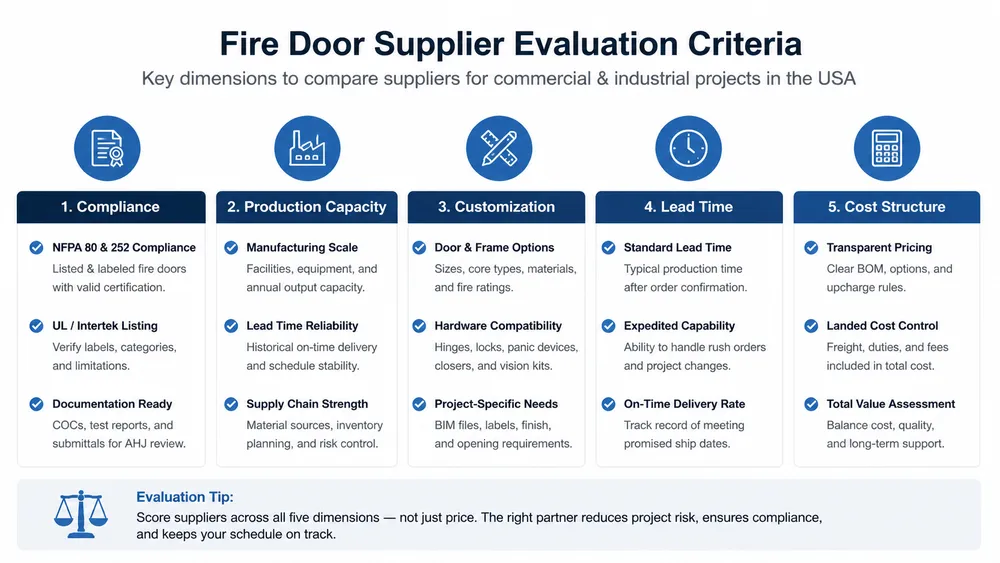
Evaluation criteria framework for comparing fire door suppliers in the USA including compliance, capacity, customization, and lead time

How to Evaluate a Fire Door Supplier Before You Send an RFQ

Before comparing specific companies, it helps to know what separates a reliable fire door supplier from one that will cost you time and rework. These are the criteria that matter at the procurement level — not marketing claims, but the things that determine whether your doors arrive compliant, on time, and within budget.

Fire rating and labeling documentation. Every fire door needs a valid label from an accredited testing lab (UL, Intertek/WHI, or equivalent). The supplier should be able to confirm the specific listing number, the test standard (UL 10C, UL 10B, or NFPA 252), and the rating (20-min, 45-min, 60-min, 90-min, or 3-hour). If they can't produce this documentation before you order, that's a red flag — you'll be chasing paper when the inspector shows up.

Door and frame construction. For hollow metal fire doors, ask about steel gauge (16-ga and 18-ga are standard for commercial fire doors), core material (mineral core, polystyrene, or steel stiffened), and edge construction. The frame matters just as much — a fire-rated door in a non-rated frame is a failed assembly, and the AHJ won't sign off on it.

Hardware prep and compatibility. Fire doors ship with specific preps for hinges, locksets, closers, and exit devices. If the supplier's standard prep doesn't match your specified hardware, you need to know that before production — field modification of a labeled fire door voids the listing. (I've seen containers of doors arrive with the wrong hinge prep because the buyer assumed "standard" meant the same thing to both parties. It's a $15 conversation that prevents a $15,000 problem.)

Customization range. Standard catalog fire doors cover most openings, but commercial projects regularly need non-standard sizes, vision lite cutouts, specific glazing ratings, custom finishes, or transom panels. Some suppliers handle this routinely; others treat every custom request as a special order with a 4-week adder.

Lead time and capacity. Domestic manufacturers typically quote 4–8 weeks for standard fire doors and 8–12 weeks for custom. Quick-ship distributors can deliver in 2–5 days from stock. Factory-direct import runs 30–45 days plus ocean freight. The right lead time depends on your project schedule and whether you're buying for a single job or stocking inventory.

Compliance documentation package. Beyond the door label, you may need mill test reports, fire test reports, product data sheets, and installation instructions for the project file. Suppliers who export regularly tend to have this documentation standardized; smaller regional shops may need to pull it together on request.

10 Fire Door Suppliers Serving the US Commercial Market

The companies below represent the range of supplier models available to US buyers — from large integrated manufacturers with national distribution to regional specialists and quick-ship operations. This is a sourcing landscape, not a ranked competition. Your best supplier depends on your project size, timeline, customization needs, and cost structure.

1. Ceco Door (ASSA ABLOY)

Supplier type: Major integrated manufacturer Website: cecodoor.com

Ceco Door is one of the largest hollow metal door and frame manufacturers in North America, operating under the ASSA ABLOY group. They produce fire-rated hollow metal doors and frames across multiple US manufacturing facilities, covering ratings from 20 minutes to 3 hours. Ceco's strength is scale and specification depth — they maintain UL and WHI listings across a wide range of configurations, and their product data integrates with major architectural specification platforms.

For large commercial projects where the architect has already specified Ceco by name, the procurement path is straightforward through their distributor network. The trade-off: lead times on custom configurations can stretch, and pricing runs through distribution layers that add margin at each step. If you're a distributor or importer looking for private-label supply, Ceco is a competitor, not a sourcing partner.

2. Steelcraft (Allegion)

Supplier type: Major integrated manufacturer Website: allegion.com (Steelcraft brand)

Steelcraft is Allegion's hollow metal door and frame brand, with manufacturing in the US and a distribution network that covers most major metro markets. Their fire-rated product line includes standard and custom hollow metal doors, frames, and borrowed lite assemblies. Steelcraft's specification tools and BIM objects make them a common choice on architect-driven projects.

Similar to Ceco, Steelcraft's distribution model means your landed cost includes manufacturer margin plus distributor margin. Their strength is specification compliance and project documentation — if you're bidding a job where the spec names Steelcraft, you're buying Steelcraft. For open-spec projects where you have substitution flexibility, the cost comparison against other sources is worth running.

3. Republic Doors and Frames

Supplier type: Domestic manufacturer Website: republicdoor.com

Republic Doors and Frames manufactures hollow metal doors and frames in McKenzie, Tennessee. They cover standard and custom fire-rated configurations and have built a reputation for handling mid-size commercial projects where the order isn't large enough to get priority attention from the biggest manufacturers but still needs full compliance documentation.

Republic's value proposition sits in the middle of the market — more responsive than the largest manufacturers on custom work, with domestic production that keeps lead times shorter than import alternatives. They're a solid option for contractors and regional distributors who need reliable fire door supply without the overhead of navigating a global manufacturer's distribution chain.

4. CURRIES (ASSA ABLOY)

Supplier type: Major integrated manufacturer Website: curries.com

CURRIES is another ASSA ABLOY brand, manufacturing hollow metal doors and frames with a focus on commercial and institutional projects. Their product range overlaps with Ceco in many areas, but CURRIES has historically been strong in the education and healthcare segments where fire-rated openings are specified in high volume.

The procurement dynamic is similar to other ASSA ABLOY brands — you're buying through authorized distributors, and the pricing reflects the full distribution chain. CURRIES' fire door listings are well-documented, and their frames are widely specified by architects in the institutional space.

5. Mesker Door

Supplier type: Domestic manufacturer Website: meskerdoor.com

Mesker has been manufacturing hollow metal doors and frames since the 1800s — one of the oldest names in the US door industry. Based in Huntington, Indiana, they produce fire-rated doors and frames for commercial, industrial, and institutional applications. Mesker's product line covers standard and custom configurations, and they maintain UL listings across their fire-rated range.

Mesker's appeal is domestic manufacturing with a long track record. They're particularly known in the industrial and institutional segments. For buyers who value a direct relationship with a US manufacturer (rather than buying through a multi-brand distributor), Mesker is worth including in your RFQ set.

6. Trudoor

Supplier type: Quick-ship distributor / fabricator Website: trudoor.com

Trudoor operates a different model from the large manufacturers — they focus on fast turnaround for hollow metal doors and frames, including fire-rated configurations. Their value proposition is speed: stock doors and frames can ship in 2–5 business days, and custom orders move faster than typical manufacturer lead times.

If you need fire doors for a project that's already behind schedule, or you're replacing a failed unit before an inspection, Trudoor's quick-ship model solves a real problem. The trade-off is that their pricing reflects the speed premium, and their customization range is narrower than what a full manufacturer offers. For emergency and small-quantity needs, they're hard to beat on turnaround. For 500-door projects, the economics point elsewhere.

7. National Guard Products (NGP)

Supplier type: Fire door hardware and component specialist Website: quincyil.com (National Guard Products)

NGP is not a door manufacturer — they specialize in fire door hardware, gasketing, thresholds, and sealing systems. I'm including them because fire door compliance isn't just about the door leaf; it's about the complete assembly. NGP's fire-rated gasketing and intumescent seals are specified on a large percentage of commercial fire door installations in the US, and their technical documentation is some of the best in the industry for helping buyers understand assembly-level compliance.

If your fire door supplier doesn't address gasketing and sealing as part of the assembly, NGP fills that gap. They're a complementary supplier, not a replacement for a door manufacturer — but ignoring the hardware and sealing side of fire door procurement is how assemblies fail inspection.

8. Hollow Metal Xpress (HMX)

Supplier type: Quick-ship distributor Website: hollowmetalxpress.com

HMX focuses on fast delivery of hollow metal doors and frames, including fire-rated units. They stock standard sizes and configurations for quick turnaround and can handle custom orders on shorter timelines than most full-line manufacturers. Their model is similar to Trudoor's — speed and convenience for buyers who can't wait 6–8 weeks.

HMX is a good option for small-to-medium orders where time is the primary constraint. For large-volume procurement or projects requiring extensive customization, you'll likely need to go upstream to a manufacturer or consider factory-direct sourcing.

9. Ambico

Supplier type: Specialty manufacturer (blast, bullet, and fire-rated) Website: ambico.com

Ambico manufactures specialty steel doors including fire-rated, blast-resistant, and bullet-resistant configurations. Based in Canada with distribution into the US market, they serve projects where the fire door also needs to meet additional performance requirements — government buildings, embassies, data centers, and high-security facilities.

Ambico occupies a niche that the large commodity manufacturers don't prioritize. If your project requires a fire-rated door that also meets forced-entry resistance or blast criteria, Ambico is one of the few manufacturers with tested and listed products in that overlap zone. For standard commercial fire doors without specialty requirements, their pricing will be higher than commodity alternatives.

10. DCI Hollow Metal

Supplier type: Regional manufacturer / custom fabricator Website: dcihollowmetal.com

DCI Hollow Metal is a custom hollow metal door and frame fabricator serving the US market. They handle non-standard sizes, unusual frame configurations, and project-specific requirements that fall outside the standard catalogs of the major manufacturers. Their fire-rated products carry appropriate listings, and they're known for working directly with contractors on field-condition challenges.

DCI's strength is flexibility on custom work — the kind of openings where the field conditions don't match any standard catalog size and someone needs to fabricate a solution that still carries a fire rating. For standard high-volume orders, the major manufacturers will be more cost-effective. For the 15% of openings on a project that don't fit the catalog, a fabricator like DCI earns their premium.

Comparison matrix of 10 US fire door suppliers showing supplier type, best-fit buyer, and key strengths

Domestic Supplier Strengths — and Where They Hit a Ceiling

The 10 suppliers above cover the domestic fire door landscape well. For many projects, buying from a US manufacturer or distributor is the right call. Domestic supply gives you shorter lead times (2–8 weeks depending on the supplier model), easier communication in the same time zone, and simpler logistics — no customs clearance, no ocean freight, no container minimum.

Where domestic supply works best:

  • Single-project orders under 100 doors where speed matters more than unit cost
  • Emergency replacements and inspection-driven rush orders
  • Projects where the architect has specified a particular manufacturer by name
  • Small contractors who don't have the cash flow or warehouse space for container-scale purchasing

Where domestic supply starts to cost you:

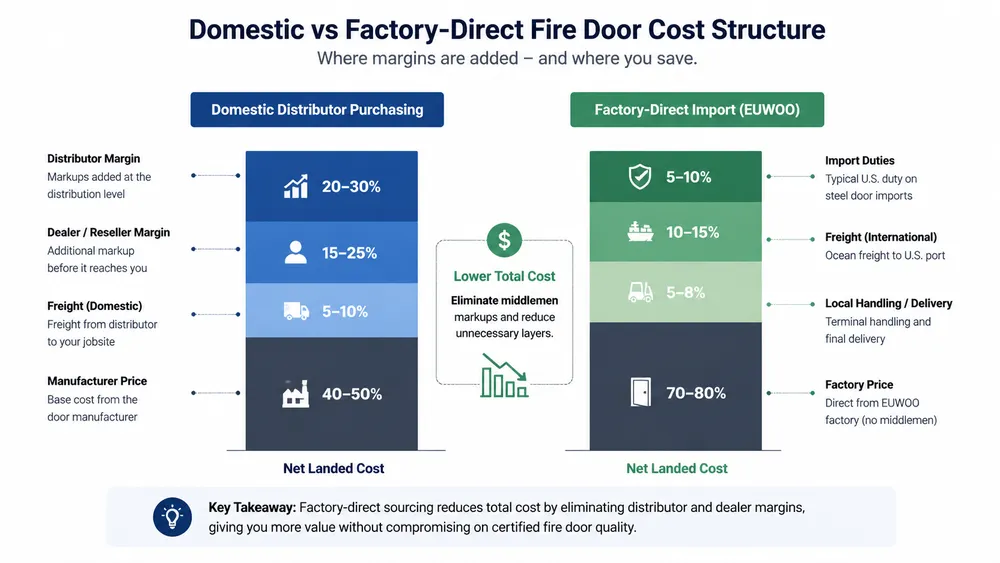
  • Margin compression on repeat volume. If you're a distributor buying 500+ fire doors per year through another manufacturer's distribution chain, every layer between the factory floor and your warehouse is margin you're giving away. A domestic manufacturer sells to their distributor, who sells to you, who sells to your customer. Each step adds 15–25%.
  • Limited private-label flexibility. Most US manufacturers sell under their own brand. If you want fire doors with your branding, your packaging, your documentation — that's not how their distribution model works.
  • Customization bottlenecks. The large manufacturers optimize for standard configurations. Non-standard sizes, custom vision lite locations, unusual hardware preps, or specific finish requirements often trigger extended lead times and upcharges that erode your project budget.
  • Capacity allocation. During peak construction seasons, the major manufacturers prioritize their largest accounts. If you're not a top-tier distributor, your 200-door order may sit in the queue behind a hospital system's 2,000-door spec.

None of this makes domestic suppliers bad — it makes them optimized for a specific buying pattern. If your buying pattern is different, the economics shift.

When Factory-Direct Sourcing Changes the Math

For importers, distributors building private-label programs, and contractors bidding large commercial projects, there's a sourcing model that most domestic supplier lists don't mention: buying fire doors directly from the manufacturing source.

Factory-direct sourcing means your purchase order goes to the facility that actually forms the steel, fills the core, applies the coating, and assembles the door. No distributor margin, no trading company markup, no brand licensing fee between you and the production floor.

The trade-offs are real and worth understanding clearly:

What you gain:

  • Unit cost reduction of 30–50% on equivalent specifications — because you're buying at manufacturing cost plus factory margin, not retail distribution pricing. On a 500-door order, that difference funds your freight, duties, and warehousing and still leaves margin improvement.
  • Full OEM/ODM capability — your brand, your specs, your packaging. The factory's engineering team works directly with you on door configuration, hardware prep, finish, and labeling. You own the product identity.
  • Production capacity that doesn't compete with a domestic brand's own distribution — your order gets dedicated line time, not leftover capacity after the manufacturer fills their own channel.
  • Direct QC communication — when you need to adjust a tolerance, change a hardware prep, or add a vision lite to a configuration, you're talking to the people running the press brake, not a sales rep relaying messages.

What you trade:

  • Lead time extends to 30–45 days production plus 25–35 days ocean freight — so you're planning 8–12 weeks from order confirmation to warehouse arrival. This works for inventory stocking and planned projects; it doesn't work for emergency replacements.
  • Container minimum quantities — a 40HQ container holds roughly 200–280 KD fire door sets depending on configuration. You need the volume and warehouse capacity to receive at that scale.
  • Import logistics responsibility — customs clearance, duties, port handling, and inland freight are on your side of the transaction. If you've imported before, this is routine. If you haven't, there's a learning curve.

The decision isn't domestic vs. import — it's understanding which orders belong in which channel. Your rush replacements and small tenant improvements go through domestic quick-ship suppliers. Your annual stocking orders, large project bids, and private-label programs are where factory-direct sourcing earns its margin advantage.

EUWOO as a Factory-Direct Fire Door Source

We've been manufacturing fire doors at our facility in Luoyang, China since 2008. I'll be specific about what we offer because vague claims don't help you evaluate a sourcing partner.

Facility and capacity. 18,000 m² of dedicated door manufacturing space, 6 production lines, 220 employees, 450,000-unit annual capacity. We don't share production lines with other product categories — your fire door order runs on lines built for door production. (For context, that capacity means a 1,000-unit fire door order is roughly two days of dedicated line time. We're not rearranging the floor to fit your job in.)

Fire door construction. Our standard commercial fire door uses 1.0–1.2mm SPCC cold-rolled steel body panels with mineral core fill, CNC laser-cut and press brake-formed to ±0.5mm dimensional tolerance. Frames are roll-formed from matching gauge steel with welded or KD assembly options. We produce single-leaf and double-leaf configurations in ratings from 45 minutes to 3 hours, with vision lite cutouts and glazing options available across the range.

Certification and compliance. We hold NFPA 80, ISO 9001:2015, CE, and SGS certifications. For US-market fire doors, NFPA 80 compliance is the critical standard, and we've maintained that certification since we entered the North American export market. Our fire door certification documentation includes test reports, product data sheets, and installation instructions formatted for US project files.

Quality control. Every fire door goes through our 5-stage inspection process: incoming steel verification, post-forming dimensional check, weld integrity inspection, coating adhesion and thickness measurement (60–80μm powder coat over zinc phosphate pretreatment), and 100% final assembly inspection before container loading. We don't do statistical sampling on outgoing product — every unit is inspected. Batch traceability links each door to its production date, line, material lot, and inspection record.

Customization and OEM/ODM capability. Our 15-engineer R&D team handles custom door configurations from spec review through 3D rendering, prototype, and production. Non-standard sizes, custom hardware preps, specific vision lite locations, branded packaging, and private-label documentation are standard service — not special-order exceptions. MOQ is 50 units for standard catalog fire doors, 100 units for custom configurations.

Finish options. The automated powder coating line runs 60+ colors with consistent film thickness across full production batches. We switched to zinc phosphate pretreatment in 2020 after seeing adhesion inconsistencies on coastal-market shipments — the current process passes 500-hour salt spray testing, which covers the corrosion resistance threshold for most US commercial installations.

Logistics. Fire doors ship in KD flat-pack format optimized for 40HQ container loading — approximately 200–280 door sets per container depending on configuration. Every carton carries a barcode linked to the production batch record for arrival-side traceability. Standard lead time is 25–35 days from deposit confirmation for catalog models. We've shipped to Los Angeles, Houston, and other US ports with complete documentation packages (commercial invoice, packing list, bill of lading, certificate of origin, test certificates) ready for customs clearance.

If you're evaluating whether factory-direct fire door sourcing fits your business model, the comparison isn't abstract — request a quote with your specifications and we'll send back a detailed cost breakdown you can compare against your current domestic pricing.

Cost structure comparison between domestic distributor fire door purchasing and factory-direct import sourcing

Fire Door RFQ Checklist — What to Include When You Request Quotes

Whether you're sending RFQs to domestic suppliers or evaluating a factory-direct source, a complete specification request saves weeks of back-and-forth. Here's what your fire door RFQ should cover:

  • Fire rating: 20-min, 45-min, 60-min, 90-min, or 3-hour — and whether you need a temperature-rise rating
  • Opening size: Width × height of the masonry or drywall opening, not the door leaf size
  • Door leaf construction: Steel gauge (16-ga, 18-ga), core type (mineral, polystyrene, steel stiffened), edge type (beveled, square)
  • Frame type: Welded, KD (knock-down), or drywall slip-on — and frame gauge
  • Hardware prep: Hinge size and location, lock prep (cylindrical, mortise, exit device), closer reinforcement, coordinator prep for pairs
  • Vision lite: Size, location, glazing fire rating, and frame kit specification
  • Finish: Primer only, powder coat (specify color), or galvanized
  • Quantity: Total door sets, broken down by configuration if multiple types
  • Labeling requirements: UL, WHI, or other listing body; label placement preferences
  • Packaging: KD flat-pack, pre-hung, or crated — and any palletizing requirements
  • Destination: Job site address or port of entry (for import quotes, the destination port determines freight cost)
  • Timeline: Required delivery date or project phase milestone

A complete RFQ gets you accurate quotes faster and makes supplier comparison meaningful. If you're comparing a domestic distributor quote against a factory-direct landed cost, make sure both quotes are based on the same specification — otherwise you're comparing different products, not different prices.

Matching the Supplier Model to Your Buying Pattern

The right fire door supplier depends on how you buy, not just what you buy.

You need doors for a single project on a tight schedule. Go domestic. Trudoor, HMX, or your regional distributor can get standard fire-rated doors to your job site in days, not months. The unit cost premium is the price of speed, and on a time-sensitive project, it's worth paying.

You're a contractor bidding multiple commercial projects per year. Build relationships with one or two domestic manufacturers (Republic, Mesker, or one of the ASSA ABLOY brands) for your standard specifications, and keep a quick-ship source for the inevitable rush orders. If your annual volume exceeds 300–500 doors, run a parallel quote from a fire door manufacturer with factory-direct pricing to see where the crossover point is.

You're a distributor or importer building a fire door product line. This is where factory-direct sourcing delivers the most value. You need consistent supply at a cost basis that leaves room for your margin, private-label flexibility so you're building your brand equity (not someone else's), and direct engineering access for custom configurations. Container-scale purchasing with 100% pre-shipment inspection and batch traceability gives you the quality control documentation your downstream customers expect.

You're bidding a large institutional or industrial project (500+ doors). At this volume, the unit cost difference between domestic distribution and factory-direct manufacturing is significant enough to cover freight, duties, warehousing, and still improve your bid margin. The lead time works if you're planning procurement against a construction schedule rather than reacting to field emergencies.

You need specialty fire doors (blast-rated, bullet-resistant, acoustic). Ambico or a similar specialty manufacturer is your primary source. Standard fire door suppliers — domestic or import — don't typically carry multi-threat rated products. Budget accordingly; specialty ratings carry specialty pricing.

The US fire door market gives you options across the full spectrum of speed, cost, customization, and volume. The suppliers in this guide cover that spectrum. Your job is matching the right supplier model to each purchasing scenario in your business — and most buyers who source fire doors regularly end up using more than one channel.

Fire Door Inspection Checklist for Buyers: How to Check Doors on Arrival Before Installation

What a missed defect costs you before a single hinge gets mounted

A fire door that fails inspection after installation is one of the most expensive mistakes in commercial construction logistics. You've already paid freight, cleared customs, unloaded containers, and scheduled a crew. If the door leaf is warped, the intumescent seal is damaged, or the fire rating label is missing, you're looking at rework, project delays, and a compliance argument with your supplier that's much harder to win once the door is already hung in the opening.

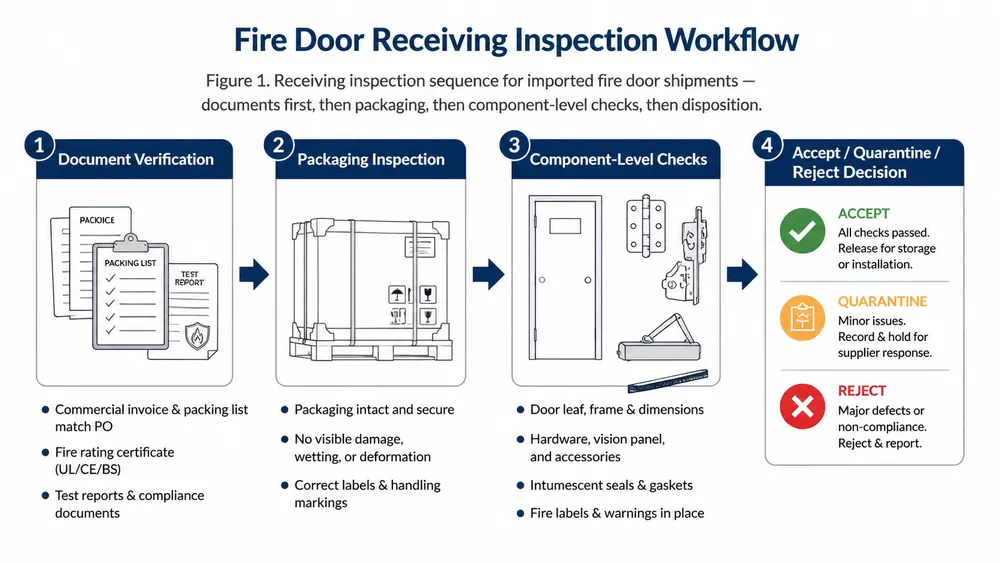
The problem is timing. Most fire door inspection guides focus on annual maintenance — checking doors that are already installed and in service. That's a different job entirely. What you need is a receiving inspection workflow: a systematic check you run on the loading dock or in the warehouse, before your installers touch the product, before you absorb any labor cost, and while your leverage with the supplier is still intact.

I've spent over a decade managing fire door production and export QC. The defects that cause the most damage downstream are rarely dramatic — they're a missing label, a seal that got crushed in transit, a frame that's 3mm out of square, or a closer that wasn't included in the hardware carton. Each one is easy to catch on arrival if you know where to look. Each one becomes a project-stopping problem if you find it after the frame is anchored in the wall.

This checklist is built for that window between delivery and installation. Use it to protect your schedule, your compliance file, and your margin.

Fire door receiving inspection workflow showing document check, packaging check, component inspection, and accept or reject decision

Check the paperwork before you open a single crate

Start with documents, not with the doors themselves. If the certification paperwork is wrong or missing, the physical condition of the product is secondary — you can't install a fire door that doesn't have the right documentation, regardless of how good it looks.

Pull these against your purchase order:

  • Packing list vs. PO: Match quantities, door sizes, fire ratings, and hardware line items. Count cartons against the packing list total. Shortages are easier to claim now than after your warehouse team has scattered the shipment across a job site.
  • Fire test report or certificate: This should reference a recognized standard — NFPA 252, UL 10C, EN 1634-1, or BS 476 depending on your market. The report must match the specific door configuration you ordered (size, glazing, hardware prep). A generic test report for a different door size or construction doesn't cover your units.
  • Rating label or listing mark: Every fire-rated door leaf and frame should carry a permanent label from the listing agency (UL, Intertek/WHI, or equivalent). If the label is missing, the door is not a fire door in the eyes of any building inspector — full stop.
  • Material test certificates: For steel doors, mill certificates confirming steel grade and gauge. For fire cores, documentation of the core material and its fire performance.
  • Batch or lot traceability: A barcode, QR code, or lot number that links each door to a production batch. This is your audit trail if a defect surfaces later. (We barcode-link every unit to its production batch, inspection record, and test-fit data — if you're sourcing from a factory that can't trace a unit back to its production date, that's a red flag worth noting.)

If any certification document is missing or doesn't match your order, quarantine the shipment and notify your supplier before proceeding. Installing a fire door without proper documentation creates a compliance liability that lands on you, not on the factory.

For a deeper look at what fire door certifications and standards apply to your market, that page breaks down NFPA 80, CE marking, UL listing, and EN 1634 requirements by region.

Packaging and freight damage — the 60-second exterior check

Before you cut strapping or open crates, inspect the packaging itself. Freight damage that's visible on the outside often means worse damage inside, and documenting it before you open anything strengthens your claim with both the carrier and the supplier.

Walk the shipment and check:

  • Crate and carton condition: Look for crushed corners, punctures, water staining, and broken strapping. Photograph any damage with the shipping label visible in the frame.
  • Stacking and orientation: Were the crates shipped and stored upright as marked? Fire doors shipped flat and stacked under heavy freight can develop leaf bow that's hard to detect until you try to hang them.
  • Moisture indicators: If the shipment includes humidity indicator cards (common on ocean freight), check them before opening. A tripped indicator means the doors sat in high humidity — check for surface corrosion and core swelling once you open up.
  • Corner and edge protection: Foam-lined crates with frame corner guards are standard for export-grade fire door packaging. If the corner guards are missing or displaced, inspect the frame corners and edges first — that's where transit damage concentrates.

Count the cartons and cross-reference against the packing list before you sign the carrier's delivery receipt. Any discrepancy in count or visible damage should be noted on the receipt itself. Once you sign clean, the carrier's liability gets much harder to enforce.

Door leaf inspection — what to measure and what to look for

Open the crate and start with the door leaf. This is where the most consequential defects hide, because a compromised leaf can't be field-repaired without voiding the fire rating.

Dimensional checks:

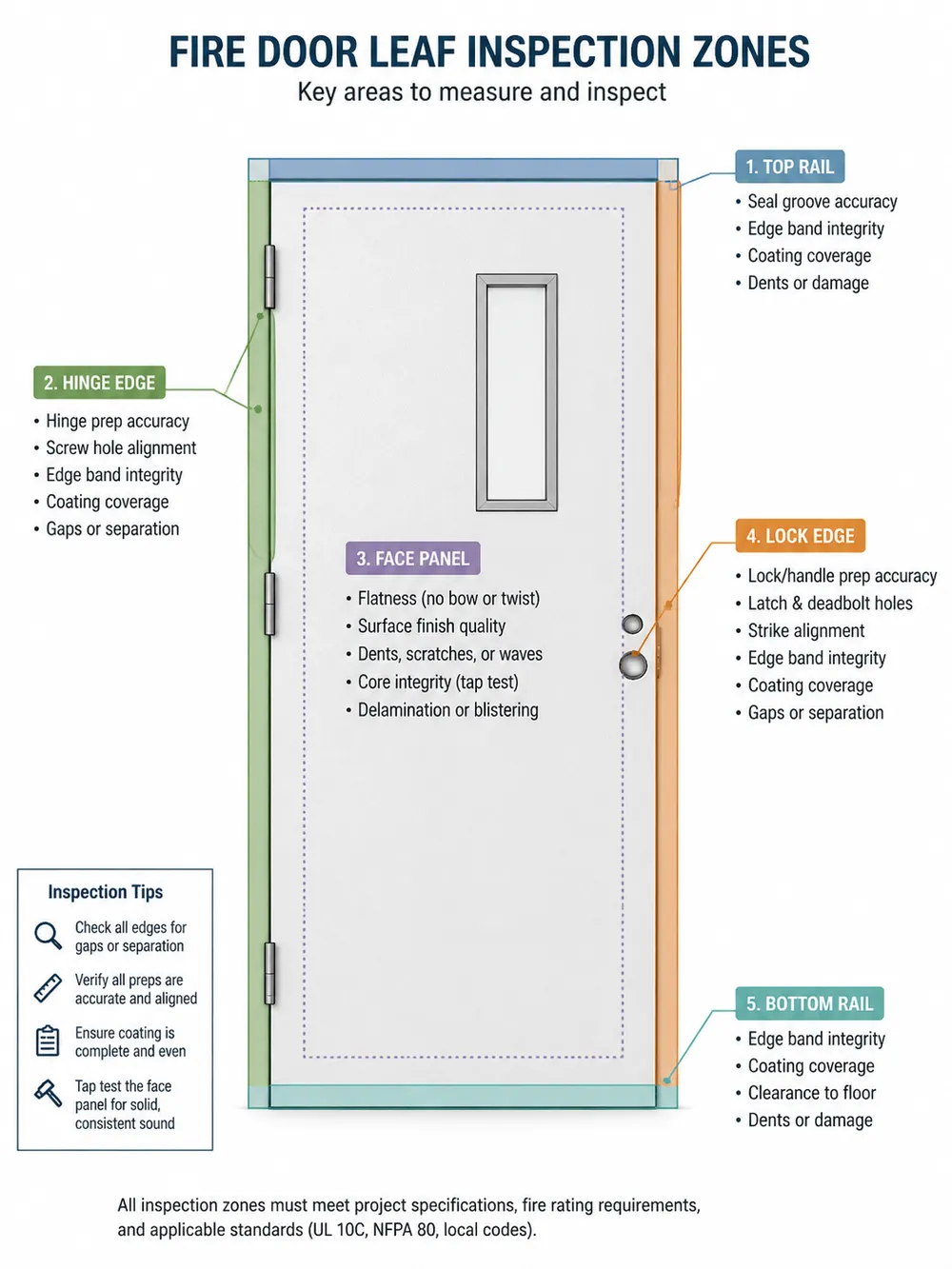
  • Measure height, width, and thickness at multiple points. Fire doors have tighter dimensional tolerances than standard doors because the gap between leaf and frame is a fire-performance parameter, not just a fit issue. Typical allowable tolerance is ±1.5mm on height and width for a standard commercial fire door.
  • Check for leaf bow and twist. Lay the door flat on a known-flat surface (or use a straightedge across the face). Bow exceeding 3-4mm across the full height is a problem — it will create uneven gaps in the frame that compromise both the fire seal and the closer function.
  • Measure diagonal dimensions corner to corner. If the two diagonals differ by more than 2mm, the leaf is out of square and will not hang properly.

Surface and finish checks:

  • Inspect the powder coat or paint finish under good lighting. Look for scratches, chips, orange peel, pinholes, and inconsistent color. Minor transit scratches on the hinge edge are cosmetic and repairable. Scratches or chips that expose bare steel on the face or the seal rabbet are a corrosion risk and a potential rejection.
  • Check the bottom edge and top edge — these are often the first places where coating coverage gets thin. On steel fire doors, an uncoated edge is a rust path.

Core and construction integrity:

  • Tap the face panel in several locations. A fire door with a proper mineral core or honeycomb-and-insulation fill sounds solid and consistent. Hollow spots, rattling, or inconsistent sound can indicate core damage, delamination, or a manufacturing defect.
  • Inspect the leaf edges for any separation between the face sheet and the edge band. On steel fire doors, the edge band is typically a folded or welded channel — any gap or separation there is a fire-path failure point.
Diagram showing fire door leaf inspection zones including face, edges, top rail, bottom rail, hinge prep, and lock prep areas

Frame inspection — squareness, anchoring prep, and seal grooves

The frame is half the fire door assembly, and it's the half that gets permanently anchored into the wall. A frame defect found after installation means demolition, not adjustment.

  • Squareness: Measure the frame diagonals. Difference should be under 2mm. An out-of-square frame means uneven gaps around the leaf, which means the intumescent seal won't compress evenly, which means the fire rating is compromised.
  • Throat dimension: Confirm the frame throat matches your wall thickness. This is a common mismatch on import orders — the frame was built for a different wall spec than what's on site. Measure at the head and both jambs.
  • Anchor and hinge prep: Check that anchor points, hinge reinforcements, and strike plate preps are in the correct locations and match the hardware schedule. Mislocated hinge preps are not field-correctable on a fire-rated frame without voiding the listing.
  • Seal groove condition: Run your finger along the intumescent seal groove on both jambs and the head. The groove should be clean, consistent depth, and free of dents or deformation. If the frame ships with the intumescent seal pre-installed, check that the seal is continuous, undamaged, and properly seated. Gaps or crushed sections in the intumescent strip are a direct fire-performance failure.
  • Finish: Same coating checks as the leaf — look for chips, scratches, and bare steel, especially at weld joints and corners where coating adhesion is weakest.

(A note from production experience: the single most common frame defect we catch in our own pre-shipment QC is a slight twist in the hinge jamb from welding stress. We straighten and re-check every frame on a surface plate before packing. If your supplier doesn't test-fit the leaf to the frame before shipping, you're doing that QC on your dock instead of theirs.)

Intumescent seals, smoke seals, and glazing — the fire-performance details

These components are what actually make a fire door perform in a fire. A door can look perfect and still fail a fire test if the seals are damaged or the glazing doesn't match the listing.

Intumescent seals:

  • Check that intumescent strips are present on all required locations — typically the leaf edge, the frame rabbet, or both, depending on the door design and listing.
  • Look for cuts, tears, gaps, or compression damage. Intumescent material that's been crushed flat during shipping may not expand properly under heat.
  • Confirm the seal material matches the listing. Different fire ratings require different intumescent formulations and cross-section sizes. A 60-minute door with a 30-minute seal is not a 60-minute door.

Smoke seals:

  • If the door is rated for smoke control (S-rated or meets UL 1784), verify that the smoke gasket is installed and continuous around the full perimeter.
  • Check the compression fit by closing the door in the frame (if you're doing a test-fit on the dock). The gasket should compress evenly with no visible light gaps.

Glazing (for vision panels):

  • Confirm the glass type matches the fire rating. Fire-rated glazing is not interchangeable — borosilicate, ceramic, and intumescent-laminated glass each have different ratings and listing requirements.
  • Check for cracks, chips, edge damage, and proper seating in the glazing bead. Loose or improperly seated glazing beads are a common transit-damage issue.
  • Verify that the vision panel size matches the listing. Fire-rated glazing has maximum area limits that vary by rating and standard. An oversized vision panel voids the door's fire rating even if the glass itself is rated.

Hardware carton audit — hinges, locks, closers, and the parts that get forgotten

Hardware problems are the most common cause of installation delays on fire door projects, and they're almost always preventable with a 10-minute carton check on arrival.

Open the hardware carton and verify against the hardware schedule in your PO:

  • Hinges: Correct quantity (typically 3 per leaf for standard commercial fire doors, 4 for oversized or heavy doors), correct size, correct material (steel, not aluminum — aluminum hinges are not listed for fire doors), and correct finish. Ball-bearing hinges are standard for fire doors; plain-bearing hinges won't meet cycle-life requirements under NFPA 80.
  • Lock and latch set: Confirm the function (passage, storeroom, classroom, etc.) matches your spec. Check that the backset matches the door prep. Fire-rated locksets must be listed — look for the UL or equivalent mark on the lock body.
  • Door closer: Confirm the closer model, size, and mounting type match the spec. A closer that's undersized for the door weight won't maintain the required closing speed and latching force. Check that the closer arm, mounting plate, and fasteners are all included. (Missing closer arms are surprisingly common in hardware cartons — it's a small part that gets left out of the box more often than you'd expect.)
  • Threshold and bottom seal: If specified, confirm the threshold type and the bottom seal or automatic door bottom are included and undamaged.
  • Fasteners and strike plates: Count them. Missing screws and strike plates are a nuisance that stops installation cold if your crew doesn't carry spares.

Any missing or mismatched hardware item should be documented and reported to your supplier immediately. Do not substitute non-listed hardware on a fire-rated door — it voids the assembly rating.

How to document defects for a supplier claim that actually works

Finding a defect is only half the job. Documenting it properly is what determines whether your supplier replaces the unit, credits your account, or argues about it for weeks.

For every defect you identify:

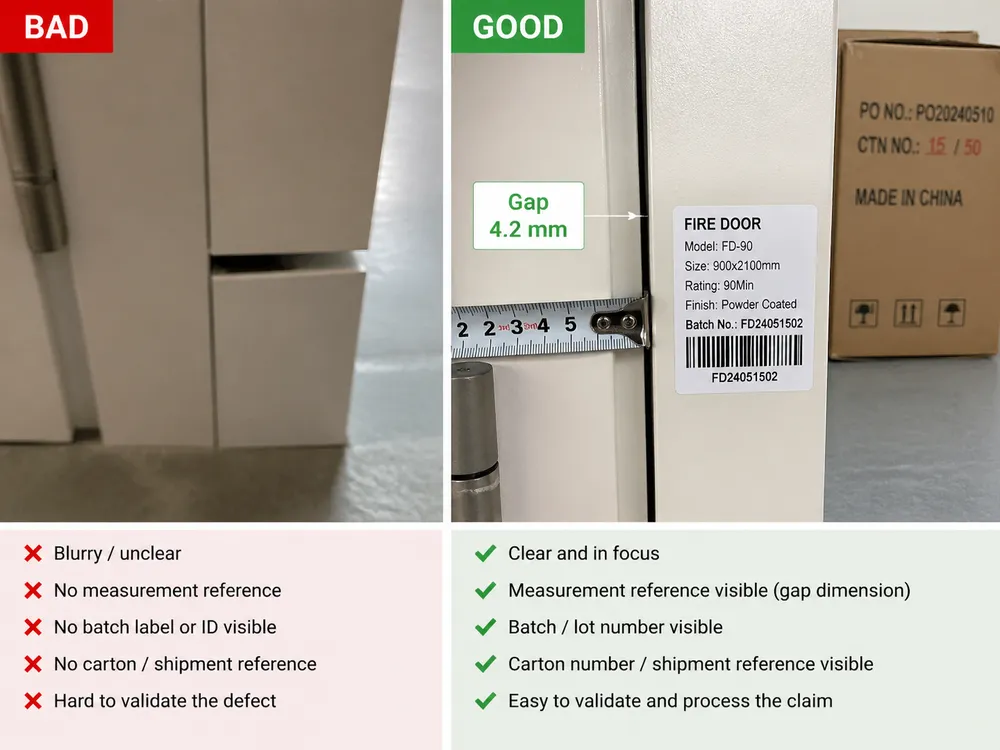
  1. Photograph the defect with a ruler or tape measure in the frame for scale. Include the door's batch label or barcode in at least one photo so the image is traceable to a specific unit.
  2. Photograph the carton and shipping label of the affected unit. This links the defect to a specific package in the shipment.
  3. Record the measurement — gap dimension, bow measurement, diagonal difference, coating thickness reading, or whatever quantifies the defect. "The frame is out of square" is an opinion. "Frame diagonals differ by 4.5mm" is a claim.
  4. Note the installation status: not installed, partially installed, or fully installed. Your claim is strongest when the defect is documented before any installation work begins.
  5. Classify the defect against your accept/reject criteria (see the decision table below).

Send the documentation package to your supplier within the claim window specified in your purchase contract — typically 7-14 days from delivery for visible defects. Include your PO number, the batch/lot numbers of affected units, and a clear statement of what you need: replacement, credit, or repair parts.

Example of properly documented fire door defect showing measurement, batch label, and shipping carton in a single photograph

Accept, quarantine, or reject — a decision framework for common fire door defects

Not every defect is a rejection. Some issues are cosmetic and field-repairable without affecting the fire rating. Others are non-negotiable. This table gives you a starting framework — adjust thresholds based on your project spec and local code requirements.

Defect Severity Action
Minor surface scratch on face (no bare steel exposed) Cosmetic Accept — touch up with manufacturer-supplied paint pen
Scratch or chip exposing bare steel on seal rabbet or edge Moderate Quarantine — repairable only if the listing allows field touch-up; confirm with supplier
Leaf bow > 4mm over full height Structural Reject — will not seal properly in frame; not field-correctable
Frame diagonals differ > 3mm Structural Reject — out-of-square frame compromises gap dimensions and seal performance
Missing or damaged intumescent seal Fire performance Reject — do not install; replacement seal must match the listing exactly
Missing fire rating label Compliance Reject — unlabeled door is not a fire door; cannot pass inspection
Glazing cracked or chipped Fire performance Reject — fire-rated glass cannot be field-replaced without re-listing
Wrong hardware function (e.g., passage instead of storeroom) Specification Quarantine — request correct hardware from supplier; do not substitute
Missing door closer or closer arm Specification Quarantine — order replacement; do not install door without closer
Hinge prep mislocated on frame Structural Reject — cannot be field-corrected on a fire-rated frame
Powder coat orange peel or color mismatch Cosmetic Accept with note — document for warranty file; does not affect fire rating
Core delamination or hollow spots on tap test Structural Reject — compromised core integrity; fire performance unknown

The general rule: if a defect touches the fire rating, the seal path, or the certification label, it's a reject or a quarantine until the supplier provides a documented resolution. Cosmetic issues that don't affect fire performance or structural integrity can be accepted with documentation.

What your supplier's QC should have caught before the container loaded

A good receiving inspection protects you. A good supplier makes most of that inspection redundant.

When you're evaluating fire door manufacturers, ask specifically about their pre-shipment QC process. The checks you're running on your dock are the same checks that should have happened on the factory floor — and a factory that does them properly will have documentation to prove it.

At our facility, every fire door goes through a 5-stage inspection before it reaches the packing line: incoming steel verification, in-process dimensional check after forming, weld integrity inspection, coating adhesion and thickness measurement, and a final assembly stage where the leaf is test-fitted into its frame, hardware is cycled, and gap dimensions are verified. 100% of units are inspected — we don't do statistical sampling on fire-rated product. Each unit gets a barcode that links to its full inspection record, so if you flag a defect on arrival, we can pull the production data for that specific door within minutes.

That level of traceability isn't universal. If your current supplier can't provide batch-level inspection records, or if you're consistently finding defects that should have been caught at the factory, the inspection checklist above becomes your primary quality gate — and that's a sign your sourcing needs a closer look.

For buyers who want to request a quote on fire door supply with full pre-shipment QC documentation, send your fire rating, door sizes, hardware schedule, destination market, and required certifications. We'll quote the complete door assembly package including the documentation set your project needs for code compliance.

Frequently asked questions

What documents should come with imported fire doors?

At minimum: a fire test report or certificate referencing the applicable standard (NFPA 252, UL 10C, EN 1634-1, or BS 476), a listing label on each door leaf and frame, a packing list matching your PO, and material certificates for the steel and core. For international shipments, you should also receive a commercial invoice, bill of lading, certificate of origin, and any market-specific compliance documents. If your supplier doesn't provide batch traceability linking each unit to a production and inspection record, ask for it — it's your audit trail if problems surface after installation.

Can I field-repair a damaged intumescent seal without voiding the fire rating?

It depends on the listing. Some listings allow field replacement of intumescent seals using the exact same seal product specified in the original test report. Others require the seal to be factory-installed. Check the door's listing documentation or contact the listing agency directly. Never substitute a different seal product or cross-section size — even if it looks similar, it hasn't been tested in that specific door assembly and the rating is void.

How much leaf bow is acceptable on a fire door?

Most standards and listing agencies allow up to 4mm (approximately 5/32") of bow measured across the full height of the leaf. Beyond that, the door won't maintain consistent contact with the intumescent seal and the frame stop, which means the fire performance is compromised. Bow is usually caused by improper storage (laying doors flat under load) or uneven core curing during manufacturing. If you receive doors with excessive bow, reject them — it's not a field-correctable condition.

What's the difference between a receiving inspection and an annual fire door inspection?

A receiving inspection happens on the dock before installation. You're checking for manufacturing defects, shipping damage, specification mismatches, and missing documentation. An annual inspection (per NFPA 80 or local code) happens after the door is installed and in service — it checks for wear, damage, improper modifications, and continued compliance. Both are necessary, but they catch different problems at different stages. The receiving inspection is your last chance to reject defective product before you absorb installation labor cost.

Should I inspect every door in a large shipment or can I sample?

For fire-rated doors, inspect every unit. Statistical sampling works for commodity products where a defect is an inconvenience. On fire doors, a single defective unit that gets installed is a code violation, a failed inspection, and a potential liability. The time cost of 100% receiving inspection is small compared to the cost of pulling an installed fire door out of a finished wall because the label was missing or the seal was damaged.

Fire Door Standard Guide | EUWOO

The Standard on Your Test Report Determines Where You Can Sell

A fire door that passes testing under one standard can be rejected under another — even if the physical door is identical. If you're sourcing fire doors for multiple markets, the standard printed on the test report is the single most important line item on your compliance file. Get it wrong and your shipment clears customs fine but fails the building inspector's review, which is a far more expensive problem.

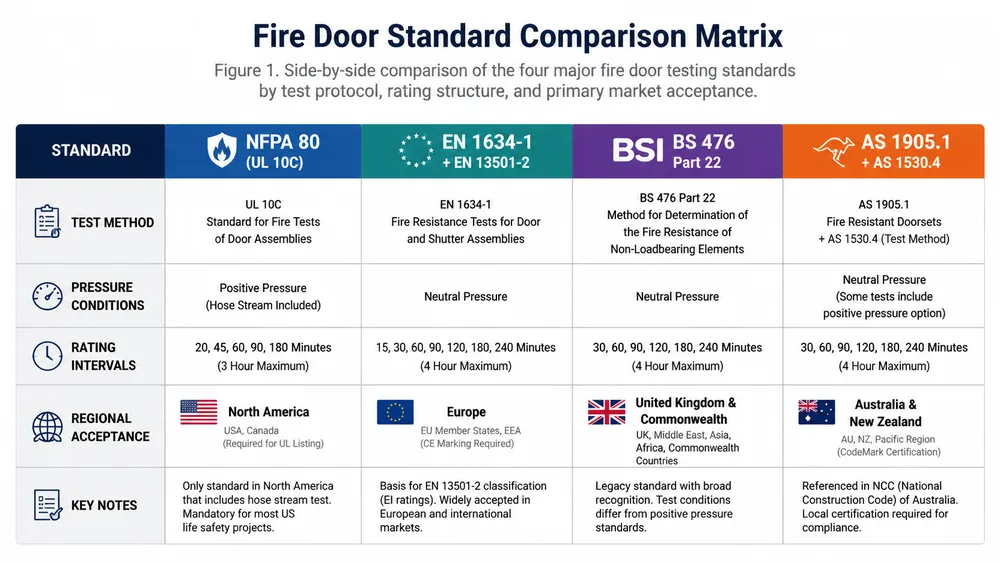
A fire door standard defines how a door assembly is tested for fire resistance, what performance thresholds it must meet, and what documentation must travel with the product. It covers the complete assembly — leaf, frame, glazing, hardware, seals — not just the door panel. The standard dictates the test protocol (furnace type, pressure conditions, hose stream exposure), the rating intervals (20, 45, 60, 90 minutes or more), and the labeling and inspection requirements that follow the door through its installed life.

We've been manufacturing fire doors to multiple standards since we added the dedicated fire door line in our Luoyang facility. The certification process for NFPA 80 alone took us the better part of a year — not because the manufacturing was difficult, but because the documentation, test specimen control, and follow-up inspection program are rigorous. That experience is exactly why standard selection matters so much at the sourcing stage: the cost of certification is baked into the product, and ordering against the wrong standard means you're paying for compliance your market doesn't recognize.

The Four Standards You'll Encounter in Export Markets

Most B2B fire door orders we handle fall under one of four testing and compliance frameworks. Your target market determines which one applies — and in some cases, more than one.

Standard Region Test Method Common Ratings Key Requirement
NFPA 80 / UL 10C USA, Canada Positive pressure furnace + hose stream 20, 45, 60, 90 min Listed and labeled by accredited agency (UL, WHI, Intertek)
EN 1634-1 EU, UK, Middle East (adopted) EN standard fire curve, positive pressure EI 30, EI 60, EI 90, EI 120 CE marking under EN 16034 + DoP
BS 476 Part 22 UK (legacy), parts of Asia, Africa BS fire curve, neutral pressure 30, 60, 90, 120 min Still accepted in many Commonwealth markets
AS 1905.1 Australia, New Zealand Based on AS 1530.4 test -/60/60, -/120/120 Must reference test to AS 1530.4
Comparison matrix of NFPA 80, EN 1634, BS 476, and AS 1905 fire door standards showing test method, rating intervals, and regional acceptance

The distinction between these isn't academic. A door tested to BS 476 Part 22 under neutral pressure conditions may behave differently under the positive pressure protocol required by UL 10C. We've had buyers assume a BS 476-tested door would satisfy a US project — it won't, because the test conditions and listing requirements are fundamentally different. (This is the single most common compliance mistake we see from first-time fire door importers.)

NFPA 80 and UL 10C — What the US Market Actually Requires

If you're supplying fire doors into the United States, the compliance chain runs through three layers: the test standard (UL 10C or UL 10B), the installation and maintenance standard (NFPA 80), and the listing/labeling program run by an accredited agency.

UL 10C is the fire test itself — a positive-pressure furnace test that simulates real fire conditions more aggressively than older neutral-pressure methods. The door assembly (leaf, frame, hardware, glazing if any) is exposed to a standard time-temperature curve, and the assembly must maintain integrity for the rated duration. After the fire exposure, a hose stream test hits the assembly with high-pressure water to check structural integrity under thermal shock. Doors that survive both phases earn their fire rating.

NFPA 80 governs everything around the test: how fire door assemblies must be installed, inspected, tested, and maintained throughout their service life. For you as a sourcing buyer, the critical NFPA 80 requirements are:

  • The door must carry a permanent label from an accredited listing agency (UL, WHI, or Intertek)
  • All components — closer, hinges, latch, frame, glazing, seals — must be listed for use in fire door assemblies
  • Annual inspection is required per NFPA 80 Chapter 5, which means your downstream customers need doors that arrive with correct labeling and documentation intact

We manufacture to UL 10C test requirements and carry NFPA 80 compliance documentation. The label isn't something we print in-house — it's issued through the listing agency's follow-up inspection program, which means an independent auditor visits our facility to verify that production doors match the tested specimens. That third-party verification is what gives the label its legal weight in US building code enforcement.

What this means for your import business: if you're stocking fire doors for the US market, every unit needs to ship with the listing label already applied and a matching test report reference available. Doors without labels are non-compliant regardless of their actual fire performance — building inspectors check the label, not the door construction.

EN 1634 and CE Marking — The European Framework

The European fire door compliance system works differently from the US model. Testing happens under EN 1634-1, and the results feed into a CE marking process governed by EN 16034 (the harmonized product standard for fire-rated doorsets).

EN 1634-1 tests fire resistance using the standard EN fire curve with positive pressure conditions. The rating system uses a two-letter classification:

  • E = integrity (the door prevents flame passage)
  • I = insulation (the unexposed face stays below temperature thresholds)
  • EI 30, EI 60, EI 90 = the assembly maintains both integrity and insulation for 30, 60, or 90 minutes

Some markets accept E-only ratings (integrity without insulation), but most commercial building codes in the EU require the full EI classification. If your buyer's project spec says "EI 60," the door must pass both criteria for 60 minutes — an E 60 rating alone won't satisfy it.

CE marking under EN 16034 requires a Declaration of Performance (DoP) issued by the manufacturer, backed by test reports from a notified body. The DoP is the legal document that travels with the product and declares its performance characteristics. Without it, the door cannot legally be placed on the EU market for fire-rated applications.

For Middle Eastern markets — particularly the Gulf states — EN 1634 testing is increasingly accepted alongside or instead of BS 476. We've seen this shift accelerate over the past five years as UAE and Saudi building codes align more closely with European standards. If you're supplying into Dubai or Riyadh, confirm whether the project spec references EN 1634 or BS 476 before you place the order. (We can produce to either, but the test documentation is different and not interchangeable.)

BS 476 Part 22 — Still Relevant in More Markets Than You'd Expect

BS 476 is the older British standard, and while the UK has largely moved toward EN 1634 for new construction, BS 476 Part 22 test reports remain widely accepted across Commonwealth markets: parts of Southeast Asia, Africa, the Indian subcontinent, and Hong Kong.

The key technical difference: BS 476 Part 22 uses neutral pressure conditions in the furnace, while EN 1634 and UL 10C use positive pressure. Positive pressure pushes hot gases through gaps in the assembly, which is a more demanding test condition. A door that passes BS 476 at 60 minutes may not automatically pass EN 1634-1 at the same duration — the positive pressure exposes edge seal weaknesses and gap tolerances that neutral pressure doesn't stress as aggressively.

For your sourcing decisions, BS 476 certification is typically less expensive to obtain and the test reports are accepted in a wider range of developing markets. If your distribution covers Africa or Southeast Asia, BS 476 Part 22 reports may be all you need. But if you're also targeting EU or US projects with the same product, you'll need separate test documentation — one test report doesn't cover both frameworks.

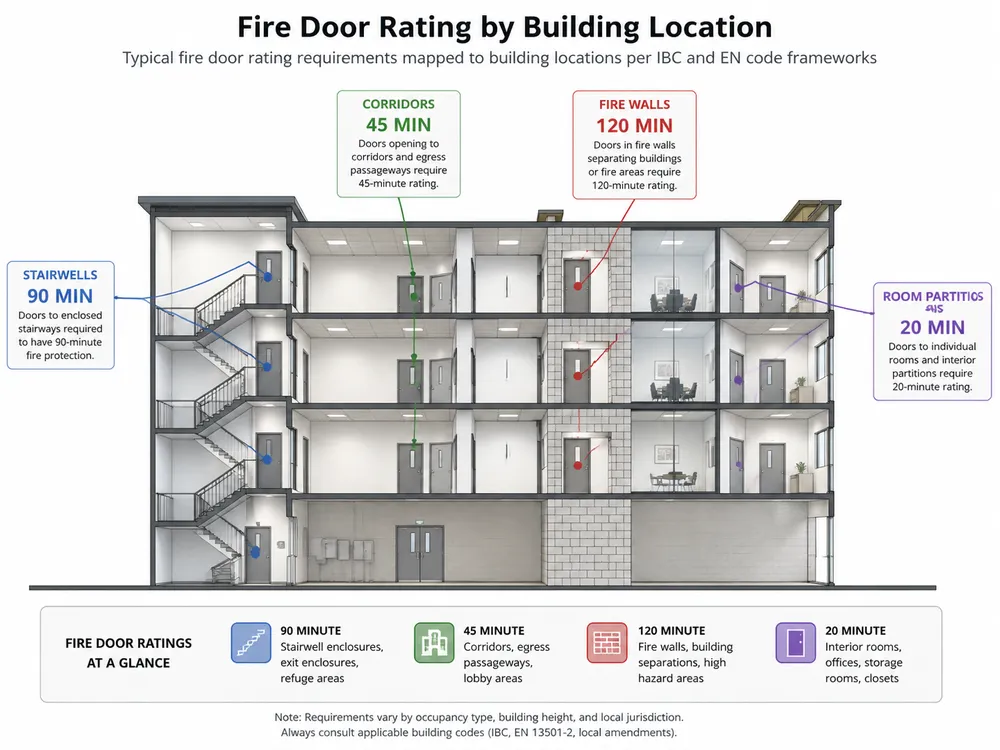
How Fire Ratings Map to Building Code Requirements

Fire door ratings aren't arbitrary numbers — they correspond to specific locations within a building as defined by local building codes. Understanding this mapping helps you stock the right mix of ratings for your market.

Rating Typical Building Code Application Common Order Pattern
20 min Corridor doors, room partitions in sprinklered buildings (US) High volume, standard commercial
45 min Corridor and room separations (US, per IBC) Most common US commercial rating
60 min (EI 60) Stairwell enclosures, shaft walls, EU commercial High volume in EU and Middle East
90 min (EI 90) Exit stairways, high-rise separations, industrial Project-specific, larger orders
120 min Fire walls, occupancy separations, high-hazard Specialty, lower volume

The 45-minute and 60-minute ratings account for roughly 70% of the commercial fire door volume we ship. If you're building initial inventory for a distribution business, those two ratings cover the broadest range of project requirements. The 90-minute and 120-minute ratings are typically ordered against specific project specs rather than stocked — the unit cost is higher and the application is narrower.

Diagram showing fire door rating requirements by building location including stairwells, corridors, and fire walls

What Actually Gets Tested — The Assembly, Not Just the Door

One of the most consequential misunderstandings in fire door sourcing: the fire rating applies to the complete assembly, not the door leaf alone. The test specimen includes the leaf, frame, hinges, closer, latch, intumescent seals, and any glazing. Change any one of those components and the rating may no longer apply.

This matters for your business in two specific ways:

Hardware substitution risk. If your customer installs a fire-rated door leaf with non-listed hinges or a closer that wasn't part of the tested assembly, the door loses its fire rating. We ship fire door assemblies with all hardware pre-specified and documented against the test report — the listing label covers the complete package. If you're selling door-only (leaf and frame without hardware), make sure your documentation clearly states which listed hardware must be used to maintain the rating.

Glazing limitations. Fire-rated vision panels require fire-rated glazing — standard tempered glass will shatter within minutes of fire exposure. The glazing type, size, and frame must match the tested configuration. We use ceramic glass rated to the same duration as the door assembly, with steel glazing beads and intumescent gaskets. Maximum vision panel size is limited by the test report — typically 100 × 100 mm for 90-minute ratings, larger openings available at 60 minutes depending on the glazing system. (If your buyer wants a full-lite fire door, confirm the rating and glazing spec early — it significantly affects unit cost.)

Intumescent Seals and Edge Gap Tolerances

Intumescent seals are the component that makes a fire door work as a fire barrier rather than just a heavy door. These seals expand when exposed to heat — typically activating between 150–200°C — and fill the gap between the door leaf and frame, blocking smoke and flame passage.

The seal configuration must match the tested assembly. For most fire door assemblies we produce:

  • Single-leaf doors: intumescent seal in a routed groove on the door edge or frame rebate, continuous around three sides (both jambs and head)
  • Double-leaf doors: additional intumescent meeting stile seal where the two leaves overlap
  • Smoke seals: combined intumescent + brush or blade smoke seal for assemblies that require both fire and smoke ratings (common in corridor applications)

Edge gap tolerances are specified in the test standard and enforced by building inspectors. NFPA 80 allows a maximum clearance of 3.2 mm (⅛ inch) at the frame-to-leaf interface and 6.4 mm (¼ inch) at the bottom. EN standards specify similar tolerances. We hold our frame-to-leaf fit within ±1.0 mm during manufacturing, which gives your installer a margin of error during field installation without exceeding the code maximum.

Gaps that exceed tolerance are the number-one reason fire doors fail field inspection. If you're distributing fire doors, the quality of the frame-to-leaf dimensional consistency at the factory directly determines your pass rate on job-site inspections — and your warranty exposure.

The Documentation Package That Travels With Your Order

Fire door compliance isn't just about the physical product — it's about the paper trail. Missing or incomplete documentation can hold up your project delivery even when the doors themselves are fully compliant.

For US-market orders (NFPA 80 / UL), each door ships with:

  • Permanent listing label (UL, WHI, or Intertek) applied at the factory
  • Test report reference number traceable to the listing agency
  • Hardware schedule confirming all components are listed for fire door use

For EU-market orders (EN 1634 / CE), each door ships with:

  • CE marking on the product
  • Declaration of Performance (DoP) referencing the EN 1634-1 test report
  • Notified body certificate number

For BS 476 markets, each door ships with:

  • Test report from an accredited laboratory
  • Certificate of conformity referencing the tested configuration

We maintain batch traceability on every fire door we produce — each unit carries a barcode linked to its production date, line, material batch, and inspection record. If a compliance question comes up six months after delivery, you can trace any individual door back to its full production history within minutes. That traceability is what protects your business when a building inspector or end client asks for verification.

Flowchart showing fire door compliance documentation requirements for US NFPA, EU CE marking, and BS 476 export markets

Common Sourcing Mistakes That Create Compliance Failures

After 11 years of shipping fire doors to multiple markets, the failure patterns are predictable. These are the sourcing shortcuts that generate the most expensive problems:

Assuming one test report covers all markets. A BS 476 Part 22 report does not satisfy NFPA 80 requirements. An EN 1634 test does not produce a UL listing. If you're sourcing for multiple regions, you need market-specific documentation — or you need to confirm upfront which standards your supplier actually holds. Ask for the test report and listing certificate before you place the order, not after the container ships.

Ordering fire-rated doors from a supplier who subcontracts the fire door production. Fire door certification is tied to a specific manufacturing facility and production process. If your supplier farms out fire door production to a subcontractor, the listing may not transfer. We manufacture every fire door in our own facility under our own certification — the listing label is issued against our production line, our QC process, and our tested specimens.

Ignoring hardware compatibility. A fire door leaf tested with specific hinges, closer, and latch hardware loses its rating if different hardware is installed. We've seen buyers source doors from one factory and hardware from another, then discover at the job site that the combination isn't listed. Every fire door assembly we ship includes a hardware schedule that matches the tested configuration.

Skipping the intumescent seal specification. Some suppliers ship fire doors with generic or undersized intumescent seals to reduce cost. The seal must match the tested assembly — wrong seal profile, wrong expansion ratio, or missing seals on the meeting stile of double doors will fail inspection. We use the same seal specification that was present in our test specimens, verified during our Stage 5 pre-shipment inspection.

Not confirming the rating duration matches the project spec. A 60-minute door installed where the code requires 90 minutes is a failed inspection and a door replacement at your cost. Confirm the required rating with your buyer's project architect or code consultant before ordering. (This sounds obvious, but we get rating-change requests after production has started at least twice a quarter.)

How We Control Fire Door Quality at the Factory Stage

Our 5-stage quality control process applies to all door production, but fire doors get additional checkpoints because the compliance stakes are higher.

Core fill verification. Fire door cores use mineral wool, vermiculite board, or perlite-based fill depending on the rating and standard. We verify core material density and thickness against the tested specification before the door leaf is closed. A core that's 5mm thinner than spec might look identical from the outside but will fail a fire test — and more importantly, fail in an actual fire.

Intumescent seal inspection. Every fire door is checked for correct seal profile, continuous application without gaps, and proper seating in the routed groove. We run this check after seal installation and again during final assembly — seals that get displaced during hardware installation are caught before the door leaves the line.

Hardware torque and function check. Fire door hardware — particularly closers and latching mechanisms — must function correctly under the thermal expansion that occurs during a fire. We cycle-test closers and verify latch engagement on every unit. A closer that doesn't fully latch the door is a fire barrier that's already breached before the fire starts.

Label and documentation audit. Before packing, every fire door is verified for correct label placement, label legibility, and matching documentation. The label is the legal proof of compliance — a door without a readable label is, from a code enforcement perspective, not a fire door.

Choosing the Right Standard for Your Market Mix

If you're distributing fire doors across multiple regions, your standard selection directly affects your inventory strategy and landed cost.

Single-market distribution: straightforward. Match the standard to your market — NFPA 80/UL for the US, EN 1634/CE for Europe, BS 476 for Commonwealth markets. One certification, one documentation package, one inventory pool.

Multi-market distribution: this is where it gets commercially interesting. A door tested to EN 1634-1 with CE marking covers the EU and is increasingly accepted in the Middle East and parts of Asia. If you add a BS 476 test on the same product, you extend coverage to African and Southeast Asian markets without changing the physical door — only the documentation changes. Adding US market coverage requires UL listing, which is a separate certification with its own follow-up inspection program.

We hold certifications across NFPA 80, CE, and can produce to BS 476 test requirements. For buyers building a multi-market fire door program, we can configure your orders with the correct documentation package for each destination — same production line, same quality standard, different compliance paperwork. That consolidation reduces your supplier count and simplifies your QC oversight.

If you're evaluating whether to add fire doors to your product line or expanding into a new regional market, send your target market list and volume expectations to our team through the RFQ page — we'll map the certification requirements and quote accordingly.

FAQ

What is the difference between NFPA 80 and UL 10C?

UL 10C is the fire test standard — it defines the furnace conditions, time-temperature curve, and hose stream test that the door assembly must survive. NFPA 80 is the installation, inspection, and maintenance standard that governs how fire doors are used throughout their service life. You need both: UL 10C proves the door can resist fire, NFPA 80 ensures it's installed and maintained so it actually will. For sourcing purposes, your supplier must provide a UL-listed product (tested to UL 10C) with documentation that supports NFPA 80 compliance in the field.

Can a fire door tested to BS 476 be used in the US market?

No. US building codes require fire doors to be tested and listed under UL 10B or UL 10C, with labeling from an accredited agency (UL, WHI, or Intertek). A BS 476 test report, regardless of the rating achieved, does not satisfy US code requirements. If you're sourcing for both US and Commonwealth markets, you need separate test documentation for each. The physical door construction may be similar, but the certification and labeling are distinct.

How do I verify that a fire door supplier's certification is legitimate?

Request the listing certificate or test report number and verify it directly with the issuing body. For UL-listed products, check the UL Product iQ database. For CE-marked products, request the Declaration of Performance and verify the notified body number. For BS 476, request the full test report from the accredited laboratory. Any credible supplier will provide these documents before you place an order — if there's hesitation or delay in producing certification paperwork, treat that as a sourcing risk signal.

What fire door rating should I stock for general commercial distribution?

45-minute and 60-minute ratings cover the widest range of commercial building code requirements across most markets. The 45-minute rating is the most common specification for US commercial corridor and room separation applications under IBC. The 60-minute (EI 60) rating is the standard commercial specification in EU and Middle Eastern markets. Stocking both gives you coverage for the majority of project inquiries without overcommitting capital to specialty ratings. Add 90-minute inventory only if you have confirmed project demand — it's a higher unit cost with narrower application.

Do intumescent seals need to be replaced during the door's service life?

Intumescent seals have a functional lifespan, and NFPA 80 requires them to be inspected annually as part of the fire door assembly inspection. Seals that are painted over, damaged, missing, or show signs of degradation must be replaced with the same specification used in the original tested assembly. This is relevant to your after-sales business: if you're distributing fire doors, stocking replacement intumescent seal kits in the correct profile for your product line creates a recurring revenue stream and keeps your installed base compliant. We can supply seal kits matched to our fire door assemblies as a separate line item.

Fire Door Certification Requirements by Market — A Buyer’s Compliance Breakdown

The compliance problem that costs more than the door itself

A fire door that fails inspection at the job site costs you far more than the unit price. You eat the freight, the storage, the project delay, and sometimes the re-order at rush pricing. I've seen containers of fire-rated doors held at customs in Dubai because the test certificate referenced the wrong standard. I've seen a 600-unit shipment rejected on a U.S. school project because the label was missing a single line of required text. The doors were fine. The paperwork wasn't.

Fire door certification requirements change depending on where the door gets installed, what building code the authority having jurisdiction (AHJ) enforces, what fire rating the project spec calls for, and what hardware is part of the assembly. There is no single global fire door certificate. If your RFQ doesn't specify the destination market and the applicable standard, you're leaving compliance to chance — and chance doesn't pass inspection.

This breakdown maps the certification expectations across the markets we ship to most: North America, Europe, the Gulf, Southeast Asia, Africa, and Australia. The goal is to give you a sourcing checklist — what to confirm, what documents to request, and where the common mistakes happen — so your order arrives with the right paperwork the first time.

Overview diagram showing fire door certification standards mapped to major export markets including North America, Europe, Gulf, Southeast Asia, Africa, and Australia

What "fire door certification" actually means in a sourcing context

When a project spec says "certified fire door," it's referencing a chain of evidence — not a single document. That chain typically includes:

  • A fire test report from an accredited lab, proving the door assembly (leaf, frame, glazing, seals, hardware) survived the required duration under a specific test standard
  • A product listing or classification from a certification body (UL, Intertek/WHI, a European Notified Body, etc.) confirming ongoing production compliance
  • A label on the physical door that ties the installed unit back to the tested and listed assembly
  • Factory production control documentation showing the manufacturer maintains consistent quality between the tested sample and the production run you're buying

Miss any link in that chain and the door may be physically fire-resistant but legally non-compliant. The AHJ at the job site doesn't test your door — they check the label, the listing, and the documentation trail. If those don't match, the door gets rejected regardless of how well it would actually perform in a fire.

We manage this chain across multiple standards at our facility. Our fire door production line runs under documented procedures for NFPA 80, CE (EN 1634-1), and SGS-verified quality controls, so the test-to-production traceability is built into the manufacturing process, not bolted on after the fact.

Market-by-market certification expectations

The table below covers the most common fire door certification requirements across our active export markets. Use it as a starting checklist for your RFQ — but always confirm the specific requirements with your local AHJ or project consultant, because building codes get amended and local authorities sometimes enforce stricter interpretations than the national standard.

Market Primary test standard Common certification / listing Label requirements Key documents to request
United States NFPA 252 (test method), NFPA 80 (installation/maintenance) UL or Intertek/WHI listing UL or WHI label on door and frame, showing fire rating, manufacturer, and listing number UL/WHI listing report, fire test report, NFPA 80 compliance letter
Canada CAN/ULC-S104 ULC listing ULC label with fire rating and listing reference ULC listing certificate, test report
European Union EN 1634-1 (fire resistance test) CE marking under CPR (Construction Products Regulation) CE mark + DoP (Declaration of Performance) reference DoP document, EN 1634-1 test report, factory production control certificate
United Kingdom BS 476-22 or EN 1634-1 Third-party certification (Certifire, BWF-Certifire, BM TRADA) Certifire or equivalent label, fire rating, and certificate number Third-party certificate, test evidence, chain-of-custody documentation
Gulf (UAE, Saudi, Qatar) Referenced standards vary — often NFPA 252 or BS 476 Civil Defense approval in the specific emirate or municipality Label matching the approved submission, fire rating clearly marked Civil Defense approval letter, fire test report matching the referenced standard, manufacturer's declaration
Southeast Asia (Singapore, Malaysia, Philippines) BS 476-22 or EN 1634-1 (varies by country) SCDF approval (Singapore), BOMBA (Malaysia), BFP (Philippines) Label with fire rating and test reference Local authority approval, test report, manufacturer's QMS certificate
Australia AS 1530.4 (test method), AS 1905.1 (installation) Listing with a JAS-ANZ accredited body or CodeMark Label with fire rating, test evidence reference, and manufacturer ID AS 1530.4 test report, FRL (Fire Resistance Level) documentation, CodeMark or equivalent
Africa (Nigeria, Kenya, South Africa) SANS 1253 (South Africa), BS 476 (commonly referenced elsewhere) SABS approval (South Africa), SON (Nigeria) Varies — often requires fire rating and manufacturer identification Test report referencing the applicable standard, ISO 9001 certificate, SGS or equivalent third-party report

(A note on the Gulf market specifically: Civil Defense requirements can differ between Dubai, Abu Dhabi, Sharjah, and Riyadh. We've had orders where the same door model needed different documentation packages for two projects in the same country. Always get the specific Civil Defense office requirements before finalizing your order.)

Flowchart showing the fire door compliance document chain from fire test report through certification listing to production label and factory QC records

The documents you should request before placing an order

Asking "do you have fire door certification?" is not specific enough. That question gets you a PDF of an ISO 9001 certificate and a vague assurance. Here's what to actually request, and why each document matters for your compliance file:

Fire test report — This is the foundation. It should reference the specific test standard (NFPA 252, EN 1634-1, BS 476-22, or AS 1530.4) and describe the exact assembly that was tested: door leaf construction, frame type, glazing (if any), intumescent seals, hinges, closer, and lock. If the test report describes a different assembly than what you're ordering, the certification may not cover your configuration.

Certification listing or classification report — From UL, Intertek/WHI, a European Notified Body, or the relevant regional body. This confirms the manufacturer is authorized to produce fire doors under ongoing surveillance, not just that a single sample passed a test once.

Declaration of Performance (DoP) — Required for CE-marked fire doors entering the EU market. The DoP ties the product to its tested performance characteristics and is a legal document under the Construction Products Regulation.

Factory production control (FPC) certificate — For CE-marked products, this is issued by the Notified Body after auditing the manufacturer's production process. It confirms the factory maintains the same construction, materials, and quality controls as the tested sample.

ISO 9001:2015 certificate — Not fire-specific, but it tells you the manufacturer operates under a documented quality management system. For markets where fire door certification infrastructure is less developed, ISO 9001 plus an SGS or equivalent third-party audit report is often the strongest evidence available.

SGS or third-party inspection report — Independent verification of production quality. We make our SGS reports available on request — they cover material verification, dimensional checks, and finish quality across production batches.

Batch traceability records — Every door in your shipment should trace back to a production batch with documented material inputs, inspection records, and test data. If a question comes up at the job site or during a building inspection, batch traceability is how you answer it. At our facility, every carton carries a barcode linked to the production batch record — material source, production date, line, and inspection sign-off are all retrievable.

Where sourcing mistakes actually happen

The fire door itself is rarely the problem. The compliance failures I see most often come from gaps between what was tested and what was ordered, or between what was ordered and what was shipped. Here are the patterns:

Mismatched hardware sets. A fire door is tested as a complete assembly — leaf, frame, hinges, closer, lock, and seals. If you swap any component after testing, the certification may no longer apply. The most common version of this: a buyer specifies a different lock or closer than what's on the test report, and the AHJ catches it during inspection. Your door certifications and standards page should be part of your pre-order review for exactly this reason.

Wrong fire rating for the application. A 60-minute door where the code requires 90 minutes. Or a door tested for fire resistance only (integrity) when the project spec requires insulation performance too. In EN 1634-1 terminology, that's the difference between an E rating and an EI rating — and it's a detail that gets missed in RFQs more often than it should.

Invalid or expired certificates. Certification listings require periodic renewal and factory surveillance audits. If the manufacturer's listing lapsed or the certificate references an old facility address, the AHJ may reject it. Always check the issue date and validity period.

Labels that don't match the listing. The physical label on the door must reference the correct listing number, fire rating, and manufacturer. If the label is generic, missing, or references a different product line, the door fails inspection even if it's physically identical to the tested assembly.

No intumescent seals or wrong seal specification. Intumescent seals expand under heat to close the gap between door and frame. They're part of the tested assembly. If they're missing, the wrong profile, or installed incorrectly, the fire rating is void. We install intumescent seals at the factory as part of the assembly process — they're not a field-install afterthought.

Frame and wall condition mismatch. A fire door is tested in a specific frame type installed in a specific wall construction. If your project has a different wall condition (masonry vs. drywall vs. concrete block), confirm the test report covers that installation scenario. This is one of the most overlooked details in fire door procurement.

Checklist diagram showing common fire door sourcing compliance risks including mismatched hardware, wrong rating, expired certificates, missing labels, and seal specification errors

How to build an RFQ that prevents compliance problems

The quality of your fire door order starts with the quality of your RFQ. A vague request gets a vague quote — and vague quotes are where compliance gaps hide. Here's what your RFQ should specify:

  • Destination market and applicable standard — "NFPA 80 for a U.S. commercial project" or "EN 1634-1 EI60 for a UAE Civil Defense submission" — be specific
  • Required fire rating and performance class — 30, 60, 90, or 120 minutes; integrity only (E) or integrity plus insulation (EI) where applicable
  • Door size and configuration — single leaf, double leaf, with or without transom, vision panel dimensions if glazed
  • Frame type and wall condition — pressed steel frame, welded frame, or adjustable frame; masonry, drywall, or concrete block wall
  • Hardware schedule — hinges (number, type, fire-rated), closer (overhead or concealed, hold-open if permitted), lock (mortise, cylindrical, panic hardware), and any access control integration
  • Intumescent seal specification — profile type and location (leaf edge, frame rebate, or both)
  • Finish and color — powder coat color (RAL number if possible), surface texture
  • Quantity and delivery schedule
  • Required documentation package — list every certificate, test report, and label requirement your project or import authority needs

When you send us an RFQ with this level of detail, our engineering team can confirm whether the requested configuration falls within our tested and certified assemblies, flag any components that would need substitution or additional testing, and quote accurately the first time. We have 15 engineers on staff who handle exactly this kind of spec review — it's a standard part of our quote process, not an extra service.

(One thing I'd add from experience: if you're importing fire doors for a market you haven't shipped to before, get the local AHJ requirements in writing before you finalize the order. Verbal confirmations from project managers have a way of changing between the order date and the inspection date.)

How factory-level controls connect to your compliance confidence

Certification starts at the test lab, but compliance is maintained on the production floor. The gap between a tested sample and a production run of 2,000 doors is where quality control either holds or breaks.

At our facility, fire door production runs on a dedicated line with documented procedures that mirror the tested assembly. The core fill material, steel gauge, seal specification, and hardware mounting positions are controlled by work instructions tied to the specific certification. When we run an NFPA 80 fire door, the line follows the NFPA 80 assembly protocol — not a generic door assembly process with a fire door label stuck on at the end.

Our 5-stage QC process applies to every fire door unit. Incoming steel is verified for gauge and grade. Formed panels are dimensionally checked against the certified assembly tolerances. Weld integrity is inspected with dye penetrant testing on fire door production specifically. Coating thickness is measured. And every completed door is test-fitted with its frame, hardware is cycled, and the unit is checked for squareness and gap consistency before it gets a label and goes into packing.

100% of outgoing fire doors are individually inspected — we don't use statistical sampling on fire-rated products. That practice came from our QC manager's background in automotive stamping, where safety-relevant parts get 100% inspection as a non-negotiable standard. The same logic applies here: a fire door is a life-safety product, and the inspection standard should reflect that.

Every unit ships with batch traceability. If a question comes up during your building inspection six months after delivery, you can give us the barcode from the carton and we'll pull the full production record — material source, production date, line assignment, and inspection sign-off — within the same day.

Frequently asked questions

What is the difference between a fire test report and a fire door certification?

A fire test report documents a single test event — one assembly, one lab, one date. A certification (UL listing, CE marking, Certifire certificate) means a certification body has verified that the manufacturer's ongoing production matches the tested assembly, typically through periodic factory audits. The test report proves the design works. The certification proves the factory consistently builds what was tested. You need both.

Can I use an NFPA 80 fire door in a project that requires EN 1634-1 compliance?

Not directly. NFPA 80 references NFPA 252 as the test method; EN 1634-1 is a different test protocol with different performance classifications (E, EI, EW). Some test labs can run both standards on the same assembly, and some certification bodies accept cross-referenced test data, but the AHJ in your destination market makes the final call. If your project requires EN 1634-1, confirm the door has been tested to EN 1634-1 specifically. We hold certifications under both NFPA 80 and CE (EN 1634-1), so we can supply against either standard from the same production line.

How do I verify that a manufacturer's fire door certification is still valid?

Check the certificate's issue date and expiry. For UL-listed products, you can search the UL Product iQ database online. For CE-marked products, ask for the current DoP and FPC certificate with the Notified Body's reference number. For Certifire, the certificate number is searchable on the Certifire website. If a manufacturer can't provide a current, verifiable certificate — or if the certificate references a different factory address than where your doors are being made — treat that as a red flag.

What happens if the hardware on my fire door doesn't match the tested assembly?

The fire rating is void for that unit. Fire doors are tested as complete assemblies. If you substitute a closer, lock, hinge, or seal that wasn't part of the original test, the certification no longer applies to that configuration. Some certification bodies maintain lists of approved alternative components, but you need to verify compatibility before ordering, not after installation.

Do I need a separate fire door certification for each export market?

In most cases, yes. A UL listing satisfies U.S. and often Canadian requirements, but it won't satisfy EU CE marking requirements or Australian AS 1905.1 requirements. Some markets accept test reports from internationally accredited labs as supporting evidence, but the certification or approval itself is market-specific. Build your documentation package around the destination market's requirements, and confirm with the local AHJ before you commit to a large order.

What fire door ratings does EUWOO manufacture?

We produce fire doors rated from 30 minutes to 120 minutes, tested under NFPA 252 and EN 1634-1. Standard production covers 60-minute and 90-minute ratings, which account for the majority of commercial project requirements across our export markets. For specific rating and configuration questions, send your project spec to our engineering team — they'll confirm whether the configuration falls within our certified assemblies or requires additional testing.