
What a missed defect costs you before a single hinge gets mounted
A fire door that fails inspection after installation is one of the most expensive mistakes in commercial construction logistics. You've already paid freight, cleared customs, unloaded containers, and scheduled a crew. If the door leaf is warped, the intumescent seal is damaged, or the fire rating label is missing, you're looking at rework, project delays, and a compliance argument with your supplier that's much harder to win once the door is already hung in the opening.
The problem is timing. Most fire door inspection guides focus on annual maintenance — checking doors that are already installed and in service. That's a different job entirely. What you need is a receiving inspection workflow: a systematic check you run on the loading dock or in the warehouse, before your installers touch the product, before you absorb any labor cost, and while your leverage with the supplier is still intact.
I've spent over a decade managing fire door production and export QC. The defects that cause the most damage downstream are rarely dramatic — they're a missing label, a seal that got crushed in transit, a frame that's 3mm out of square, or a closer that wasn't included in the hardware carton. Each one is easy to catch on arrival if you know where to look. Each one becomes a project-stopping problem if you find it after the frame is anchored in the wall.
This checklist is built for that window between delivery and installation. Use it to protect your schedule, your compliance file, and your margin.
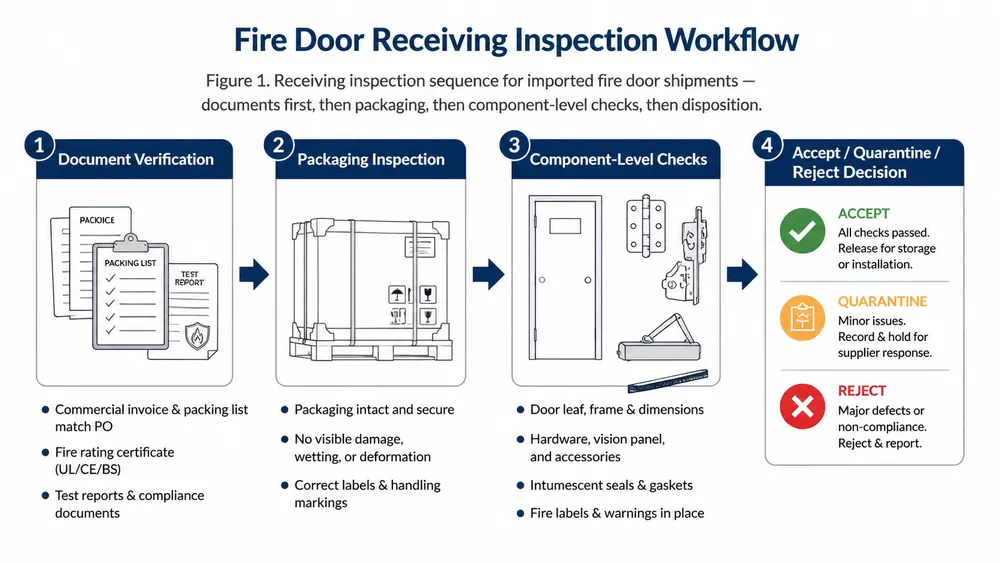
Check the paperwork before you open a single crate
Start with documents, not with the doors themselves. If the certification paperwork is wrong or missing, the physical condition of the product is secondary — you can't install a fire door that doesn't have the right documentation, regardless of how good it looks.
Pull these against your purchase order:
- Packing list vs. PO: Match quantities, door sizes, fire ratings, and hardware line items. Count cartons against the packing list total. Shortages are easier to claim now than after your warehouse team has scattered the shipment across a job site.
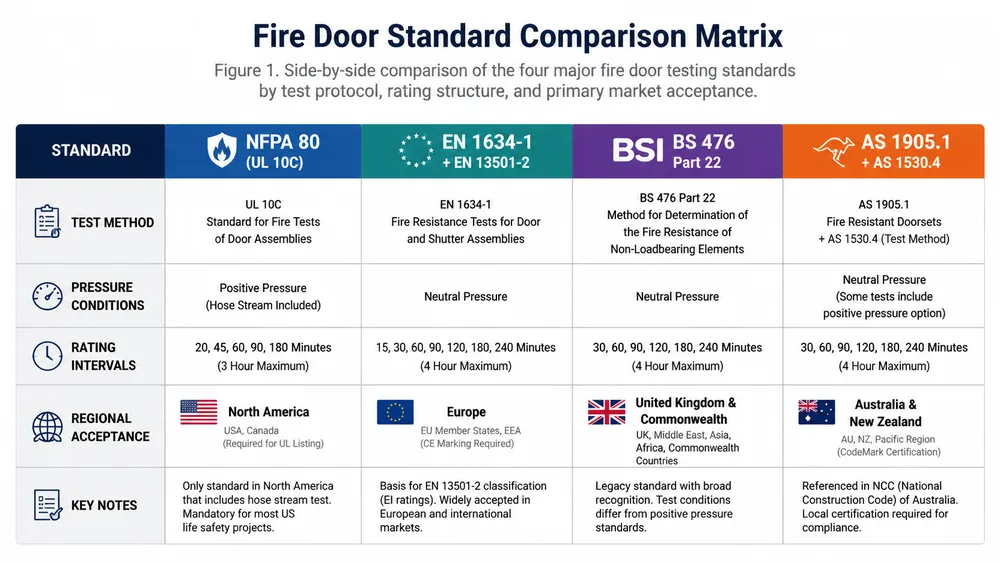
- Fire test report or certificate: This should reference a recognized standard — NFPA 252, UL 10C, EN 1634-1, or BS 476 depending on your market. The report must match the specific door configuration you ordered (size, glazing, hardware prep). A generic test report for a different door size or construction doesn't cover your units.
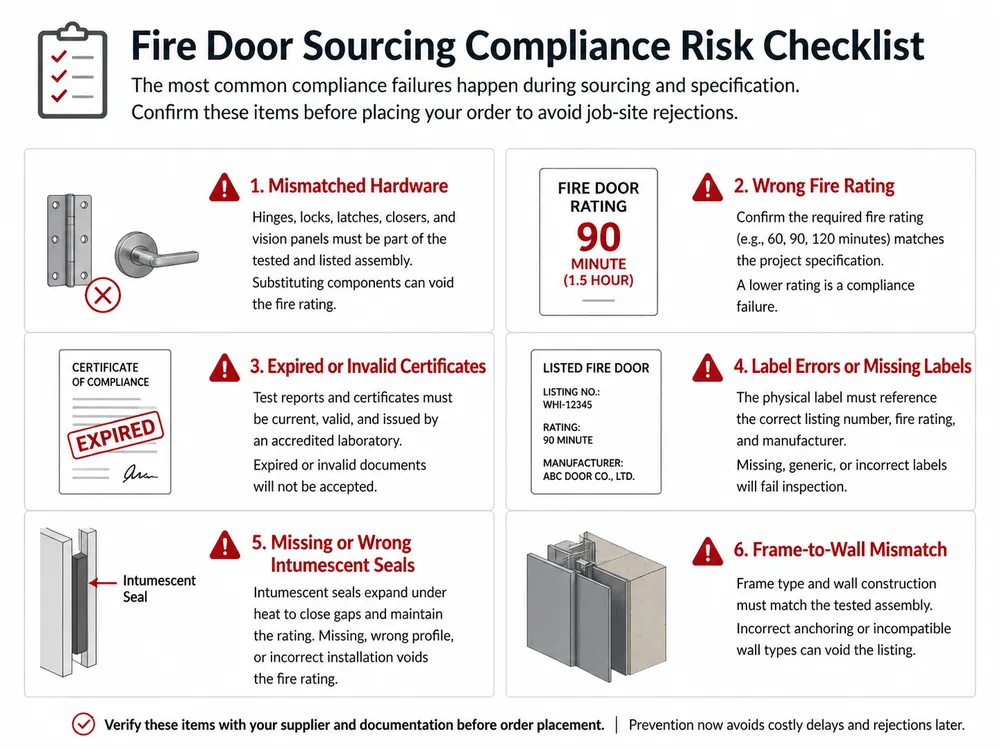
- Rating label or listing mark: Every fire-rated door leaf and frame should carry a permanent label from the listing agency (UL, Intertek/WHI, or equivalent). If the label is missing, the door is not a fire door in the eyes of any building inspector — full stop.
- Material test certificates: For steel doors, mill certificates confirming steel grade and gauge. For fire cores, documentation of the core material and its fire performance.
- Batch or lot traceability: A barcode, QR code, or lot number that links each door to a production batch. This is your audit trail if a defect surfaces later. (We barcode-link every unit to its production batch, inspection record, and test-fit data — if you're sourcing from a factory that can't trace a unit back to its production date, that's a red flag worth noting.)
If any certification document is missing or doesn't match your order, quarantine the shipment and notify your supplier before proceeding. Installing a fire door without proper documentation creates a compliance liability that lands on you, not on the factory.
For a deeper look at what fire door certifications and standards apply to your market, that page breaks down NFPA 80, CE marking, UL listing, and EN 1634 requirements by region.
Packaging and freight damage — the 60-second exterior check
Before you cut strapping or open crates, inspect the packaging itself. Freight damage that's visible on the outside often means worse damage inside, and documenting it before you open anything strengthens your claim with both the carrier and the supplier.
Walk the shipment and check:
- Crate and carton condition: Look for crushed corners, punctures, water staining, and broken strapping. Photograph any damage with the shipping label visible in the frame.
- Stacking and orientation: Were the crates shipped and stored upright as marked? Fire doors shipped flat and stacked under heavy freight can develop leaf bow that's hard to detect until you try to hang them.
- Moisture indicators: If the shipment includes humidity indicator cards (common on ocean freight), check them before opening. A tripped indicator means the doors sat in high humidity — check for surface corrosion and core swelling once you open up.
- Corner and edge protection: Foam-lined crates with frame corner guards are standard for export-grade fire door packaging. If the corner guards are missing or displaced, inspect the frame corners and edges first — that's where transit damage concentrates.
Count the cartons and cross-reference against the packing list before you sign the carrier's delivery receipt. Any discrepancy in count or visible damage should be noted on the receipt itself. Once you sign clean, the carrier's liability gets much harder to enforce.
Door leaf inspection — what to measure and what to look for
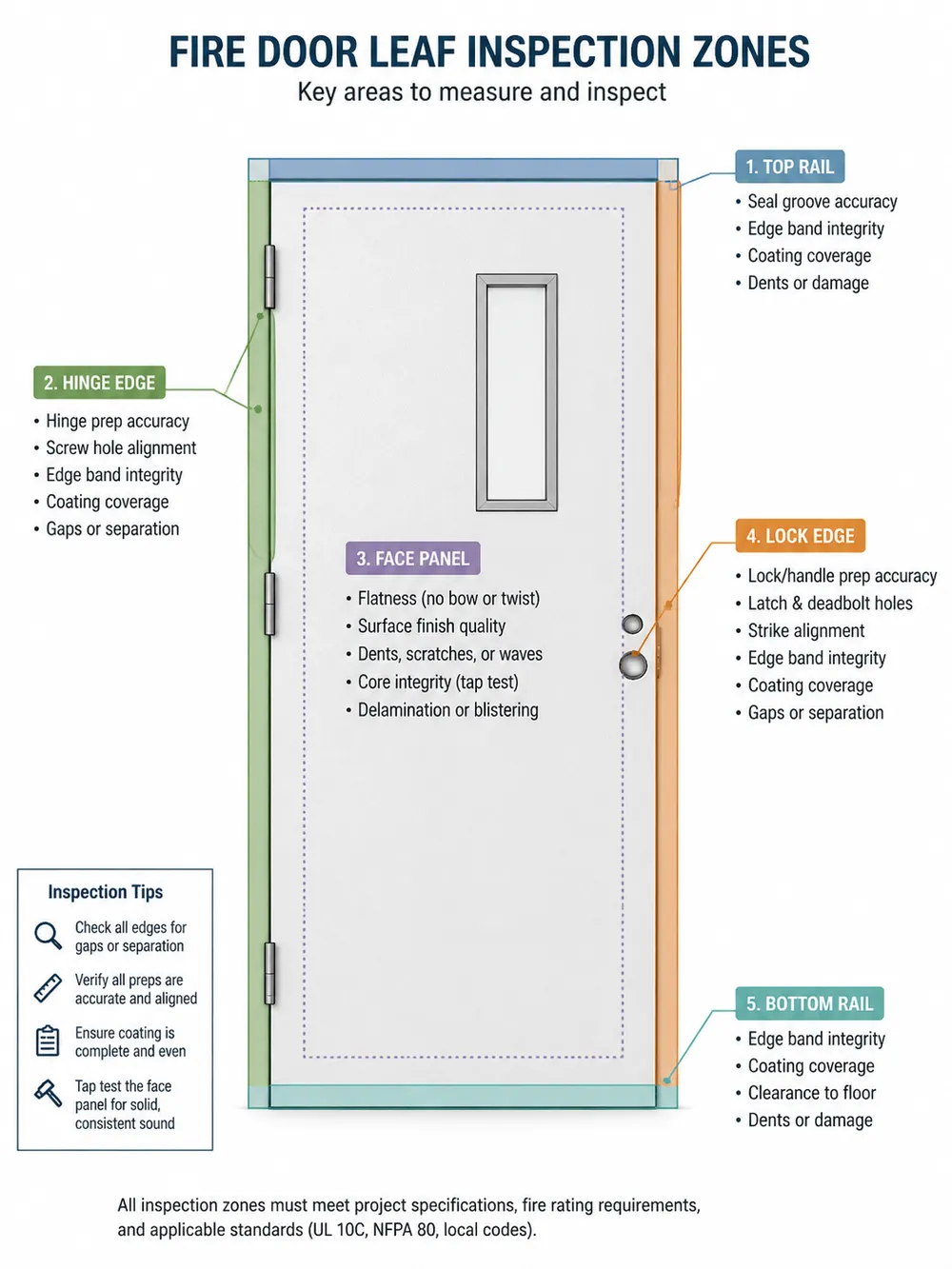
Open the crate and start with the door leaf. This is where the most consequential defects hide, because a compromised leaf can't be field-repaired without voiding the fire rating.
Dimensional checks:
- Measure height, width, and thickness at multiple points. Fire doors have tighter dimensional tolerances than standard doors because the gap between leaf and frame is a fire-performance parameter, not just a fit issue. Typical allowable tolerance is ±1.5mm on height and width for a standard commercial fire door.
- Check for leaf bow and twist. Lay the door flat on a known-flat surface (or use a straightedge across the face). Bow exceeding 3-4mm across the full height is a problem — it will create uneven gaps in the frame that compromise both the fire seal and the closer function.
- Measure diagonal dimensions corner to corner. If the two diagonals differ by more than 2mm, the leaf is out of square and will not hang properly.
Surface and finish checks:
- Inspect the powder coat or paint finish under good lighting. Look for scratches, chips, orange peel, pinholes, and inconsistent color. Minor transit scratches on the hinge edge are cosmetic and repairable. Scratches or chips that expose bare steel on the face or the seal rabbet are a corrosion risk and a potential rejection.
- Check the bottom edge and top edge — these are often the first places where coating coverage gets thin. On steel fire doors, an uncoated edge is a rust path.
Core and construction integrity:
- Tap the face panel in several locations. A fire door with a proper mineral core or honeycomb-and-insulation fill sounds solid and consistent. Hollow spots, rattling, or inconsistent sound can indicate core damage, delamination, or a manufacturing defect.
- Inspect the leaf edges for any separation between the face sheet and the edge band. On steel fire doors, the edge band is typically a folded or welded channel — any gap or separation there is a fire-path failure point.
Frame inspection — squareness, anchoring prep, and seal grooves
The frame is half the fire door assembly, and it's the half that gets permanently anchored into the wall. A frame defect found after installation means demolition, not adjustment.
- Squareness: Measure the frame diagonals. Difference should be under 2mm. An out-of-square frame means uneven gaps around the leaf, which means the intumescent seal won't compress evenly, which means the fire rating is compromised.
- Throat dimension: Confirm the frame throat matches your wall thickness. This is a common mismatch on import orders — the frame was built for a different wall spec than what's on site. Measure at the head and both jambs.
- Anchor and hinge prep: Check that anchor points, hinge reinforcements, and strike plate preps are in the correct locations and match the hardware schedule. Mislocated hinge preps are not field-correctable on a fire-rated frame without voiding the listing.
- Seal groove condition: Run your finger along the intumescent seal groove on both jambs and the head. The groove should be clean, consistent depth, and free of dents or deformation. If the frame ships with the intumescent seal pre-installed, check that the seal is continuous, undamaged, and properly seated. Gaps or crushed sections in the intumescent strip are a direct fire-performance failure.
- Finish: Same coating checks as the leaf — look for chips, scratches, and bare steel, especially at weld joints and corners where coating adhesion is weakest.
(A note from production experience: the single most common frame defect we catch in our own pre-shipment QC is a slight twist in the hinge jamb from welding stress. We straighten and re-check every frame on a surface plate before packing. If your supplier doesn't test-fit the leaf to the frame before shipping, you're doing that QC on your dock instead of theirs.)
Intumescent seals, smoke seals, and glazing — the fire-performance details
These components are what actually make a fire door perform in a fire. A door can look perfect and still fail a fire test if the seals are damaged or the glazing doesn't match the listing.
Intumescent seals:
- Check that intumescent strips are present on all required locations — typically the leaf edge, the frame rabbet, or both, depending on the door design and listing.
- Look for cuts, tears, gaps, or compression damage. Intumescent material that's been crushed flat during shipping may not expand properly under heat.
- Confirm the seal material matches the listing. Different fire ratings require different intumescent formulations and cross-section sizes. A 60-minute door with a 30-minute seal is not a 60-minute door.
Smoke seals:
- If the door is rated for smoke control (S-rated or meets UL 1784), verify that the smoke gasket is installed and continuous around the full perimeter.
- Check the compression fit by closing the door in the frame (if you're doing a test-fit on the dock). The gasket should compress evenly with no visible light gaps.
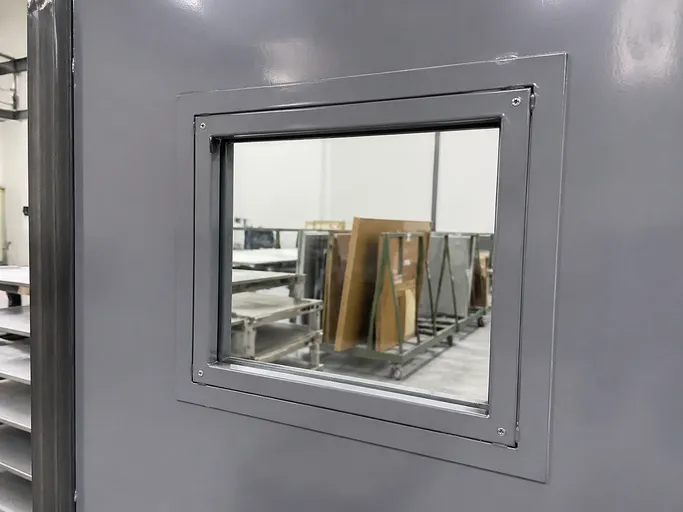
Glazing (for vision panels):
- Confirm the glass type matches the fire rating. Fire-rated glazing is not interchangeable — borosilicate, ceramic, and intumescent-laminated glass each have different ratings and listing requirements.
- Check for cracks, chips, edge damage, and proper seating in the glazing bead. Loose or improperly seated glazing beads are a common transit-damage issue.
- Verify that the vision panel size matches the listing. Fire-rated glazing has maximum area limits that vary by rating and standard. An oversized vision panel voids the door's fire rating even if the glass itself is rated.
Hardware carton audit — hinges, locks, closers, and the parts that get forgotten
Hardware problems are the most common cause of installation delays on fire door projects, and they're almost always preventable with a 10-minute carton check on arrival.
Open the hardware carton and verify against the hardware schedule in your PO:
- Hinges: Correct quantity (typically 3 per leaf for standard commercial fire doors, 4 for oversized or heavy doors), correct size, correct material (steel, not aluminum — aluminum hinges are not listed for fire doors), and correct finish. Ball-bearing hinges are standard for fire doors; plain-bearing hinges won't meet cycle-life requirements under NFPA 80.
- Lock and latch set: Confirm the function (passage, storeroom, classroom, etc.) matches your spec. Check that the backset matches the door prep. Fire-rated locksets must be listed — look for the UL or equivalent mark on the lock body.
- Door closer: Confirm the closer model, size, and mounting type match the spec. A closer that's undersized for the door weight won't maintain the required closing speed and latching force. Check that the closer arm, mounting plate, and fasteners are all included. (Missing closer arms are surprisingly common in hardware cartons — it's a small part that gets left out of the box more often than you'd expect.)
- Threshold and bottom seal: If specified, confirm the threshold type and the bottom seal or automatic door bottom are included and undamaged.
- Fasteners and strike plates: Count them. Missing screws and strike plates are a nuisance that stops installation cold if your crew doesn't carry spares.
Any missing or mismatched hardware item should be documented and reported to your supplier immediately. Do not substitute non-listed hardware on a fire-rated door — it voids the assembly rating.
How to document defects for a supplier claim that actually works
Finding a defect is only half the job. Documenting it properly is what determines whether your supplier replaces the unit, credits your account, or argues about it for weeks.
For every defect you identify:
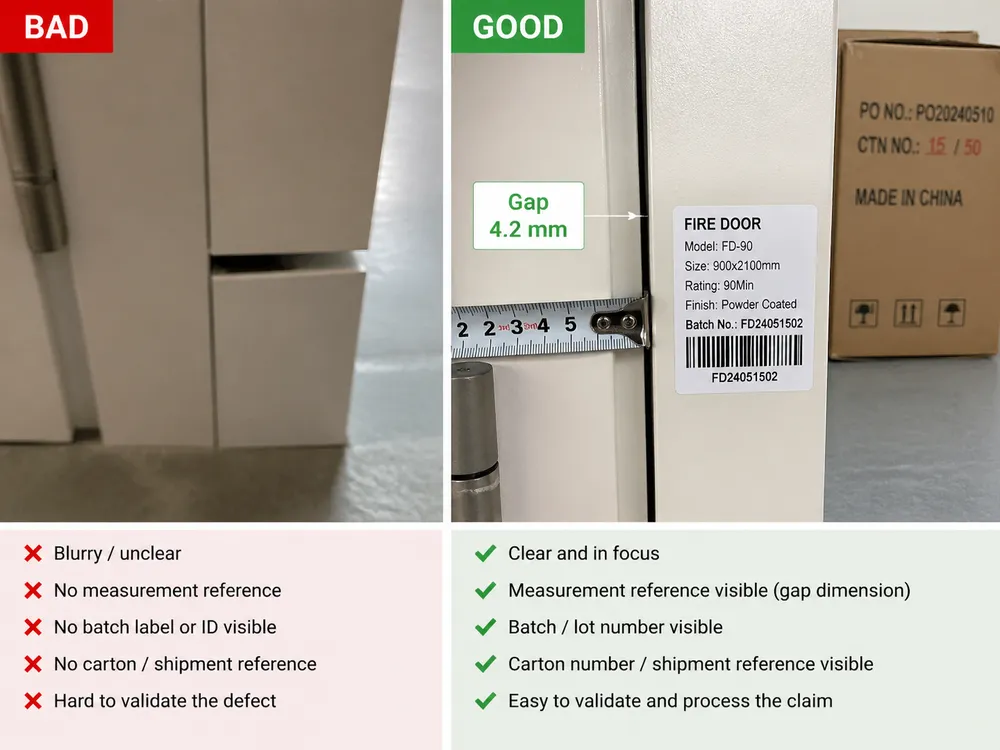
- Photograph the defect with a ruler or tape measure in the frame for scale. Include the door's batch label or barcode in at least one photo so the image is traceable to a specific unit.
- Photograph the carton and shipping label of the affected unit. This links the defect to a specific package in the shipment.
- Record the measurement — gap dimension, bow measurement, diagonal difference, coating thickness reading, or whatever quantifies the defect. "The frame is out of square" is an opinion. "Frame diagonals differ by 4.5mm" is a claim.
- Note the installation status: not installed, partially installed, or fully installed. Your claim is strongest when the defect is documented before any installation work begins.
- Classify the defect against your accept/reject criteria (see the decision table below).
Send the documentation package to your supplier within the claim window specified in your purchase contract — typically 7-14 days from delivery for visible defects. Include your PO number, the batch/lot numbers of affected units, and a clear statement of what you need: replacement, credit, or repair parts.

Accept, quarantine, or reject — a decision framework for common fire door defects
Not every defect is a rejection. Some issues are cosmetic and field-repairable without affecting the fire rating. Others are non-negotiable. This table gives you a starting framework — adjust thresholds based on your project spec and local code requirements.
| Defect | Severity | Action |
|---|---|---|
| Minor surface scratch on face (no bare steel exposed) | Cosmetic | Accept — touch up with manufacturer-supplied paint pen |
| Scratch or chip exposing bare steel on seal rabbet or edge | Moderate | Quarantine — repairable only if the listing allows field touch-up; confirm with supplier |
| Leaf bow > 4mm over full height | Structural | Reject — will not seal properly in frame; not field-correctable |
| Frame diagonals differ > 3mm | Structural | Reject — out-of-square frame compromises gap dimensions and seal performance |
| Missing or damaged intumescent seal | Fire performance | Reject — do not install; replacement seal must match the listing exactly |
| Missing fire rating label | Compliance | Reject — unlabeled door is not a fire door; cannot pass inspection |
| Glazing cracked or chipped | Fire performance | Reject — fire-rated glass cannot be field-replaced without re-listing |
| Wrong hardware function (e.g., passage instead of storeroom) | Specification | Quarantine — request correct hardware from supplier; do not substitute |
| Missing door closer or closer arm | Specification | Quarantine — order replacement; do not install door without closer |
| Hinge prep mislocated on frame | Structural | Reject — cannot be field-corrected on a fire-rated frame |
| Powder coat orange peel or color mismatch | Cosmetic | Accept with note — document for warranty file; does not affect fire rating |
| Core delamination or hollow spots on tap test | Structural | Reject — compromised core integrity; fire performance unknown |
The general rule: if a defect touches the fire rating, the seal path, or the certification label, it's a reject or a quarantine until the supplier provides a documented resolution. Cosmetic issues that don't affect fire performance or structural integrity can be accepted with documentation.
What your supplier's QC should have caught before the container loaded
A good receiving inspection protects you. A good supplier makes most of that inspection redundant.
When you're evaluating fire door manufacturers, ask specifically about their pre-shipment QC process. The checks you're running on your dock are the same checks that should have happened on the factory floor — and a factory that does them properly will have documentation to prove it.
At our facility, every fire door goes through a 5-stage inspection before it reaches the packing line: incoming steel verification, in-process dimensional check after forming, weld integrity inspection, coating adhesion and thickness measurement, and a final assembly stage where the leaf is test-fitted into its frame, hardware is cycled, and gap dimensions are verified. 100% of units are inspected — we don't do statistical sampling on fire-rated product. Each unit gets a barcode that links to its full inspection record, so if you flag a defect on arrival, we can pull the production data for that specific door within minutes.
That level of traceability isn't universal. If your current supplier can't provide batch-level inspection records, or if you're consistently finding defects that should have been caught at the factory, the inspection checklist above becomes your primary quality gate — and that's a sign your sourcing needs a closer look.
For buyers who want to request a quote on fire door supply with full pre-shipment QC documentation, send your fire rating, door sizes, hardware schedule, destination market, and required certifications. We'll quote the complete door assembly package including the documentation set your project needs for code compliance.
Frequently asked questions
What documents should come with imported fire doors?
At minimum: a fire test report or certificate referencing the applicable standard (NFPA 252, UL 10C, EN 1634-1, or BS 476), a listing label on each door leaf and frame, a packing list matching your PO, and material certificates for the steel and core. For international shipments, you should also receive a commercial invoice, bill of lading, certificate of origin, and any market-specific compliance documents. If your supplier doesn't provide batch traceability linking each unit to a production and inspection record, ask for it — it's your audit trail if problems surface after installation.
Can I field-repair a damaged intumescent seal without voiding the fire rating?
It depends on the listing. Some listings allow field replacement of intumescent seals using the exact same seal product specified in the original test report. Others require the seal to be factory-installed. Check the door's listing documentation or contact the listing agency directly. Never substitute a different seal product or cross-section size — even if it looks similar, it hasn't been tested in that specific door assembly and the rating is void.
How much leaf bow is acceptable on a fire door?
Most standards and listing agencies allow up to 4mm (approximately 5/32") of bow measured across the full height of the leaf. Beyond that, the door won't maintain consistent contact with the intumescent seal and the frame stop, which means the fire performance is compromised. Bow is usually caused by improper storage (laying doors flat under load) or uneven core curing during manufacturing. If you receive doors with excessive bow, reject them — it's not a field-correctable condition.
What's the difference between a receiving inspection and an annual fire door inspection?
A receiving inspection happens on the dock before installation. You're checking for manufacturing defects, shipping damage, specification mismatches, and missing documentation. An annual inspection (per NFPA 80 or local code) happens after the door is installed and in service — it checks for wear, damage, improper modifications, and continued compliance. Both are necessary, but they catch different problems at different stages. The receiving inspection is your last chance to reject defective product before you absorb installation labor cost.
Should I inspect every door in a large shipment or can I sample?
For fire-rated doors, inspect every unit. Statistical sampling works for commodity products where a defect is an inconvenience. On fire doors, a single defective unit that gets installed is a code violation, a failed inspection, and a potential liability. The time cost of 100% receiving inspection is small compared to the cost of pulling an installed fire door out of a finished wall because the label was missing or the seal was damaged.