
Wrong rating, wrong wall, failed inspection
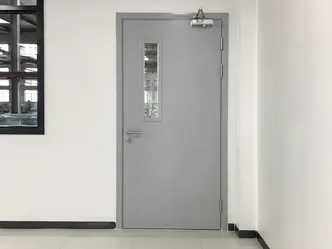
A fire door rating is a time value — 20, 45, 60, or 90 minutes — that tells you how long the assembly held during a standardized furnace test. The assembly, not just the leaf. That distinction trips up more procurement teams than any other single detail in fire door sourcing.
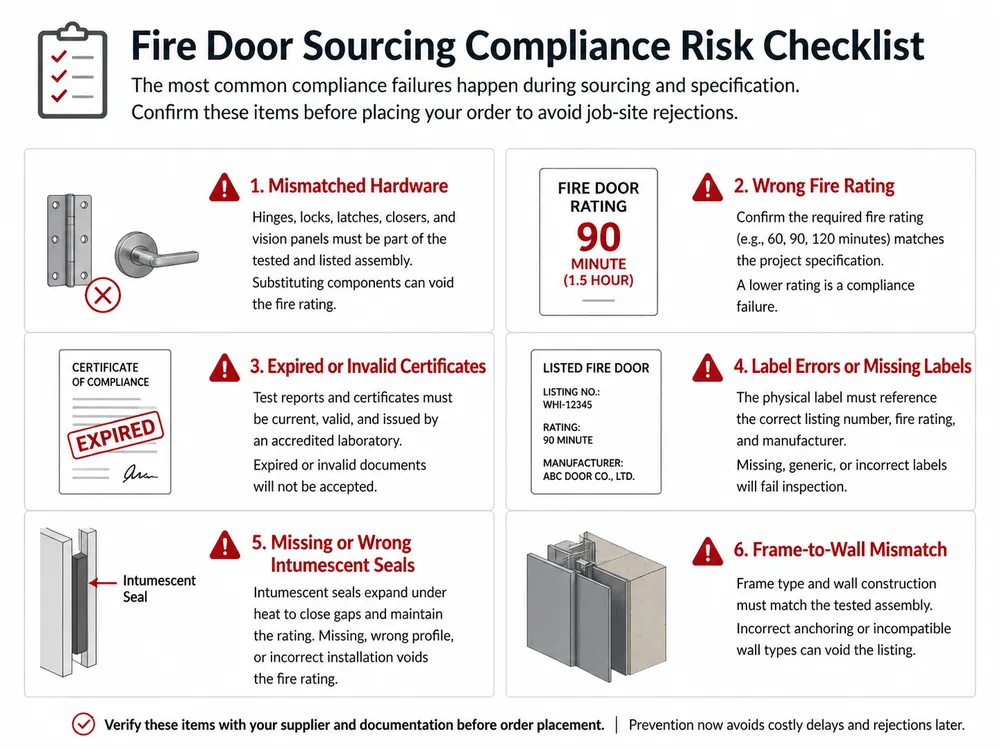
When you specify a 60-minute fire door but pair it with a frame, seal, or closer that was tested to a different rating, the entire opening fails code inspection. The door leaf might be fine. The assembly is not. And the inspector doesn't care which component was correct — the opening either passes or it doesn't.
We see this play out in export shipments regularly. A buyer orders 500 doors at the right rating, installs them with locally sourced frames or hardware that weren't part of the tested assembly, and the building authority rejects the openings. The rework cost dwarfs the original door price. The fix is straightforward: specify the complete assembly at the RFQ stage, not just the leaf.
This guide breaks down what each rating actually requires in terms of construction, hardware, glazing, and documentation — and what you need to confirm before placing an order.
What the rating number actually controls
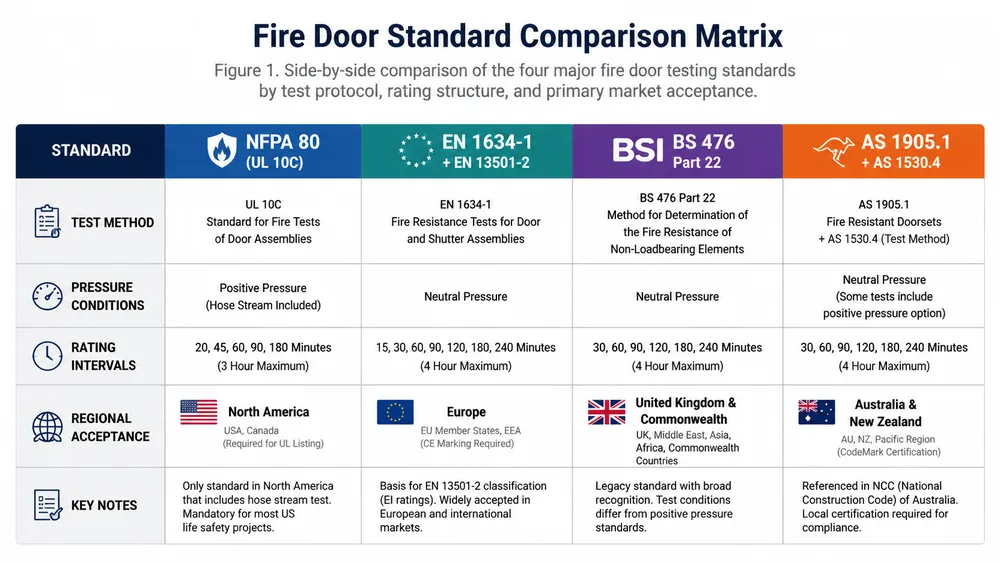
The minute value on a fire door rating comes from a furnace test conducted under a recognized standard — NFPA 252 and UL 10C in North America, EN 1634-1 in Europe, or AS 1905.1 in Australia. The test subjects a complete door assembly (leaf, frame, glazing, seals, hardware) to a controlled fire curve and measures how long the assembly maintains integrity and, depending on the standard, insulation.
Two things matter for your sourcing decisions here:
The rating applies to the tested assembly configuration. Change the frame profile, swap the intumescent seal brand, use a different closer, and the test certificate no longer covers what you're installing. This is why we always ship fire doors with matched frames and pre-installed seals — it keeps the tested configuration intact through to the job site.
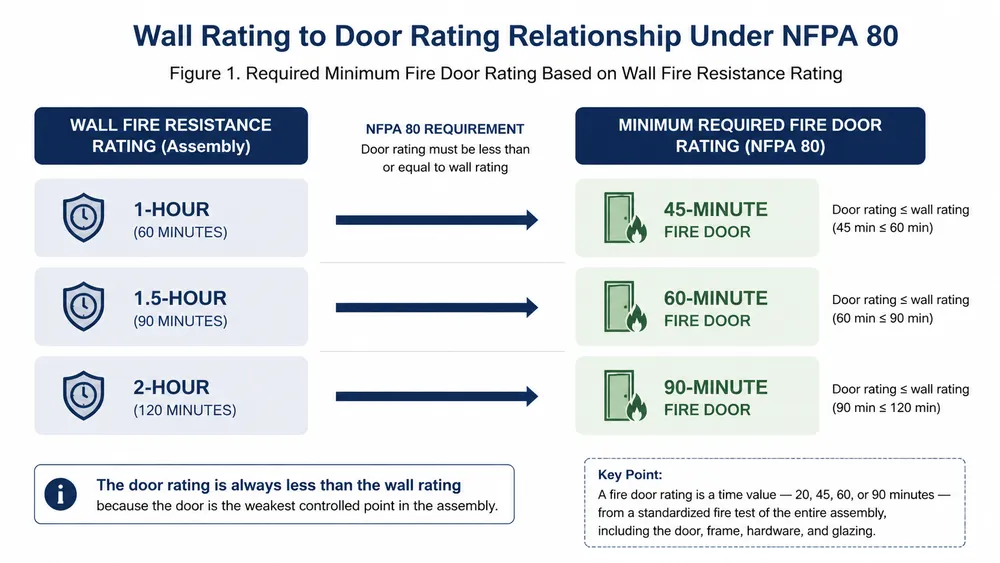
The rating must match or exceed the wall's fire resistance rating. A 2-hour fire-rated wall typically requires a minimum 90-minute fire door. A 1-hour wall typically requires a 45-minute door (under NFPA 80) or a 60-minute door (under some regional codes). The wall dictates the door, not the other way around. If you're sourcing for a project and the architect hasn't confirmed the wall rating, you're guessing — and guessing on fire ratings creates liability.

Fire door rating chart — 20, 45, 60, and 90 minutes compared
Here's where the ratings diverge in ways that directly affect your order spec, landed cost, and project risk.
| Specification | 20-minute | 45-minute | 60-minute | 90-minute |
|---|---|---|---|---|
| Typical wall rating | 1-hour (corridor/room) | 1-hour | 1.5-hour | 2-hour |
| Common applications | Corridor doors, room separations, low-risk interior openings | Stairwell doors, office separations, most commercial interiors | Hospital corridors, school stairwells, higher-risk separations | Shaft walls, high-hazard separations, industrial fire barriers |
| Leaf construction | Single-skin steel or mineral core, thinner profile | Mineral core with steel skins, standard profile | Denser mineral core, heavier gauge steel skins | Maximum-density core, heaviest gauge skins, often reinforced stiles |
| Typical leaf thickness | 40-44 mm | 44-50 mm | 50-54 mm | 54-60+ mm |
| Intumescent seal | Single-layer perimeter seal | Full perimeter intumescent seal | Full perimeter + smoke seal combination | Full perimeter + smoke seal, often dual-layer |
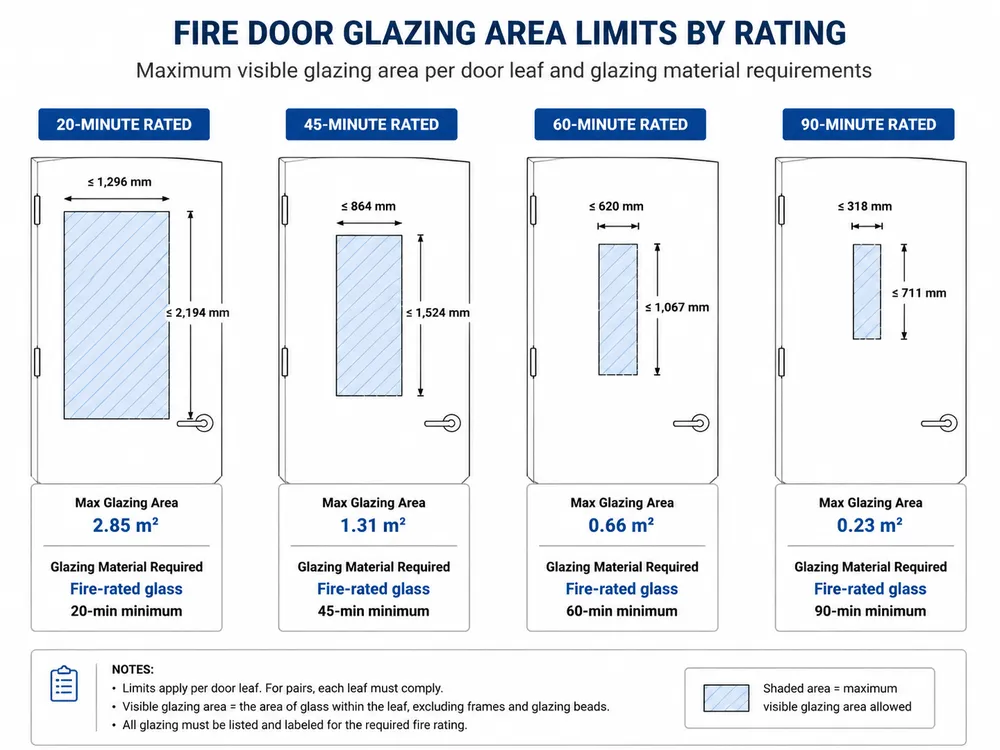
| Glazing allowance | Up to 929 cm² (1 sq ft) wired glass or rated ceramic | Up to 929 cm² standard; larger with rated ceramic | Reduced area limits; rated ceramic or intumescent-laminate only | Minimal or no glazing; rated ceramic with strict area limits |
| Frame requirement | Standard pressed steel frame | Tested steel frame with intumescent seal groove | Heavier gauge frame, deeper seal groove, tested configuration | Heaviest gauge frame, reinforced anchoring, full tested assembly |
| Closer requirement | Standard overhead closer | UL-listed closer, minimum size 3 | UL-listed closer, size 4+, backcheck recommended | UL-listed closer, size 4-5, backcheck and delayed action common |
| Hinge requirement | Steel butt hinges, minimum 2 | Steel ball-bearing hinges, minimum 3 | Steel ball-bearing hinges, minimum 3, heavier gauge | Steel ball-bearing hinges, minimum 3, spring hinges common |
| Latch/lock | Standard latch or passage set | Fire-rated latch set, positive latching required | Fire-rated mortise lock, positive latching | Fire-rated mortise lock, positive latching, panic hardware common |
| Unit weight (approx.) | 25-35 kg | 35-50 kg | 50-65 kg | 65-90+ kg |
| Freight impact | Standard KD packing | Standard KD packing | Heavier cartons, fewer units per 40HQ | Heaviest cartons, significantly fewer units per container |
The weight column matters more than most buyers expect. A 90-minute fire door at 80+ kg per leaf changes your container loading math — you'll fit roughly 30-40% fewer units per 40HQ compared to a 20-minute door. That shifts your landed cost per unit, and it changes the hardware spec on site (heavier hinges, stronger closers, reinforced frame anchoring). Factor this into your cost model early, not after the container is booked.
How rating selection changes what you're actually buying
Core fill and leaf construction
The rating drives the core. A 20-minute fire door can use a relatively thin mineral wool or honeycomb core between steel skins. Move to 45 minutes and the core density increases — we typically use a perlite-vermiculite composite board at this rating, which gives consistent thermal performance without the weight penalty of solid calcium silicate.
At 60 and 90 minutes, the core becomes the most expensive component in the door. We're using high-density calcium silicate or ceramic fiber board, and the steel skin gauge goes up to handle the thermal expansion stress during the test. (The core material is where most of the cost difference between ratings lives — a 90-minute door isn't just a thicker version of a 45-minute door. The internal construction is fundamentally different.)
Intumescent seals and smoke control
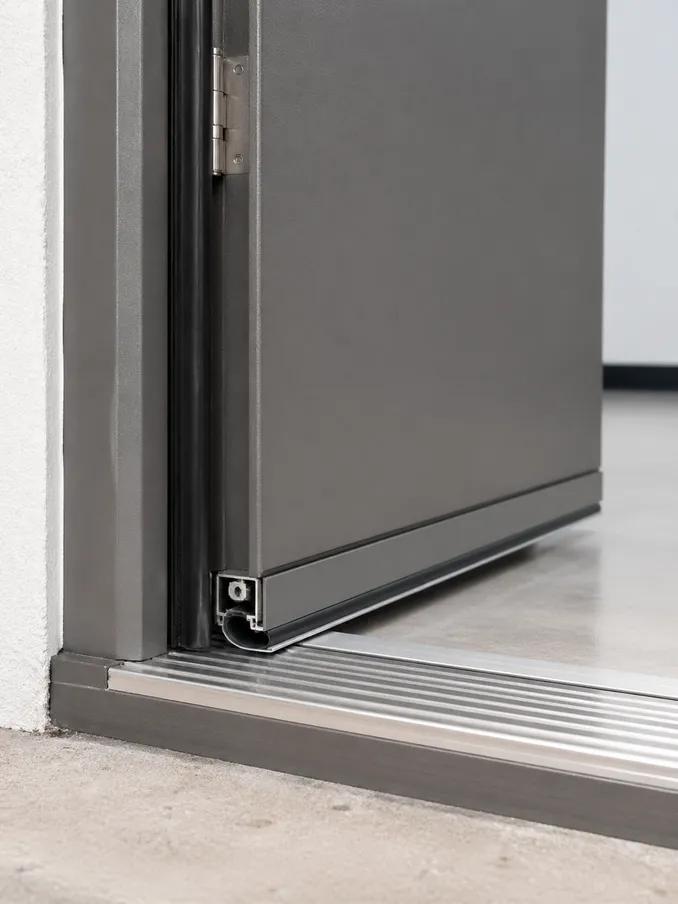
Every fire-rated door needs an intumescent seal — the strip that expands under heat to close the gap between leaf and frame. At 20 minutes, a single-layer graphite-based seal in a routed groove handles the job. At 45 and 60 minutes, you're looking at a combined intumescent-plus-smoke seal, because most codes require smoke control at these ratings.
At 90 minutes, we often run a dual-layer seal configuration: intumescent on the leaf edge and a secondary smoke seal on the frame stop. The seal has to survive the full 90-minute test without losing expansion capacity, which limits your material options and means the seal groove dimensions change. If you're sourcing frames separately from leaves, confirm the seal groove spec matches — a 3mm groove cut for a 20-minute seal won't accept the 5mm seal needed for a 90-minute assembly.
Glazing limits tighten as ratings climb
This is where buyer expectations and code reality collide. Many project specs call for vision panels in fire doors, but the allowable glazing area shrinks as the rating increases.
A 20-minute door can accept up to roughly 929 cm² of wired glass or fire-rated ceramic. At 45 minutes, the same area is possible but only with rated ceramic glazing — wired glass alone won't pass the test at this duration in most standards. At 60 minutes, the glazing area drops and the glass must be intumescent-laminate or rated ceramic with a tested frame kit. At 90 minutes, many tested configurations allow no glazing at all, or only a very small rated vision lite.
If your project requires large vision panels in a high-rated opening, you may need to rethink the opening design — split it into a door-plus-sidelight configuration, or use a rated curtain wall system adjacent to the door. We can advise on tested configurations that maximize vision area within the rating, but the physics of the furnace test set hard limits. Better to know this at the RFQ stage than after the doors are manufactured.
Hardware gets heavier and more specific
A 20-minute fire door works with standard commercial hardware. Once you cross into 45-minute territory, every piece of hardware on the door must be fire-rated and listed for that specific rating duration.
Closers are the most common failure point in fire door inspections. The closer must be UL-listed (or CE-marked, depending on your market), sized correctly for the door weight and width, and capable of latching the door fully from any open position. At 60 and 90 minutes, the door weight alone demands a size 4 or 5 closer — undersized closers won't latch a 70 kg door reliably, and an unlatched fire door during a fire event is the same as no door at all.
Hinges follow the same logic. Heavier doors need ball-bearing hinges rated for the weight, and most codes require a minimum of three hinges on fire-rated openings. At 90 minutes, spring hinges or continuous hinges become common because the door weight makes standard butt hinges a long-term reliability risk.
Panic hardware (push bars, exit devices) adds another layer. If the opening requires panic hardware, it must be fire-rated to the same duration as the door. Not all panic hardware is available at all ratings — 90-minute rated panic devices are a smaller product category with fewer manufacturers, which can affect your lead time and cost.
Standards and certifications — what your RFQ must reference
Fire door ratings don't exist in a vacuum. The rating is only valid under a specific test standard, and different markets recognize different standards. Specifying "60-minute fire door" without naming the standard is like ordering steel without naming the grade — you'll get something, but it might not be what your project needs.
| Market | Primary standard | Test method | Notes for procurement |
|---|---|---|---|
| North America | NFPA 80, NFPA 252 | UL 10C, UL 10B | Positive latching required. Door must be listed by a NRTL (UL, Intertek, etc.). Label on every door. |
| Europe / UK | EN 16034, EN 1634-1 | EN 1634-1 | CE marking required. Performance declared in classification report. Integrity (E) and insulation (I) rated separately. |
| Middle East | Often references EN or NFPA | Varies by emirate/country | Dubai Civil Defence has specific requirements. Confirm local AHJ acceptance before ordering. |
| Australia / NZ | AS 1905.1 | AS 1530.4 | FRL rating format: -/60/30 (structural adequacy/integrity/insulation). Different notation system. |
| Southeast Asia | Varies — often EN or BS | EN 1634-1 or BS 476 Part 22 | Singapore SCDF, Malaysia BOMBA each have specific acceptance criteria. |
We hold NFPA 80 certification and CE marking, and we've shipped fire doors into all five of these market regions. The documentation package changes by destination — a North American shipment includes UL-format test reports and NRTL listing labels; a European shipment includes the Declaration of Performance and CE label. When you send an RFQ, include your destination market so we can confirm which certification and documentation package applies to your order.
(One thing we've learned from 11 years of export fire door work: the standard listed on the project spec and the standard the local authority actually enforces are not always the same. If you're shipping to a market you haven't supplied before, verify acceptance with the local Authority Having Jurisdiction before committing to a large order.)
Specification mistakes that cost you on site
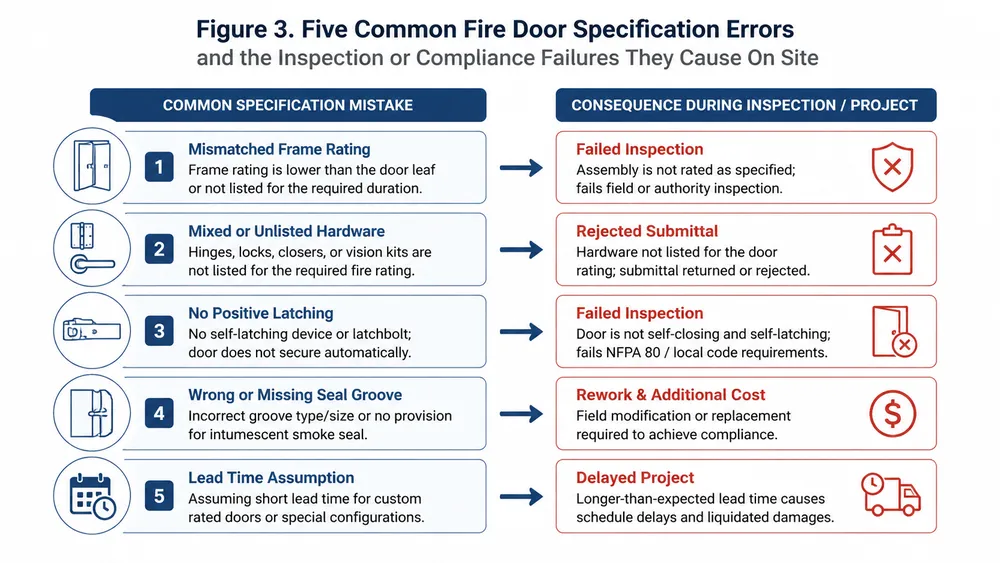
After more than a decade of producing and shipping fire doors, we've seen the same sourcing mistakes repeat across markets. These aren't obscure edge cases — they're the errors that show up in 20-30% of first-time fire door orders.
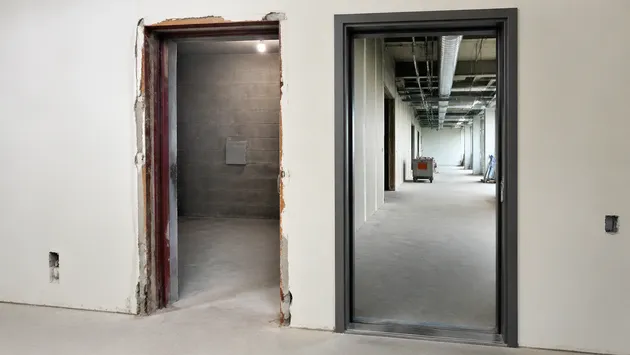
Specifying the leaf rating without the frame. The most common one. You order a 60-minute door leaf, install it in a locally fabricated frame that was never tested with that leaf, and the assembly has no valid test certificate. The inspector is right to reject it. Always specify leaf and frame as a tested pair.
Mixing hardware from different test reports. A closer tested with Door Assembly A and a hinge tested with Door Assembly B don't automatically combine into a valid Assembly C. If you're sourcing hardware separately, confirm that every component appears on the same test report or listing.
Ignoring the positive latching requirement. NFPA 80 requires fire doors to positively latch — the latch bolt must engage the strike plate without manual intervention. Passage-function locksets (no latch bolt) fail this requirement. We've seen entire floors of doors rejected because the lockset spec was copied from a non-rated door schedule.
Ordering the wrong seal groove dimension. If you source frames from one supplier and leaves from another, the intumescent seal groove width and depth must match. A 3mm x 15mm groove won't accept a 5mm x 20mm seal. We machine our seal grooves to match the specific seal profile for each rating — if you're mixing sources, get the groove spec in writing.
Assuming all ratings ship on the same lead time. A 20-minute door uses standard materials and runs on our regular steel fire door production line. A 90-minute door uses specialty core materials and heavier gauge steel that may need to be ordered separately. Plan for longer lead times on higher ratings, especially on large-quantity orders.
RFQ checklist — what to include when you request a quote
A complete fire door RFQ eliminates back-and-forth and gets you an accurate quote faster. Here's what we need to confirm a compliant specification:
- Fire rating: 20, 45, 60, or 90 minutes
- Applicable standard: NFPA 252/UL 10C, EN 1634-1, AS 1905.1, or project-specific
- Door size: Width x height, single or double leaf
- Opening direction: Left-hand, right-hand, or pair configuration
- Frame type: Knock-down, welded, or wrap-around; wall condition (masonry, drywall, concrete)
- Material gauge: Leaf and frame steel thickness
- Core type: If you have a preference or project spec requirement
- Glazing: Vision panel size, glass type, and whether the vision lite kit must be included
- Intumescent seal: Included in assembly or supplied separately
- Closer: Brand/model preference, or specify by size and function
- Lockset/latch: Function (passage, storeroom, classroom, panic), brand preference
- Hinges: Quantity, type (butt, continuous, spring), weight rating
- Panic hardware: If required — specify function and rating
- Finish: Powder coat color (RAL number), primer only, or galvanized
- Quantity: Total units, broken down by configuration if multiple specs
- Destination market: Country and port — this determines certification, labeling, and documentation requirements
- Project timeline: When doors need to arrive on site
Missing any of these creates ambiguity, and ambiguity on a fire door order creates risk. If you don't have all the answers yet, send what you have — our engineering team can help you fill in the gaps based on the applicable code and your project conditions. Request a quote with your available specs and we'll respond with a detailed specification review.
How we build and verify fire-rated doors at EUWOO
We produce fire doors across all four standard ratings on our dedicated fire door production lines. The construction process changes meaningfully between ratings, which is why we run fire doors on separate lines from our standard steel door production — the core materials, seal configurations, and QC checkpoints are different enough that mixing them on the same line creates quality risk.
Our 5-stage quality control process applies to every fire door, but the inspection criteria tighten at higher ratings. At 90 minutes, we're checking core density with a calibrated scale at the assembly station, verifying seal compression with a gap gauge at every frame-to-leaf junction, and cycling the closer 10 times to confirm full positive latching before the door moves to packing. (We added the closer cycling step after a batch of 60-minute doors shipped with closers that latched on the test bench but didn't latch consistently once mounted on the heavier production doors. Small difference in arm geometry — caught it in QC, not on site.)
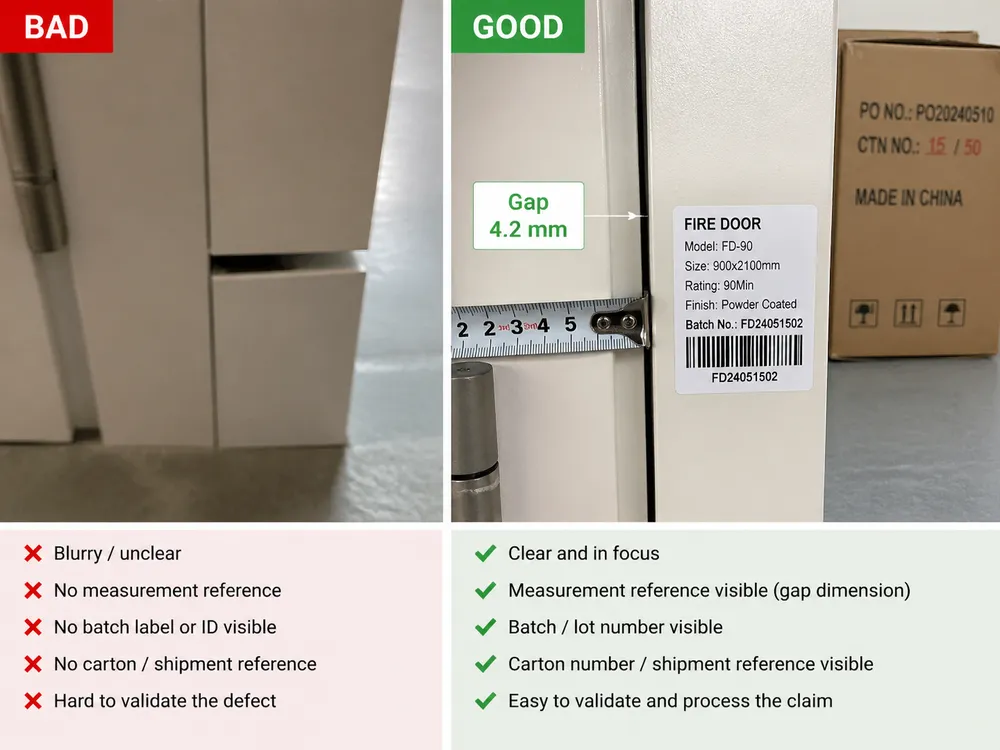
Every fire door ships with batch-traceable documentation: test certificate reference, production date, line number, QC sign-off, and the specific seal and hardware configuration installed. If an inspector on your job site has a question about a specific door, you can trace it back to the production record within minutes.
For commercial fire door projects with mixed ratings across different openings — which is most commercial buildings — we can produce and pack by floor or zone, so your installation crew isn't sorting 500 doors on site to figure out which rating goes where.
Frequently asked questions
Can I use a higher-rated door in a lower-rated wall?
Yes. A 90-minute door installed in a 1-hour wall exceeds the minimum requirement and will pass inspection. The practical question is whether the cost and weight premium are justified. A 90-minute door costs more, weighs more, and requires heavier hardware — if the wall only needs a 45-minute door, you're paying for performance you don't need and adding installation complexity. Match the rating to the wall requirement unless the project spec explicitly calls for over-rating.
What's the difference between an E rating and an EI rating?
Under EN 1634-1, fire doors receive separate classifications for integrity (E) and insulation (I). An E-rated door prevents flame and hot gas passage for the rated duration. An EI-rated door also limits heat transfer through the unexposed face. North American standards (NFPA 252, UL 10C) test for both but report a single rating. If you're sourcing for a European or Middle Eastern project, confirm whether the spec requires E only or EI — the construction and cost differ.
Do intumescent seals need to be replaced over the door's lifetime?
Intumescent seals have a service life, and most manufacturers recommend inspection every 12 months and replacement if the seal shows cracking, compression set, or damage. For your buyers and end users, this is a maintenance item — worth noting in your product documentation if you're distributing fire doors. We use graphite-based intumescent strips that maintain expansion capacity for 10+ years under normal interior conditions, but physical damage from door abuse is the more common replacement trigger.
How do I verify that a fire door test certificate is legitimate?
Request the full test report number, the testing laboratory name, and the NRTL listing number (for North American markets) or the notified body number (for CE-marked products). Cross-reference the listing number on the NRTL's online database — UL, Intertek, and other bodies maintain searchable public listings. If the supplier can't provide a traceable test report number, treat that as a red flag. We provide full test certificate references with every fire door shipment and can supply the complete test report on request.
What's the typical lead time difference between ratings?
On our lines, 20-minute and 45-minute fire doors run on standard production schedules — typically 25-35 days from deposit confirmation for catalog configurations. 60-minute doors may add 5-7 days depending on core material availability. 90-minute doors often require 35-45 days because the specialty core board and heavier gauge steel may need to be ordered from approved suppliers. Custom sizes or non-standard hardware at any rating add time. Send your quantity and spec to get an accurate lead time for your specific configuration.