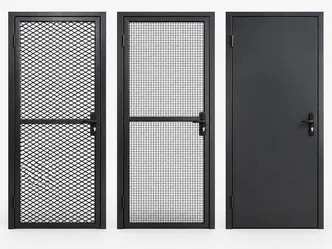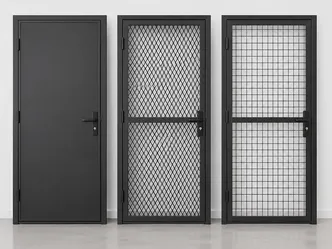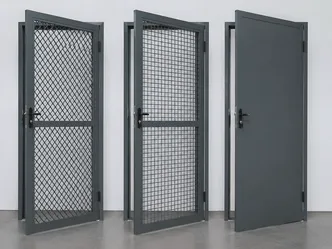

Security Screen Door Direct From Factory
Framed security screen door — insect barrier and physical security in a single factory-built unit. Fine stainless steel or aluminum mesh in a reinforced frame, powder-coated to 60–80μm, available in 60+ colors.
EUWOO manufactures security screen doors from our 18,000 m² facility in Henan, China. One supplier, one quality system, direct to your container.

What a Security Screen Door Is — and Where It Sits in Your Catalog
A security screen door is a framed door unit combining a fine-mesh panel with a structural perimeter frame, designed to sit in front of a primary entry door. It does two things simultaneously: it keeps insects out while allowing airflow, and it provides a physical barrier against forced entry. That dual function is what separates it from a standard insect screen (no security performance) and from a solid security door (no ventilation).
The product sits in a specific market position within the security door category. Buyers sourcing steel security doors or heavy-duty security doors are solving a forced-entry problem. Buyers sourcing security screen doors are solving a different problem: their end customers want to leave the primary door open for airflow — in warm climates, in residential settings, in commercial spaces without air conditioning — without sacrificing the security barrier or letting insects in.
That's a distinct purchase driver, and it means the security screen door often sells alongside a primary security door rather than instead of one.
For your distribution catalog, this product covers a segment that solid security doors don't reach. In tropical and subtropical markets — Southeast Asia, the Gulf, coastal Africa, northern Australia — the demand for ventilated security at entry points is consistent and year-round. Distributors who carry both solid security doors and security screen doors capture the full entry door replacement cycle from their downstream customers.
How It Compares in the Category
Tropical and subtropical regions where ventilated security is a year-round requirement: Southeast Asia, the Gulf, coastal Africa, northern Australia. Distributors in these markets who carry both solid security doors and security screen doors capture the full entry door replacement cycle.

Framed Security Screen Door: Construction and What Each Component Does
The commercial value of a security screen door depends almost entirely on the quality of three components: the mesh, the frame, and the hinge-and-lock assembly. Here's how we build each one, and why the choices matter for your downstream warranty exposure.
Mesh Panel
Stainless Steel Woven Mesh (316-grade)
Recommended for Coastal MarketsAluminum Woven Mesh
Inland & Price-Sensitive MarketsBoth mesh types are tensioned and mechanically fastened into the frame perimeter — not just pressed in with a rubber spline the way standard insect screens are assembled. The mechanical fastening is what gives the mesh its resistance to kick-through and cut-through attacks. A spline-retained mesh can be pushed out of the frame with moderate force; a mechanically fastened mesh requires tools and sustained effort to defeat.
Frame Construction
The frame is the structural backbone of the door. We build framed security screen doors with a 1.2mm cold-rolled SPCC steel perimeter frame, roll-formed into a box section profile. The box section gives the frame rigidity against racking — a flat-bar frame deflects under lateral force, which is how most screen door frames fail in the field. The box section holds its geometry.
Corner joints are welded, not screwed or clipped. Screwed corners are a cost-saving shortcut that shows up as frame separation after a few years of thermal cycling — the screw holes elongate and the corner opens up. Welded corners are permanent. We grind and re-treat every weld before powder coating, which is the same process we use across the full security door line to prevent adhesion failure at the weld seam.
Frame depth runs 45–55mm standard, which fits most residential and light commercial door jamb configurations without requiring custom framing. For non-standard jamb depths, we can adjust the frame profile — this is a straightforward change that doesn't affect MOQ.

Hardware: Hinges, Lock, and Closer
Heavy-Duty Hinges
Three heavy-duty hinges, 3mm plate, full-perimeter weld attachment to the frame. Same hinge specification as our standard steel security doors — the hinge is the primary forced-entry resistance point on a screen door.
Lock Options
Single-point deadbolt standard, with a multi-point option (3-point) available for buyers who need higher security ratings. Lock cylinder is a standard 70mm profile, compatible with most aftermarket cylinder upgrades.
Hydraulic Door Closer
Available as a factory-installed option. Pre-installed closer arm with closing speed adjusted at the factory. Field adjustment is a simple screw turn — worth specifying for commercial applications and residential buyers who want automatic close.
Powder Coat Finish
60–80μm powder coat thickness across the full frame assembly. 60+ color options. Every weld is ground and re-treated before coating to prevent adhesion failure at the seam — the same process used across the full security door line.
Share your target market, volume, and jamb configuration. We'll confirm the right mesh spec, frame depth, and hardware package for your order.