

Mesh Security Door Direct From Factory
Expanded mesh security door — physical barrier performance with full ventilation and sightline, factory-direct from EUWOO.
Reinforced steel frame, expanded mesh panel, powder-coated finish. A SKU that moves in residential distribution, tropical markets, and light commercial projects — one configuration that covers multiple buyer segments.

What the Mesh Security Door Is — and Where It Sits in the Security Door Range
A mesh security door is a hinged security door where the infill panel is expanded steel mesh rather than a solid steel sheet or glass. The frame is the same reinforced cold-rolled steel construction as our standard security door line — the mesh replaces the solid panel, not the structural perimeter. That distinction matters for buyers evaluating security performance: the barrier is the frame and the mesh together, not the mesh alone.
Within our security door range, the mesh security door occupies a specific position. It's not the heaviest-duty option — that's the heavy duty security door with 1.5mm body gauge and multi-point locking. It's not the ornamental option — that's the wrought iron security door. The mesh door is the SKU for buyers who need a security barrier that also allows airflow and visibility: residential entry doors in warm climates, screen-and-security combinations, light commercial applications where the door faces a ventilated corridor or courtyard.
The commercial logic for stocking this SKU: it covers a buyer need that a solid steel door cannot satisfy. In tropical and subtropical markets — Southeast Asia, the Gulf, parts of Africa and Australia — end customers actively want ventilation at the entry point.
A solid steel door solves security but creates a heat and airflow problem. The mesh security door solves both in one product, which is why it commands a price premium over a basic steel door in those markets and why distributors in those regions carry it as a core SKU rather than a specialty item.
Where It Sits in the Range
Security barrier + airflow + visibility. Core SKU for tropical/subtropical markets and ventilated entry applications.
1.5mm body gauge, multi-point locking. Maximum physical security, solid panel. For high-risk commercial and institutional applications.
Ornamental finish, decorative ironwork. For buyers where aesthetic differentiation drives the purchase decision.
Woven or welded wire infill variant. Different mesh geometry and construction method — see product page for comparison.
Expanded Mesh Panel: Construction Details That Affect Your Downstream Performance
The mesh panel is the defining component of this door, and the construction choices here are what separate a door that holds up in the field from one that generates warranty claims.
Expanded Steel Mesh — Not Welded or Woven Wire
We use expanded steel mesh — not welded wire, not woven wire. Expanded mesh is cut and stretched from a single steel sheet, which means there are no weld points or wire crossings that can corrode or separate under stress. This is a structural distinction, not a marketing one.
Aperture Spec: 20×40mm Diamond, 2.0–2.5mm Strand
The mesh aperture on our standard configuration runs approximately 20×40mm (diamond pattern), with a strand thickness of 2.0–2.5mm. That aperture size is the result of a deliberate trade-off: small enough to prevent hand insertion and resist tool leverage, large enough to maintain meaningful airflow and visibility.
Trade-off note: We've tested narrower apertures — they improve the security rating marginally but reduce airflow enough that buyers in hot climates push back. The 20×40mm spec is where most of our export volume lands.
Perimeter Welding — Not Mechanical Fasteners
The mesh panel is set into a recessed channel in the door frame and secured with perimeter welding, not mechanical fasteners. Mechanical fasteners can be driven out from the outside; a welded perimeter requires cutting equipment to defeat.

Zinc Phosphate Pre-Treatment: The Step Competitors Skip
After welding, the entire door — frame and mesh together — goes through our zinc phosphate pre-treatment bath before powder coating. This is the step most competitors skip on mesh doors because the mesh geometry makes uniform pre-treatment harder.
We run the mesh panels through the bath at a slower line speed to ensure the phosphate solution penetrates the mesh apertures and coats the strand surfaces, not just the frame.
Passes on the mesh strands themselves, not just the frame faces — which is the failure point you'll see on cheaper mesh doors in coastal markets within 12–18 months.
Frame Construction: Same Spec as Solid Steel Security Doors
Cold-rolled SPCC steel on the standard configuration
Full-perimeter welded to the frame — same spec as solid steel security doors
Internal reinforcement channels at lock zone and hinge mounting points
The mesh panel doesn't reduce the frame's structural integrity; the frame carries the load
Technical Specifications
Industry-standard values for this product type. Contact us for detailed product data sheets and custom spec confirmation.
| Parameter | Specification |
|---|---|
| Door Leaf Thickness | 45–50mm (standard) |
| Frame Material | Cold-rolled SPCC steel, 1.2mm gauge |
| Internal Reinforcement | Steel channels at lock zone and hinge points |
| Mesh Type | Expanded steel mesh (single-sheet, no weld points) |
| Mesh Aperture | ~20×40mm diamond pattern (standard) |
| Mesh Strand Thickness | 2.0–2.5mm |
| Hinge Plates | 3mm steel, full-perimeter welded |
| Hinge Configuration | 3-hinge standard; 4-hinge available |
| Standard Door Sizes | 800×2000mm, 900×2000mm, 960×2100mm, 1000×2100mm |
| Frame Depth | 90–120mm (adjustable) |
| Parameter | Specification |
|---|---|
| Surface Treatment | Zinc phosphate pre-treatment + electrostatic powder coat |
| Powder Coat Thickness | 60–80μm |
| Salt Spray Rating | 500 hours (frame and mesh) |
| Color Options | 60+ standard RAL colors; custom color matching available |
| Lock Options | Single-point standard; multi-point (3-point) available |
| Hardware | Pre-installed at factory |
| Certifications | ISO 9001:2015 CE SGS |
| MOQ (standard) | 50 units |
| MOQ (custom) | 100 units |
Specifications shown are industry-standard values for this product type. Actual specifications may vary by configuration. Contact us for detailed product data sheets and custom spec confirmation.
Request a Full Specification SheetMarket Segments Where This SKU Generates Repeatable Volume
Four distinct buyer segments drive consistent, forecastable demand for the mesh security door. Each has a different order profile — understanding which segment matches your distribution channel determines how you position inventory and pricing.
Residential Distribution — Tropical & Subtropical Markets
Primary Volume Driver
Distributors serving contractors and developers in Southeast Asia, the Gulf, parts of Africa, and Australia carry the mesh security door as a standard catalog item because the climate creates consistent demand — end customers in these regions want a lockable security barrier at the entry that doesn't trap heat.
The reorder pattern is predictable because the spec doesn't change project to project.
Renovation and Retrofit Supply
High-Frequency Segment
Homeowners and property managers replacing aging screen doors or adding a security layer to an existing entry are a high-frequency, lower-volume segment. The mesh security door is the natural upgrade from a standard screen door: it installs in the same rough opening, provides a meaningful security improvement, and the mesh maintains the ventilation the end customer already expects.
Distributors who stock this SKU alongside standard screen doors capture the upgrade sale without needing a separate supplier.
Light Commercial and Hospitality
Project Pipeline Segment
Guesthouses, small hotels, retail back-of-house, restaurant service entries — these buyers want a door that allows staff to see and hear through the entry point while maintaining a lockable barrier. The mesh security door fits that spec directly. In markets where hospitality construction is active (parts of Southeast Asia and the Middle East), a distributor positioned with contractors in this segment can build a reliable project pipeline around this product.
Container and Storage Facility Access Points
Consistent Repeat Segment
Facilities that need ventilated secure access — agricultural storage, equipment yards, utility enclosures — specify mesh doors specifically because solid steel doors create condensation and heat buildup problems in enclosed spaces. Order sizes here are typically 10–50 units, but the spec is often repeated across multiple facilities for the same operator.
Solid steel doors create condensation and heat buildup in enclosed spaces — mesh is the functional specification, not a preference.
Discuss Volume and Pricing for Your Market
Tell us which segment you're serving and your target volume. We'll confirm pricing tiers, lead times, and container loading data for your market.
Customization Options and Practical Limits
The mesh security door supports meaningful customization within the constraints of the mesh panel geometry and our forming equipment. Here's what's realistic.
Size Customization
Non-standard leaf dimensions within our press brake capacity. Outside those ranges, the frame geometry changes enough that we'd need to discuss tooling.
Width Range
700–1,200mm
Height Range
1,800–2,400mm
Covers virtually every rough opening in standard residential and light commercial applications.
Mesh Aperture & Strand Spec
Adjustable on custom runs. Higher-security applications can specify tighter aperture with heavier strand — reduces aperture below the threshold for hand insertion.
High-Security Option
15×30mm aperture, 3.0mm strand — resists tool leverage, blocks hand insertion
Trade-off to Note
Reduced airflow, adds ~3–4kg to door leaf depending on size
Product Line Opportunity
Modest material cost difference enables significant retail price differential between standard and premium SKUs
Color & Finish
60+ standard RAL colors on the powder line. Custom color matching available on qualifying runs.
Finish Note
Deep blacks and dark greens show best coverage on mesh strands. Very light colors may show minor variation at strand edges — worth noting for finish-sensitive markets.
Hardware Configuration
Hardware is pre-installed at the factory. If you have a preferred lock brand or market-specific hardware standard, send us the spec and we'll source and install accordingly.
OEM / Private-Label Program
Your branding on the door label and carton, your product codes in the documentation. Standard program applies.
Custom Configurations
MOQ 100 units
Non-standard size, mesh spec, hardware, or color
Branding Changes Only
MOQ 50 units
Catalog models with label and carton branding only
How We Manufacture This Door Differently from Standard Mesh Door Production
The mesh security door has one manufacturing challenge that solid steel doors don't: getting consistent surface treatment and coating coverage on a three-dimensional mesh geometry. Most quality failures on competitor mesh doors in the field trace back to shortcuts in this step.
Zinc Phosphate Pre-Treatment
Upgraded 2020 — Iron → Zinc PhosphateThe assembled door — frame with mesh panel welded in place — runs through a zinc phosphate bath. The solution must contact every steel surface. On a mesh panel, that means penetrating the apertures and coating strand surfaces on both faces.
Mesh doors run at slower conveyor speed than solid panel doors through the pre-treatment tank
Door oriented at a slight angle on the conveyor to prevent air pockets forming in mesh apertures
Adds line cycle time — but the only way to achieve consistent phosphate coverage on mesh geometry
Before (Iron Phosphate)
~300 hrs
Salt spray resistance
After (Zinc Phosphate)
500+ hrs
Salt spray resistance
Weld Grinding Before Pre-Treatment
Extra Operation — Corrosion PreventionThe weld between the mesh panel and the frame perimeter is ground flush before pre-treatment. Weld scale and oxidation at the joint line is the most common initiation point for corrosion on mesh doors.
Grinding removes scale and gives the phosphate bath a clean steel surface to work with
Extra operation adds cost — but it's the difference between a door that looks good at 18 months and one generating finish complaints

Powder Coat Application — Faraday Cage Compensation
Mesh-Specific Gun PositioningPowder coat application on mesh requires electrostatic gun positioning that accounts for the Faraday cage effect — the mesh apertures create zones where electrostatic charge doesn't penetrate as effectively as on a flat surface.
Coating operators adjust gun distance and angle specifically for mesh panels
Film thickness checked with digital gauge at multiple points on mesh strands after curing
Doors that don't meet thickness spec on the mesh go back to the line
Target Film Thickness
60–80μm
Measured On
Mesh strands
not just frame faces
Why These Steps Matter for Your Downstream Performance
Most quality failures on competitor mesh doors in the field — rust spots on mesh strands, coating peeling at the mesh-to-frame weld line — trace back to shortcuts in pre-treatment and coating. The three steps above (zinc phosphate bath with correct conveyor speed and angle, weld grinding before pre-treatment, and Faraday-compensated powder coat application with strand-level film thickness verification) are the reason our mesh doors hold finish in coastal and high-humidity environments where cheaper alternatives fail within 12–18 months.
For buyers building a product line or private-label range, this manufacturing consistency is what protects your brand from field complaints and warranty returns.
Salt Spray Rating
500+ hrs
Post zinc phosphate upgrade
Coating Spec
60–80μm
Verified on mesh strands
Container Loading and Landed Cost Data
Mesh security doors ship KD (knock-down) flat-pack — door leaf and frame packed separately in reinforced double-wall corrugated cartons with foam corner protection. The mesh panel is protected with a cardboard interleave inside the carton to prevent the mesh strands from abrading the frame finish during transit.
Container Loading Capacity
Standard 900×2000mm single-leaf mesh security doors at 45–50mm leaf thickness
| Container Type | Approximate Loading Quantity |
|---|---|
| 40HQ | 220–260 KD sets |
| 20GP | 90–120 KD sets |
Weight Advantage vs. Solid Steel
The mesh panel geometry means the door leaf carton is lighter than an equivalent solid steel door — the mesh replaces a solid panel.
That weight difference improves container utilization on a per-kg basis and reduces freight cost per unit — worth factoring into your landed cost calculation when comparing this SKU against solid steel alternatives.
Commercial Invoice
Ships with every order as standard documentation.
Packing List & B/L
Packing list and bill of lading included with every shipment.
Certificate of Origin
Included as standard for import compliance requirements.
Test Certificates & SGS
Test certificates ship with every order. SGS audit reports available on request for import compliance.
Lead Times
25–35 days for standard catalog configurations from deposit confirmation. Custom mesh specifications or non-standard sizes are quoted individually based on current line loading.
Buyer FAQs: Mesh Security Door Sourcing
Decision-support answers for importers and distributors evaluating mesh security door specifications, supplier quality, and order configuration.
What is the difference between an expanded mesh security door and a wire mesh security door?
Expanded mesh is cut and stretched from a single steel sheet — no weld points, no wire crossings. Wire mesh is made from individual wires welded or woven at intersections. For security doors, expanded mesh is generally preferred because the absence of weld points eliminates a corrosion initiation site and the single-sheet construction is harder to deform under lateral force.
Wire mesh doors — our wire mesh security door — use heavier gauge wire and are suited for applications requiring higher impact resistance, such as storage facilities and utility enclosures. For residential and light commercial distribution, expanded mesh is the standard specification.
What mesh aperture size should I specify for a security door application?
The standard 20×40mm diamond aperture is appropriate for most residential and light commercial applications — it prevents hand insertion, resists tool leverage, and maintains good airflow.
Ground-floor commercial, storage with valuable contents. Tighter aperture increases resistance to tool attack and reduces opening below hook/lever insertion threshold.
Residential and light commercial. Prevents hand insertion, resists tool leverage, maintains good airflow. Default specification for most distribution.
Improves airflow further but security is secondary. Consider the security screen door for this use case instead.
How do I prevent mesh security door rust in coastal or high-humidity markets?
The failure mode is almost always inadequate pre-treatment before powder coating, not the powder coat itself. A properly pre-treated and coated expanded mesh door — zinc phosphate pre-treatment, 60–80μm powder coat on the mesh strands — will pass a 500-hour salt spray test and perform reliably in coastal environments.
When evaluating suppliers, ask specifically whether the pre-treatment process covers the mesh strands or only the frame faces, and ask for salt spray test results on the mesh panel specifically. Doors that show rust on the mesh strands within 12–18 months in coastal markets were almost certainly pre-treated only on the frame, with the mesh receiving inadequate coverage.
What is the MOQ for a custom mesh aperture or non-standard door size?
Custom aperture size, strand thickness, or non-standard door dimensions. Below 100 units on a genuinely custom mesh spec, material sourcing and line setup cost makes per-unit price uncompetitive — we'll tell you that directly.
Standard catalog configurations with color or branding changes only. If your volume is below 100 units but you need a specific configuration, the standard 20×40mm aperture in a non-standard size is often achievable at the 50-unit MOQ since it uses our standard mesh stock.
Can mesh security doors be supplied with a multi-point locking system?
Yes. Three-point locking (top bolt, main latch, bottom bolt) is available as a factory-installed option. The lock mechanism runs in a channel within the door frame, which requires a slightly deeper frame profile (110mm minimum depth) than the single-point configuration.
Standard spec for most residential distribution. Simpler frame profile, lower price point.
Distributes locking force across full door height. Meaningfully improves resistance to kick-in attacks. Requires 110mm minimum frame depth. Justifies higher retail price point for light commercial and higher-security residential.
Related Products in the Mesh & Screen Range
If the mesh security door doesn't precisely match your application, two sibling products cover adjacent needs.
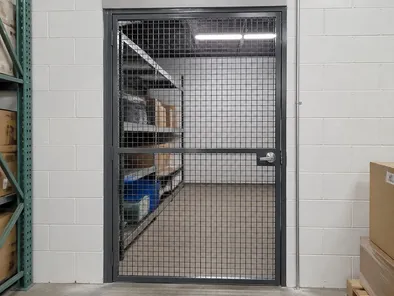
Wire Mesh Security Door
Welded wire mesh construction, heavier gauge than expanded mesh. The right choice for storage facilities, utility rooms, and commercial applications where the mesh needs to resist sustained force or repeated impact. Higher weight per unit, higher security rating, higher price point.
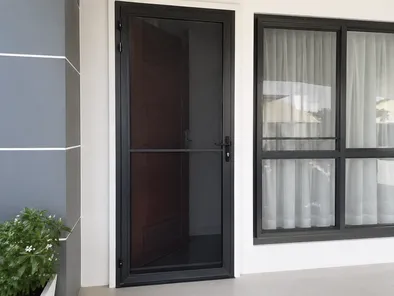
Security Screen Door
Fine mesh framed screen, designed for applications where insect screening is the primary requirement and security is secondary. Lighter construction, lower price point, covers the segment where buyers want a screen-and-security combination for residential use.
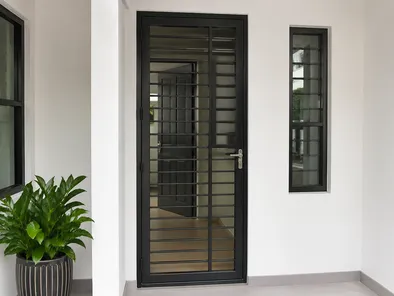
Security Grill Door
Steel bar grill construction rather than mesh. Provides maximum ventilation and visibility with a strong visual security presence. Common in tropical markets where the open grill aesthetic is preferred over mesh.
Source Mesh Security Doors Direct from the Manufacturer
We've been manufacturing and exporting security doors since 2008 — the mesh security door is a core SKU in our range, not a specialty item we produce occasionally. If you're evaluating this product for your distribution catalog or a specific project, the fastest path to a decision is to send us your target spec.
What to include in your inquiry:
- Door size
- Mesh aperture preference
- Lock configuration
- Finish color
- Target volume
Our engineering team will review it and come back with a detailed quote and, for custom configurations, a 3D rendering.
Most new buyers in this category start with a sample order of 2–5 units to test with their own customers or verify against a project spec. We can ship samples on standard lead times.
